

Key Takeaways
- According to BrightLocal (2024), 87% of consumers read online reviews for local businesses, and 76% visit a company website before hiring a contractor, making your web design the deciding factor in most lawn care sales.
- According to Portent (2022), pages that load in 1 second convert up to 3x higher than pages loading in 5 seconds, and every extra second between 0 to 5 seconds drops conversion by about 4.42%.
- According to the Spiegel Research Center at Northwestern University (2017), displaying customer reviews on product and service pages can lift conversion by up to 270% compared to pages without reviews.
- According to HubSpot landing page research, reducing form fields from 4 to 3 can increase conversions by roughly 50%, so a 3-field quote form outperforms a 10-field intake every time.
- According to the WebAIM Million Report (2024), 95.9% of the top one million homepages have detectable WCAG accessibility failures, exposing lawn care businesses to both lost leads and ADA Title III legal risk.
Homeowners do not pick a lawn care company the way they picked one a decade ago. They pull out a phone at the kitchen table, type “lawn care near me,” scan three or four websites in under a minute, and decide who earns a call. If your site loads slowly, hides your phone number, or looks like it was built in 2014, they move on before you ever know they were there.
According to BrightLocal’s 2024 Local Consumer Review Survey, 76% of people regularly read online reviews and visit a company website before hiring a local service provider. According to IBISWorld (2024), the US landscaping services industry is worth over $153 billion with more than 632,000 businesses competing for attention, so your site has to do real work to stand out. This guide breaks down the web design decisions that move lawn care homeowners from scroll to scheduled estimate.
Why Does a Strong Website Matter for Lawn Care Professionals in 2026?
A strong website matters because homeowners shop for lawn care mostly online, compare options in minutes, and judge credibility in seconds. According to Nielsen Norman Group, users form first impressions of a website in about 50 milliseconds, and design quality drives the majority of that judgment long before they read a single headline.
According to LocaliQ’s home services search advertising benchmarks, the home improvement and landscaping categories see average search ad conversion rates between 4% and 6%, meaning 94% or more of clicks bounce if the landing experience is weak. BrightLocal found that 87% of consumers read reviews and 42% will not use a business with a rating under four stars, so your site needs to present social proof, not bury it. For lawn care, a competitive website is not a brochure. It is a sales tool that pulls quotes, phone calls, and booked visits out of paid clicks and organic traffic.
If you have not yet mapped the pages homeowners expect, start with our landscaper’s website checklist before redesigning anything.
What Should the Homepage of a Lawn Care Website Include?
A lawn care homepage should load fast, explain what you do in one clear line, show trust signals above the fold, list services, and make the next step obvious. According to Unbounce’s Conversion Benchmark Report, landing pages with a clear value proposition and a single primary call-to-action convert at nearly double the rate of pages with vague messaging.
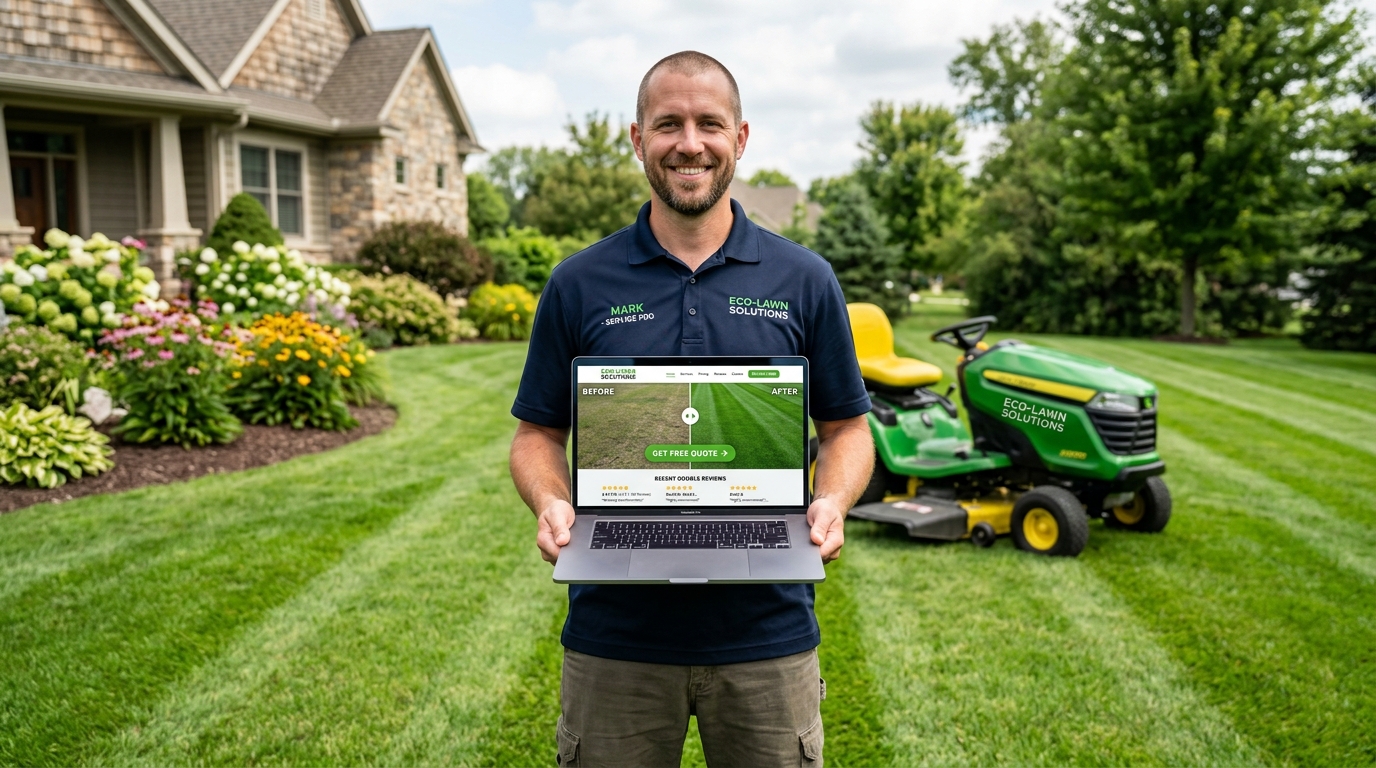
The Five Elements Every Lawn Care Homepage Needs
- A benefit-driven hero headline naming the service and the city (“Weekly Lawn Care in Tulsa, OK”).
- Two above-the-fold CTAs: one “Get Free Quote” button and one tap-to-call phone number.
- Trust signals in view on load: star rating, review count, years in business, licensing badges.
- A scannable service list with icons or thumbnails linked to deeper service pages.
- Real before-and-after photos of jobs in your service area, not stock library images.
According to Spiegel Research Center at Northwestern University, products and services with displayed reviews convert up to 270% higher than those without, and the sweet spot is an average rating between 4.2 and 4.5 stars. Homepages that embed live Google review widgets quietly inherit that lift every time a customer leaves a new star.
How Can Lawn Care Pros Design Service Pages That Convert?
Lawn care service pages convert when each page targets one service in one market, answers homeowner questions in the first 100 words, and ends with a low-friction quote form. According to Whitespark’s 2024 Local Search Ranking Factors, dedicated city-plus-service landing pages with unique content remain one of the strongest ranking levers for local service businesses in Google’s local pack.
Build one page per core service (mowing, fertilization, aeration, weed control, leaf removal) and one page per city you actually serve. Each page should open with a direct answer to “what is this service and what does it cost in my area,” show three to five photos from local jobs, list what is and is not included, add two or three customer reviews filtered by that service, and finish with a short form. For a deeper walk-through, see our guide to building high-converting service pages for landscaping companies.
Add LocalBusiness and Service schema to every page. According to Whitespark’s ranking factor survey, on-page signals including schema and internal linking now weigh heavier than citations for many local queries. Pair those pages with professional SEO services so the structure you built actually gets crawled and ranked.
Why Do Page Speed and Core Web Vitals Make or Break Lawn Care Sites?
Page speed makes or breaks lawn care sites because homeowners scan fast, Google weighs Core Web Vitals in rankings, and most seasonal traffic comes from mobile. According to Portent’s site speed study, the first five seconds of page load time have the highest impact on conversion rates, and sites that load in 1 second convert roughly 3x better than sites that load in 5 seconds.

According to Google’s web.dev business impact case studies, sites that hit the Core Web Vitals thresholds see a 24% average reduction in page abandonment. The three vitals that matter most for lawn care pages are Largest Contentful Paint under 2.5 seconds, Interaction to Next Paint under 200 milliseconds, and Cumulative Layout Shift under 0.1. Miss those and Google quietly demotes you even if your content and backlinks are strong.
Practical Speed Fixes for Lawn Care Sites
- Compress hero photos to under 200 KB and serve them in WebP or AVIF.
- Lazy-load below-the-fold images and gallery thumbnails.
- Replace autoplaying background videos with a poster image and tap-to-play.
- Cut third-party scripts (chat widgets, heavy review plugins) that block rendering.
- Choose a host with HTTP/2, caching, and a CDN baked in.
For a full audit framework, see our post on website optimization strategies for landscaping companies.
How Do Mobile-First Design Choices Help Lawn Care Websites Rank and Convert?
Mobile-first design helps lawn care websites rank and convert because most homeowner searches and nearly all tap-to-call actions happen on phones, and Google uses mobile-first indexing as the default. According to Google’s mobile research, more than 60% of home service searches now come from mobile devices, and tap-to-call extensions drive the majority of after-hours lead volume for local service categories.
Design for a 375-pixel-wide screen first, not a 1440-pixel desktop. That means a sticky header with a phone number, tap targets at least 44 by 44 pixels, body copy at 16 pixels or larger, forms that fit the screen without horizontal scroll, and images that scale rather than crop awkwardly. According to BrightLocal, 68% of local searchers want directions or to call a business within 24 hours, so your mobile view has to surface address, hours, and phone above everything else.
Mobile-first is also a ranking factor. Google crawls the mobile version of your site to decide how it ranks in both mobile and desktop search, so any content hidden behind accordions, off-canvas menus, or desktop-only widgets is effectively invisible to search. If you offer paid media alongside organic, pair mobile-first design with professional PPC management so ad clicks land on pages that actually close.
What Visual Elements Build Trust on a Lawn Care Site?
Visual elements build trust on a lawn care site when they are real, specific, and local: before-and-after galleries, photos of your team in uniform, branded trucks with plates blurred, and short video walkthroughs of finished jobs. According to VWO’s human-photo research, swapping generic stock imagery for authentic photos of real people can lift conversion by double-digit percentages on service sites.
According to Wyzowl’s 2024 Video Marketing Statistics, 89% of consumers say a product or service video has convinced them to buy, and 82% say brand video has persuaded them to purchase a service. For lawn care, a 30 to 60 second mowing or cleanup walk-through does more work than three paragraphs of copy. According to the National Association of Landscape Professionals, the landscape industry employs over one million professionals in the US, so your photos should make your specific crew recognizable, not interchangeable.
Trust-Building Visuals Checklist
- Before-and-after slider on the homepage hero.
- Gallery of 20+ local jobs tagged by neighborhood.
- Headshots of the owner and crew leads on the About page.
- Google, Nextdoor, and Facebook review badges with live star counts.
- Insurance, license, and BBB badges in the footer.
How Should Lawn Care Pros Handle Contact Forms and Calls-to-Action?
Lawn care pros should keep contact forms short, place CTAs above the fold and every second scroll, and lead with outcomes not verbs. According to HubSpot’s landing page research, reducing form fields from 4 to 3 can lift conversion by about 50%, and forms with more than 5 fields see sharp conversion drop-offs.
Ask for name, phone, and ZIP. Everything else can be captured on the follow-up call. Pair that with a button that names the outcome (“Get My Free Quote” or “Schedule My Spring Cleanup”) rather than generic verbs (“Submit” or “Send”). Unbounce’s benchmark report found that action-oriented, benefit-specific CTA copy outperforms generic “Submit” buttons by 20% to 30% across service categories.
Place CTAs in three zones on every page: a primary button in the hero, a mid-page CTA after the services or reviews section, and a sticky tap-to-call bar on mobile. If you want to drill into messaging, our post on why your landscaping blog isn’t getting read covers headline and CTA patterns that move the needle.
Why Does Accessibility and ADA Compliance Matter for Lawn Care Sites?
Accessibility and ADA compliance matter because inaccessible sites shut out paying customers and invite lawsuits. According to the WebAIM Million Report (2024), 95.9% of the top one million homepages have detectable WCAG 2 failures, with an average of 56.8 errors per page. Low contrast text, missing image alt text, empty buttons, and missing form labels are the most common problems, and all four are easy wins for lawn care sites.
According to Seyfarth Shaw’s ADA Title III tracker, federal website accessibility lawsuits have stayed in the thousands per year, with small service businesses increasingly named as defendants. A lawn care site with no alt text and low-contrast buttons is not just losing visually impaired visitors; it is sitting in the same legal exposure bucket as much larger brands. Following W3C’s WCAG 2.2 AA guidelines handles most of this with modest design and development effort.
What Web Design Mistakes Cost Lawn Care Pros Leads?
The web design mistakes that cost lawn care pros the most leads are slow pages, hidden phone numbers, stock-only photos, forms that are too long, no schema, and homepages that do not answer “what, where, and how much.” According to Portent, a one-second delay past the two-second mark drops conversion by roughly 4.42%, and most lawn care homepages carry three to four seconds of avoidable render time from oversized images alone.
Common Lawn Care Web Design Mistakes
- A hero photo that is a generic stock lawn rather than a striped lawn you actually mowed.
- Phone number buried in a dropdown instead of sticky in the header.
- A “Contact” form with name, email, address, city, state, ZIP, property size, best time to call, and a 250-character message box.
- Service pages that duplicate each other with only the city name swapped.
- No reviews embedded, or reviews buried two clicks deep.
- Background sliders with autoplay video that tank Largest Contentful Paint.
For a deeper look at the on-site and off-site signals that reinforce solid design, read our guide on on-site vs off-site SEO for landscaping companies. If you want your design and marketing working together, our landscape marketing services tie homepage copy, local SEO, and review generation into one system.
Frequently Asked Questions About Web Design for Lawn Care Professionals
Turn Your Lawn Care Website Into a Lead Machine
A great lawn care website is not fancy. It is fast, mobile-first, honest about what you do and where you do it, loaded with real photos and real reviews, and built around a three-field quote form that homeowners actually finish. Get those basics right and every ad click, organic visit, and referral starts to compound.
If you want help turning your site into a lead engine, explore our website design services built specifically for green industry companies, or read our roundup on local SEO for landscape contractors to see how the design and ranking pieces fit together. The homeowners are already searching. A well-built site is how you win the ones in your ZIP.
