Paid click-through rates on queries featuring AI Overviews dropped 68%, falling from 19.7% to 6.34% between June 2024 and September 2025 (Seer Interactive, 2025). For landscaping companies spending thousands per month on Google Ads, that shift is not a minor fluctuation. It is a fundamental change in how paid search works. The good news: companies that adapt their strategy to Google’s AI-powered advertising tools are finding new ways to reach homeowners, often at lower cost per lead than traditional search ads.
Key Takeaways
- Paid CTR dropped 68% on queries with AI Overviews, but brands cited in AI Overviews earn 91% more paid clicks (Seer Interactive, 2025)
- Performance Max campaigns drive 27% more conversions at similar CPA versus standard campaigns (Google Ads, 2025)
- Average CPC for home services hit $7.85 in 2025, up 12.8% year-over-year (WordStream, 2025)
- Local Services Ads cost landscapers approximately $39 per lead versus $87.80 for standard search ads (The Media Captain, 2024)
- Over 80% of Google advertisers now use automated Smart Bidding strategies (Fluency, 2025)
How Are AI Overviews Changing Paid Ad Visibility for Landscapers?
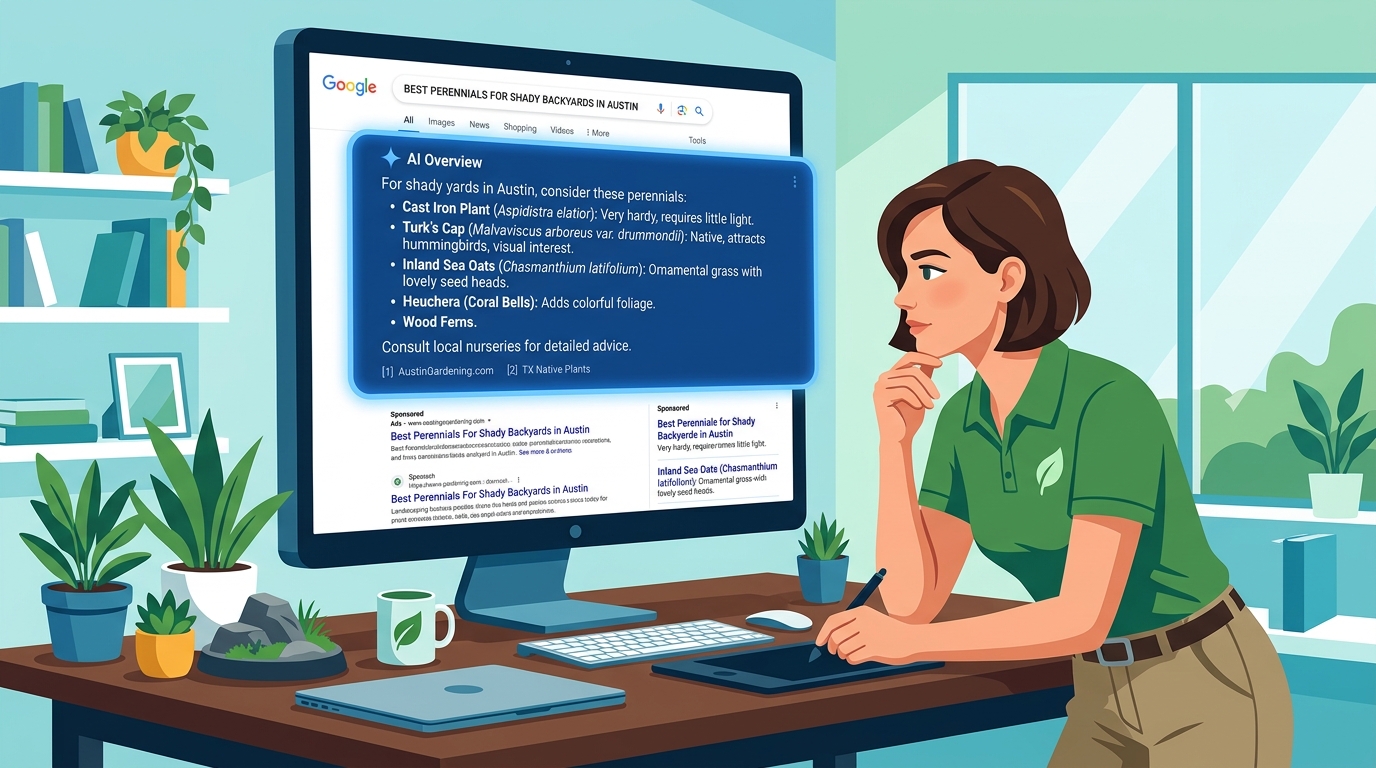
Zero-click searches increased from 56% to nearly 69% as AI Overviews expanded across Google search results (Search Engine Land, 2025). When a homeowner searches “best time to reseed a lawn” or “how much does patio installation cost,” Google’s AI now generates a summary answer at the top of the page. That answer often satisfies the searcher without them ever scrolling down to your paid ad.
For landscaping companies, this means traditional search ads are competing for a shrinking pool of clicks. Organic CTR fell 61% on queries with AI Overviews (Seer Interactive, 2025), and paid ads are feeling the same pressure. The ads that do get clicks tend to be highly specific and locally relevant, not generic “landscaper near me” campaigns.
The critical insight: brands cited within AI Overviews earn 91% more paid clicks than those not cited (Seer Interactive, 2025). This means your organic content strategy and your paid strategy are now deeply connected. If your website content gets picked up by AI Overviews, your paid ads benefit too.
What Is Performance Max and Should Landscapers Use It?
Performance Max campaigns drive 27% more conversions or conversion value at a similar CPA compared to standard campaigns (Google Ads, 2025). Adoption jumped from 60% to 71% among advertisers in 2025, with over 1 million advertisers now using Performance Max globally (Smarter Ecommerce, 2025).
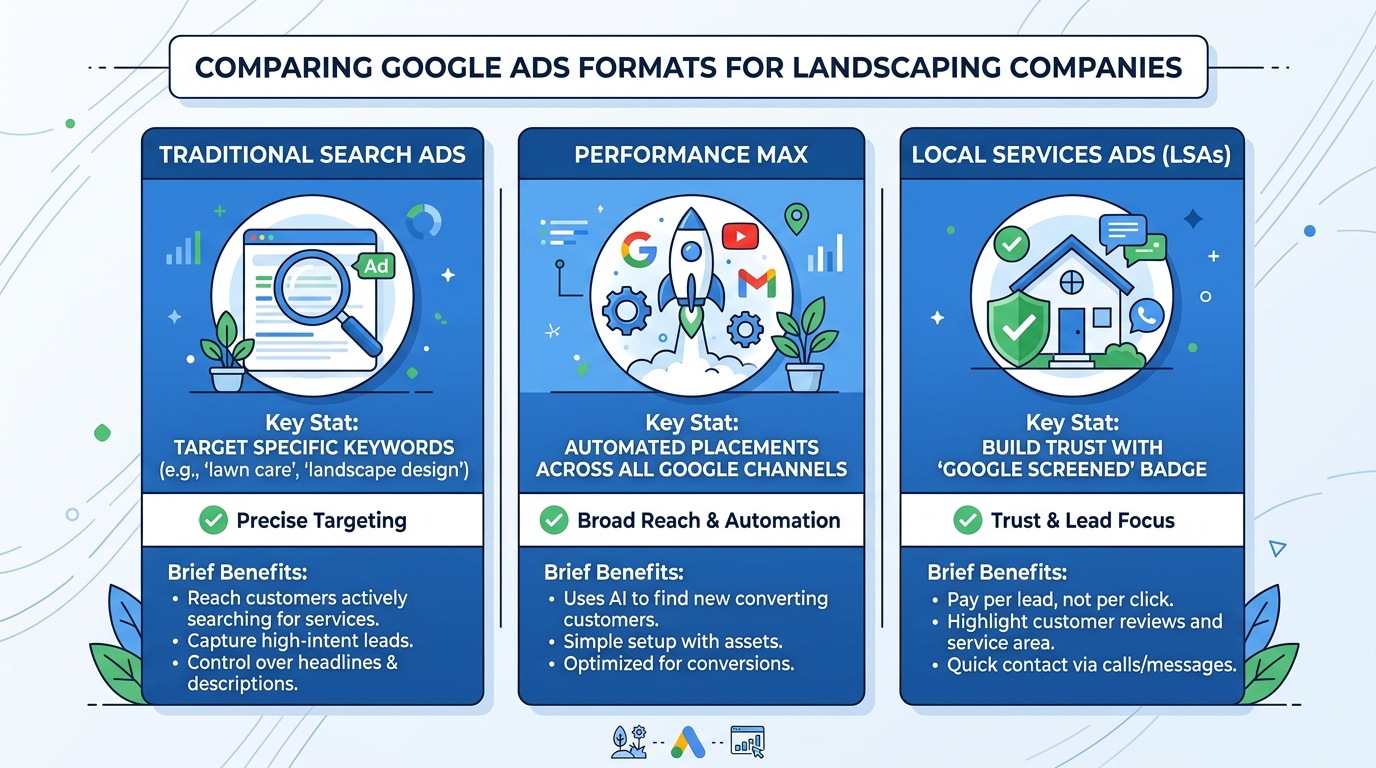
Performance Max works by running your ads across all Google channels: Search, YouTube, Maps, Gmail, and the Display Network. Google’s AI handles the targeting, bidding, and creative optimization automatically. For landscaping companies, this means your ads can show up when someone watches a yard renovation video on YouTube, searches for lawn care on Google Maps, or browses home improvement sites.
When Performance Max makes sense for landscapers:
- You have strong visual assets: Before-and-after photos of your projects perform well across Display and YouTube placements
- You want broader reach: Performance Max finds customers you would miss with Search-only campaigns
- You have conversion tracking set up: The AI needs conversion data to optimize. Without call tracking or form submission tracking, it cannot learn what works
The tradeoff is control. Performance Max gives you less visibility into exactly where your ads appear and which keywords trigger them. For landscapers who want precise keyword targeting, keeping a standard Search campaign alongside Performance Max is the recommended approach.
How Do Smart Bidding and Broad Match Change Landscaping PPC?
Over 80% of Google advertisers now use automated Smart Bidding strategies (Fluency, 2025), and Google launched more than 60 AI-powered improvements to its ads platform in 2025 alone (Google Ads, 2025). The shift from manual bidding to AI-driven bidding is not optional anymore. It is the default.
Campaigns using Smart Bidding Exploration see an 18% increase in unique search query categories and a 19% increase in conversions on average (Google Internal Data, 2025). Meanwhile, 62% of advertisers using Smart Bidding now use broad match as their primary match type (Search Scientists, 2025). Since July 2024, new Search campaigns launch with broad match enabled by default.
What this means for your landscaping campaigns:
- Broad match + Smart Bidding works: Google’s AI delivered a 10% performance uplift when combining broad match with Smart Bidding (Google Ads, 2024). Let the algorithm find relevant searches you would not have thought to target
- Check your search terms report weekly: Broad match can trigger irrelevant queries. Add negative keywords for searches outside your service area or unrelated services
- Give the AI enough data: Smart Bidding needs at least 30-50 conversions per month to optimize effectively. If your volume is lower, use Target CPA rather than Target ROAS
Advertisers switching from Target CPA to Target ROAS see 14% more conversion value at a similar return on ad spend (Google Ads Help, 2024). As your campaign matures and generates enough data, test this switch to maximize revenue rather than just lead volume.
Are Local Services Ads a Better Option Than Traditional Search Ads?
29% of users prefer clicking on Local Services Ads versus only 11% who prefer traditional Google Ads (Blue Grid Media, 2025). For landscaping companies, LSAs offer a fundamentally different model: you pay per lead, not per click. And the cost difference is significant. Landscapers can expect an LSA cost-per-lead of approximately $39 (The Media Captain, 2024), compared to $87.80 for standard Google Search Ads (Evergrow Marketing, 2025).
Local Services Ads are now available for more than 70 business types (Google, 2025), including landscaping, lawn care, and tree services. They appear above traditional search ads and include your Google Guaranteed or Google Screened badge, star rating, and service area.
LSAs vs. traditional search ads for landscapers:
- Lower cost per lead: $39 average for LSAs versus $87.80 for search ads. You only pay when a homeowner actually contacts you
- Trust signals built in: The Google Guaranteed badge and review stars give you instant credibility that text ads cannot match
- Top-of-page placement: LSAs appear above all other ad formats, giving you prime visibility even when AI Overviews are present
- Less control over targeting: You set your service area and budget, but Google decides which leads to send you. You can dispute irrelevant leads for a refund
For a deeper comparison, see our guide on Local Services Ads vs. PPC Ads. The best approach for most landscaping companies is running both LSAs and search campaigns simultaneously, allocating more budget to whichever channel delivers a lower cost per qualified lead.
How Should Landscapers Handle Rising Ad Costs in 2026?
Average CPC for Home and Home Improvement on Google Ads hit $7.85 in 2025, up 12.8% year-over-year (WordStream, 2025). CPC increased for 87% of industries, and home services conversion rates dropped 14.97% year-over-year. That means you are paying more per click while each click is less likely to become a lead.
Landscaping-specific CPC is lower at $3.65 with a cost-per-lead of $87.80 (Evergrow Marketing, 2025), but the upward trend applies across the board. Here is how to protect your paid advertising budget:
- Diversify beyond search ads: Combine search campaigns with LSAs and Performance Max to spread risk across multiple channels
- Invest in SEO alongside paid: Organic traffic does not cost per click. A strong local SEO presence reduces your dependence on paid ads and can get you cited in AI Overviews
- Improve your landing pages: A better conversion rate lowers your effective cost per lead even if CPC rises. Focus on fast load times, clear calls to action, and mobile optimization
- Use AI-powered ad creation: Advertisers using Google’s conversational AI for ad creation are 63% more likely to publish campaigns with “Good” or “Excellent” Ad Strength (Google Ads, 2024). Better ad strength means better quality scores and lower CPC
Track your marketing analytics monthly. Compare cost per lead across every channel. When one channel gets too expensive, shift budget to the ones delivering better returns.
What Should Your AI-Ready Paid Ads Strategy Look Like?
Advertisers using AI-powered Search campaigns (AI Max) see up to 14% more conversions compared to standard Search campaign setups (Google Ads, 2025). The direction is clear: Google is building its entire ads platform around AI, and the landscaping companies that lean into these tools rather than fighting them will get better results at lower cost.
Build your 2026 paid ads strategy around these priorities:
- Run LSAs as your foundation: Lowest cost per lead, highest trust signals, top-of-page placement
- Add Performance Max for reach: Let Google’s AI find customers across Search, YouTube, Maps, and Display
- Keep a targeted Search campaign: Use broad match with Smart Bidding for your highest-intent keywords like “landscaper near me” and “patio installation [city]”
- Pair paid with organic: Content that earns AI Overview citations drives more paid clicks too. Invest in both
- Review weekly, not quarterly: AI changes move fast. Weekly check-ins on spend, leads, and cost per lead keep you ahead of shifts
If managing Google’s AI-powered ad ecosystem feels overwhelming, a landscaping advertising partner can handle the technical setup, ongoing optimization, and reporting so you focus on running your business. Reach out to the Sideways8 team for a free paid ads audit.
Frequently Asked Questions
AI Overviews push paid ads lower on the page and can satisfy search queries without users clicking any results. Paid CTR dropped 68% on queries with AI Overviews (Seer Interactive, 2025). However, brands cited in AI Overviews earn 91% more paid clicks, so investing in organic content that gets picked up by AI actually boosts your paid ad performance.
Yes, for most landscapers. Performance Max drives 27% more conversions at similar cost compared to standard campaigns (Google, 2025). It works best when you have strong visual assets like project photos and proper conversion tracking set up. Run it alongside a standard Search campaign for the best combination of reach and keyword control.
Local Services Ads are significantly cheaper per lead. Landscapers pay approximately $39 per lead through LSAs (The Media Captain, 2024) compared to $87.80 per lead through standard search ads (Evergrow Marketing, 2025). LSAs also carry trust signals like the Google Guaranteed badge and appear above all other ad formats.
Smart Bidding is now the standard. Over 80% of Google advertisers use automated bidding (Fluency, 2025), and campaigns using Smart Bidding Exploration see 19% more conversions on average (Google, 2025). Manual bidding makes sense only if you have very low conversion volume or need precise control over bids for specific high-value keywords.
CPC for home services rose 12.8% year-over-year to $7.85 in 2025 (WordStream, 2025), driven by increased competition and more advertisers using AI-powered bidding that automatically raises bids. To combat rising costs, diversify across LSAs, Performance Max, and organic SEO rather than relying solely on search ads.
