

- Mobile devices account for 63% of all Google search traffic in the U.S. and up to 71% globally, making mobile optimization non-negotiable (StatCounter/Backlinko, 2025)
- 53% of mobile visitors abandon a site that takes longer than 3 seconds to load (Google/Think with Google)
- 88% of “near me” searches happen on mobile devices, and 76% of those searchers visit a business within 24 hours (Google/Synup, 2025)
- Google completed its switch to mobile-first indexing for 100% of websites in July 2024, meaning your mobile site is now the version Google ranks (Google Search Central, 2024)
- Only 48% of mobile pages pass all three Core Web Vitals, giving optimized landscaping sites a significant competitive advantage (HTTP Archive, 2025)
Google completed its migration to mobile-first indexing for 100% of websites on July 5, 2024, according to Google Search Central. This means Google now uses the mobile version of every website for indexing and ranking. For the nearly 693,000 landscaping businesses in the United States (IBISWorld, 2025), the message is clear: if your website does not work well on a phone, Google treats your entire site as if it does not work well at all.
This guide covers the specific mobile SEO factors that affect landscaping company rankings, the performance benchmarks you need to hit, and the practical steps to fix your site.
Why Did Google Switch to Mobile-First Indexing and What Does It Mean for Landscapers?
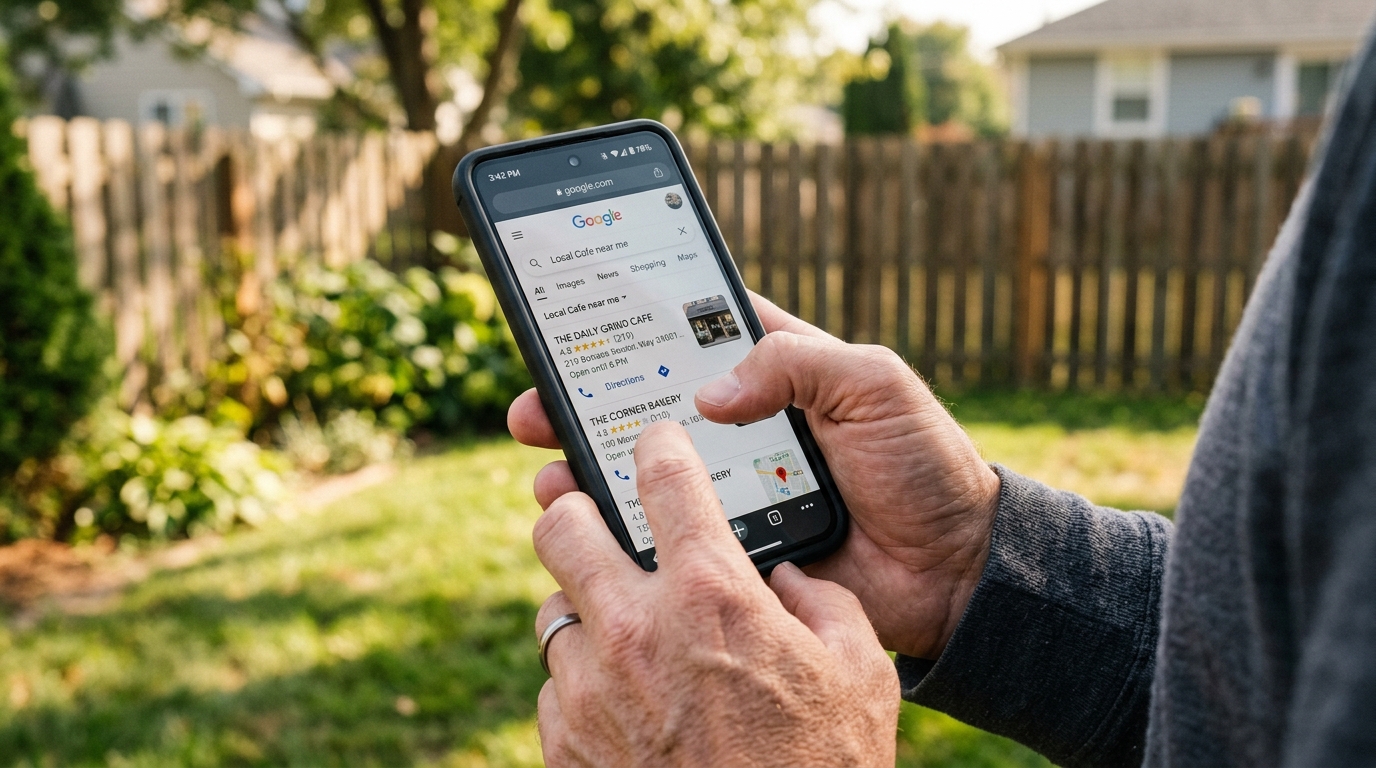
Mobile devices now account for 63% of all Google search traffic in the U.S. and up to 71% globally, according to StatCounter (2025). Google holds 94.6% of the mobile search engine market (StatCounter, January 2026). The shift to mobile-first indexing, which began in March 2018 and took nearly 7 years to complete, reflects a simple reality: most people search on phones, so Google now evaluates your website primarily through its mobile version.
For landscaping companies, this matters because your typical customer is a homeowner standing in their yard, phone in hand, searching for help. According to Synup (2025), 88% of “near me” searches happen on mobile devices. If your website loads slowly, displays poorly on a small screen, or makes it hard to tap a phone number, you are invisible to the majority of potential clients at the exact moment they are ready to hire.
How Does Mobile Page Speed Affect Your Landscaping Leads?
Page speed on mobile is not just a technical metric. It directly determines whether a potential client stays on your site or leaves for a competitor. The data from Google’s Think with Google research is unambiguous:
- 53% of mobile visitors abandon a site that takes longer than 3 seconds to load
- Bounce rate increases by 103% when page load goes from 1 to 2 seconds (Envisage Digital/Google, 2025)
- Conversion rates drop 4.42% for each additional second of load time between 0 and 5 seconds (Portent/WebFX, 2025)
- A site loading in 1 second converts 2.5x higher than one loading in 5 seconds (Portent, 2025)
- A 0.1-second improvement in mobile site speed can boost conversions by 8.4% (Deloitte/Google, 2020)
The average mobile page load time in the U.S. is currently 1.9 seconds (Google Chrome User Experience Report/DebugBear, 2025). Google’s “good” threshold is 2.5 seconds or less for Largest Contentful Paint (LCP). If your landscaping website loads in 4 or 5 seconds on mobile, you are losing more than half your visitors before they see a single photo of your work.
Test your site right now with Google’s free PageSpeed Insights tool. If your mobile score is below 50, website performance improvements should be your top priority.
What Are Google’s Core Web Vitals and Why Do They Matter for Rankings?
Core Web Vitals are the three specific metrics Google uses to evaluate your page’s user experience. As of 2025, these are confirmed ranking factors that directly affect where your site appears in search results. According to Google Search Central, the thresholds are:
- LCP (Largest Contentful Paint): 2.5 seconds or less = Good. This measures how fast your main content loads. For a landscaping site, this is typically your hero image or the largest visible element
- INP (Interaction to Next Paint): 200 milliseconds or less = Good. This replaced FID in March 2024 and measures how responsive your site is when someone taps a button or link
- CLS (Cumulative Layout Shift): 0.1 or less = Good. This measures whether elements on the page jump around while loading, which frustrates users and makes tap targets unreliable
According to HTTP Archive/Web Almanac (2025), only 48% of mobile pages pass all three Core Web Vitals. That means more than half of all websites fail Google’s own performance standards. If your landscaping site passes all three, you have an immediate advantage over the majority of your local competitors.
How Do Mobile Searches Turn Into Landscaping Jobs?
The conversion path from mobile search to booked job is shorter and more direct than most business owners realize. According to Google and BrightLocal (2024-2025):
- 76% of people who search for something “near me” visit a business within 24 hours
- 78% of local mobile searches result in an offline purchase (Google/SEO.com, 2025)
- 60% of mobile users contact a business directly from search results via click-to-call or directions (Google/BrightLocal)
- Phone calls generate 10 to 15x more revenue than web leads for service businesses (Invoca, 2025)
- 56.1% of home service seekers search for providers on their phones (Invoca, 2025)
A homeowner searching “landscaper near me” on their phone while standing in their yard is as close to a guaranteed lead as marketing gets. If your site loads fast, shows your work clearly, and makes it easy to call with one tap, you capture that lead. If it doesn’t, the homeowner taps the next result.
What Makes a Landscaping Website Mobile-Friendly?
Google explicitly recommends responsive web design as its preferred approach for mobile-friendly sites. Responsive design uses a single URL structure that adapts to every screen size, avoiding the duplicate content issues that come with separate mobile sites (like m.example.com). AMP pages are no longer required for rankings or Top Stories eligibility (confirmed by Google in 2021).
A mobile-friendly landscaping website needs these elements:
Tap targets sized for thumbs. Google recommends minimum tap target sizes of 48×48 CSS pixels with at least 8 pixels of spacing between targets (Google web.dev, 2025). Tiny buttons that require precise tapping frustrate users and increase bounce rates.
Readable text without zooming. Google and Apple both recommend a minimum font size of 16px on mobile. Text below 16px gets flagged by Google Lighthouse as too small. Your service descriptions, contact info, and calls-to-action need to be readable at a glance.
Click-to-call phone number. According to Marketing LTB (2025), 70% of mobile searchers use the call button in Google Local results. Your phone number should be tappable on every page of your site. Phone calls generate 10 to 15x more revenue than web form leads for service businesses (Invoca, 2025).
Compressed images that load fast. Your project photos should showcase your best work, but uncompressed images are the most common cause of slow mobile load times. Use WebP or AVIF format, lazy-load images below the fold, and keep your LCP image optimized so it loads within 2.5 seconds.
Simple, short forms. If a potential client wants to request a quote from their phone, help them do it in 30 seconds. Name, phone, brief description of the project. Every extra field you add reduces completion rates.
What Practical Steps Can You Take This Week to Improve Mobile SEO?
Approximately 83% of small business websites are now mobile-friendly according to Network Solutions (2025), but 57% of internet users say they will not recommend a business with a poorly designed mobile website (SocPub/HubSpot, 2024-2025). Being mobile-friendly is the baseline. Being mobile-excellent is the competitive advantage.
Start with these actions in priority order:
- Test your site with Google PageSpeed Insights. Check your mobile score. If LCP is above 2.5 seconds, focus on image compression and reducing server response time first
- Make your phone number tappable on every page. Use an HTML tel: link so mobile users can call with one tap. Place it in the header and in your main CTA
- Compress your images. Convert project photos to WebP format and compress to under 100KB where possible. This is the single biggest speed improvement for most landscaping sites
- Check your tap targets. Open your site on your phone and try to tap every button, link, and menu item with your thumb. If anything is hard to hit, increase the size to at least 48×48 pixels
- Simplify your contact form. Reduce to 3-4 fields maximum: name, phone, project description. Test the form on your own phone to make sure it works smoothly
- Optimize your Google Business Profile for mobile. Most GBP interactions happen on phones. Ensure your hours, phone number, and service descriptions are current
How Does Voice Search on Mobile Affect Landscaping Companies?
Voice search is growing steadily on mobile. According to DemandSage (2025), 27% of people worldwide now use voice search on mobile, with smartphones accounting for 56% of all voice search device usage. Among adults aged 18-34, 77% use voice search on their smartphones (Blogging Wizard/Invoca, 2025).
Voice queries tend to be longer and more conversational than typed searches. Instead of “landscaper Atlanta,” a voice searcher might say “who does landscape design near me” or “what’s the best time to plant shrubs in Georgia.” Content that answers these natural-language questions directly, especially in FAQ sections, is more likely to be selected as the voice search result.
The foundation for voice search visibility is the same as for all mobile SEO: a fast, well-structured site with a complete Google Business Profile, fresh reviews, and content that answers real questions. Businesses with complete Google Business Profiles are 70% more likely to attract location-based voice queries (Synup, 2025).
What Is the Single Most Important Thing to Fix on Your Mobile Site Today?
If you do nothing else, test your website on your own phone right now. Pull it up, try to navigate to your services, and try to call your own number. Time how long the page takes to load. If it takes more than 3 seconds, more than half of your potential visitors are leaving before they see anything (Google).
Desktop still converts approximately 2x higher than mobile (4.3% vs 2.2% according to SQ Magazine/Statista, 2025), which means there is significant room to improve mobile conversion rates for most landscaping sites. Every improvement to your mobile experience closes that gap and captures leads your competitors are losing.
The landscaping companies getting the most calls from online search are not the ones with the fanciest websites. They are the ones whose sites load in under 2 seconds, display a tappable phone number prominently, and make it obvious what services they offer and where they work. If you want help getting your mobile performance up to standard, request a consultation with our landscape marketing team.
Do I need a separate mobile website for my landscaping company?
No. Google explicitly recommends responsive web design, which uses a single website that automatically adapts to every screen size. Separate mobile sites (like m.example.com) create duplicate content issues and are harder to maintain. A responsive design is the current best practice and is what Google’s mobile-first indexing is built to evaluate.
How can I check if my landscaping website is mobile-friendly?
Use Google’s free PageSpeed Insights tool at pagespeed.web.dev. Enter your URL and check the mobile tab. It will show your Core Web Vitals scores (LCP should be under 2.5 seconds, INP under 200ms, CLS under 0.1) and flag specific issues like images that are too large, text that is too small, or tap targets that are too close together. Only 48% of mobile pages pass all three metrics, so there is likely room to improve.
How much does it cost to make a landscaping website mobile-friendly?
Costs vary widely. On WordPress, switching to a modern responsive theme can be free or under $100. Image compression and basic speed optimization are DIY tasks that cost nothing. More significant work like redesigning navigation, rebuilding forms, or resolving Core Web Vitals issues may require a developer and cost $500 to $3,000 depending on scope. Given that 53% of mobile visitors abandon slow sites, the cost of not optimizing is almost certainly higher than the cost of fixing it.
Will improving mobile SEO actually bring my landscaping company more customers?
Yes. 88% of “near me” searches happen on mobile (Synup, 2025), and 76% of those searchers visit a business within 24 hours (Google). Phone calls from mobile search generate 10 to 15x more revenue than web leads for service businesses (Invoca, 2025). A faster, more usable mobile site ranks higher in Google, appears in more local searches, and converts more of those visitors into calls and quote requests.
How fast should my landscaping website load on mobile?
Google’s “good” threshold for Largest Contentful Paint (LCP) is 2.5 seconds or less. The average U.S. mobile page loads in 1.9 seconds (Google CrUX/DebugBear, 2025). 47% of users expect a page to load in 2 seconds or less (Akamai). A site loading in 1 second converts 2.5 times higher than one loading in 5 seconds. Aim for under 2 seconds for optimal performance and conversion rates.
