
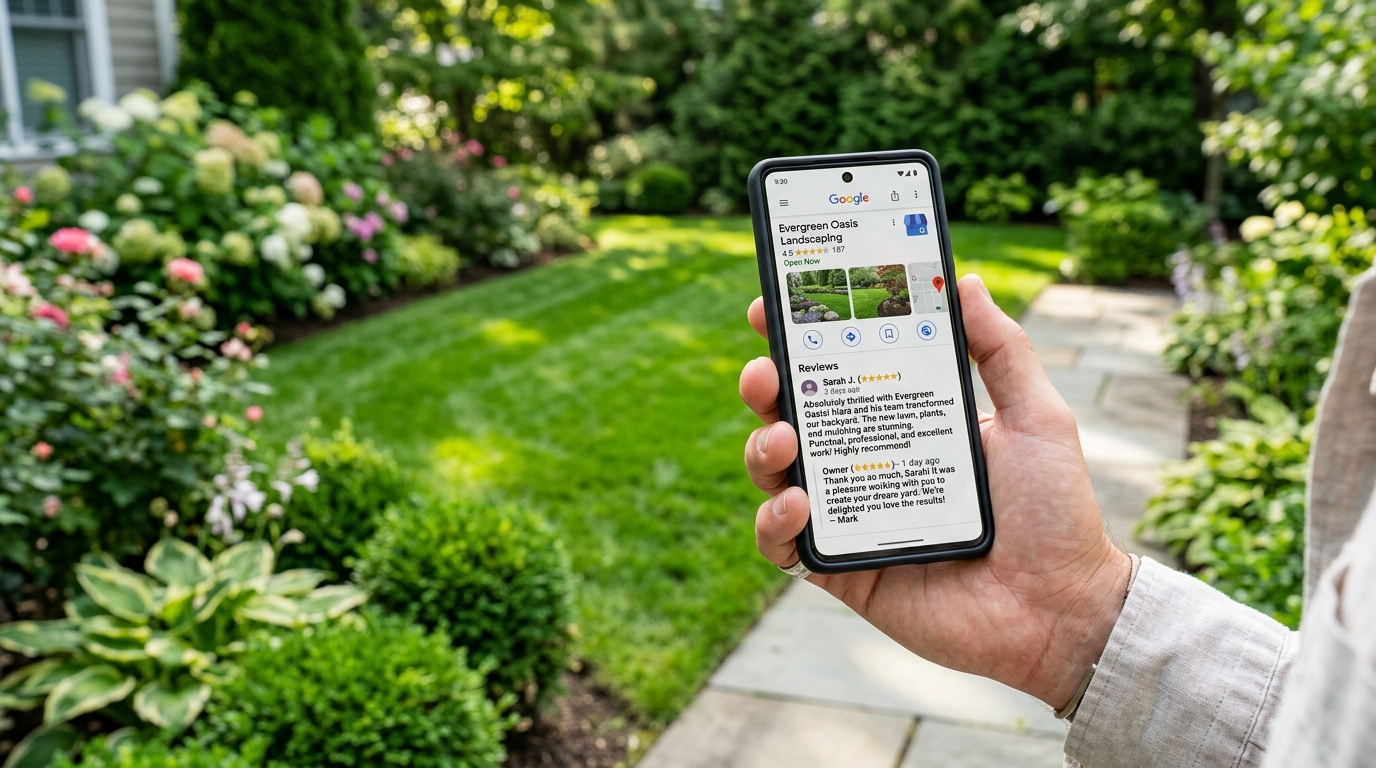
Online reviews for local businesses have become the deciding factor in whether homeowners call your landscaping company or scroll past it. BrightLocal’s 2026 Local Consumer Review Survey shows 68% of consumers now only use a business with 4+ stars, while Harvard Business School research links each extra Yelp star to a 5-9% revenue jump.
Key Takeaways
- 71% of consumers read reviews regularly when browsing local businesses, per BrightLocal’s 2026 Local Consumer Review Survey.
- 68% of consumers will only use a business with 4+ stars, and 31% require 4.5 stars or higher (BrightLocal, 2026).
- Showing five reviews on a listing increases purchase likelihood by 270%, according to Northwestern’s Spiegel Research Center.
- A one-star rating bump delivers a 5-9% revenue increase for independent local businesses (Harvard Business School, Luca).
- Review signals now drive roughly 20% of Google Local Pack rankings, up from 16% in 2023 (Whitespark 2026 Local Search Ranking Factors).
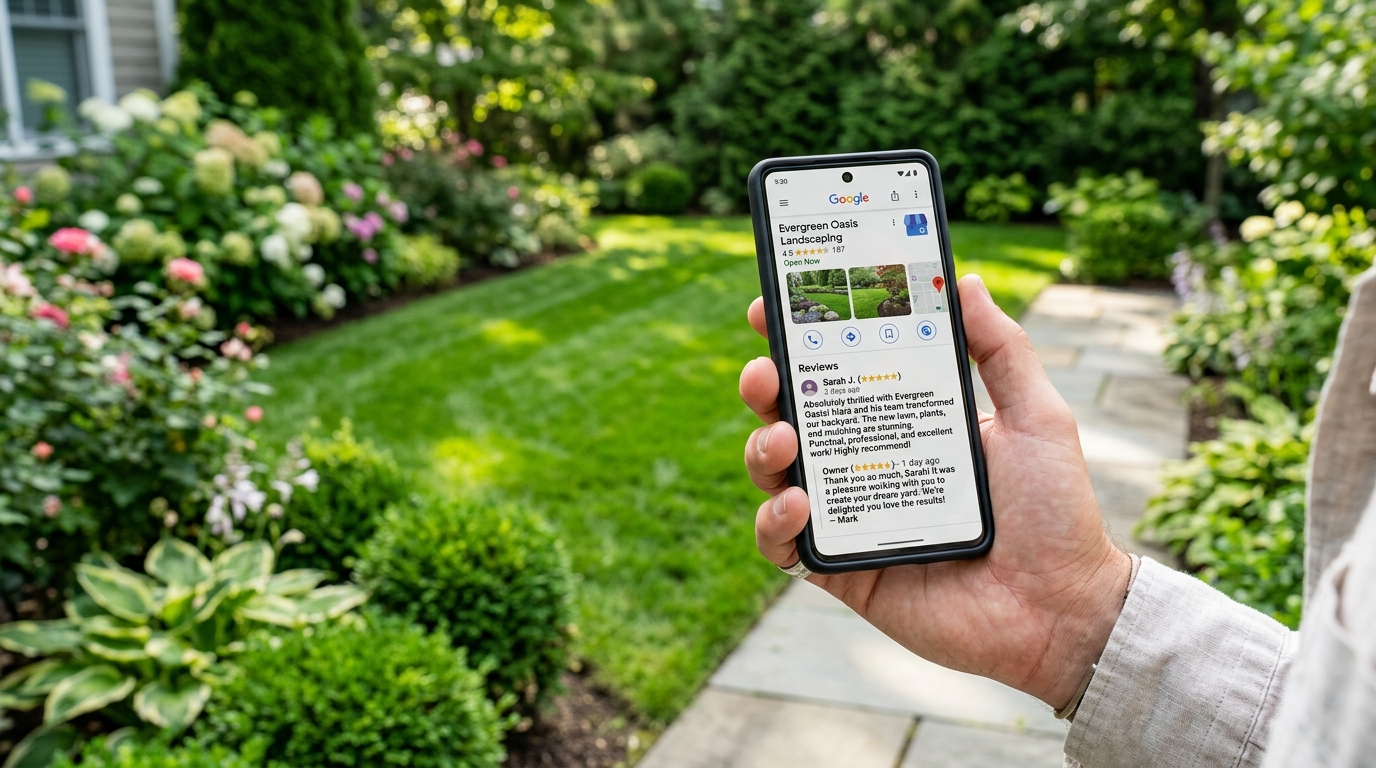
Why Do Online Reviews Make or Break Local Businesses in 2026?
Reviews are the new storefront window. BrightLocal’s 2026 survey reports 71% of consumers read reviews regularly, and Nielsen notes 88% trust peer recommendations more than any paid channel. For landscapers, that means your rating and reply quality decide whether a homeowner books a site visit.
Reviews as Modern Word of Mouth
Before driving past your truck, homeowners pull up Google Maps. According to ReviewTrackers, 92.4% of consumers use online reviews to guide ordinary purchase decisions. Every five-star review with photos of a completed patio or lawn installation acts as a 24/7 referral from a trusted neighbor.
The Revenue Impact of One Extra Star
Michael Luca’s Harvard Business School working paper (HBS 12-016) found a one-star Yelp rating increase boosts revenue 5-9% for independent businesses. Stack that against Spiegel Research Center data showing purchase likelihood jumps 270% once five reviews appear, and reputation becomes a direct revenue lever for your landscape marketing plan.
Why Earned Trust Beats Paid Ads
Paid channels get skipped. Nielsen’s Global Trust in Advertising data shows 92% of consumers trust earned media and peer recommendations more than any other format, while traditional ad trust sits closer to 50%. A $3,000 monthly paid budget cannot replicate the credibility of 40 glowing, recent Google reviews from homeowners in your service area.
How Many Reviews and What Rating Do Consumers Expect?
In BrightLocal’s 2026 data, 68% of consumers will only use a business with at least four stars, and 31% insist on 4.5 stars or higher, up from 17% a year earlier. Combined with the Spiegel finding that the first five reviews drive most of the conversion lift, the floor is clear: land at 4.5+ stars with at least a few dozen recent reviews.
The 4.5-Star Sweet Spot
A perfect 5.0 can feel suspicious. Spiegel researchers found consumers trust ratings between 4.2 and 4.5 the most because a few 3- and 4-star reviews signal authenticity. Respond well to those middling reviews and your average stays in the sweet spot without sacrificing trust.
Review Volume and Recency
Volume alone no longer wins. Whitespark named review recency one of the most underrated local ranking factors, noting reviews within the last 60-90 days carry the most weight. Aim for a steady monthly cadence rather than a once-a-year push to stay visible in local search.
ACHR News reports 91% of homeowners read reviews before picking a contractor, and MarketSharp found 76% will not consider a home services pro below 4 stars. Those numbers compound during peak lawn season, when homeowners compare three or four landscapers in a single afternoon and shortlist only the highest-rated, most recently reviewed options.
Which Review Platforms Matter Most for Local Service Businesses?
Google dominates. ReviewTrackers data shows 63% of consumers read reviews on Google compared to 45% on Yelp and roughly a quarter on Facebook or TripAdvisor. Google Business Profile alone hosts about 73% of all online reviews, so it should anchor your strategy even while you keep secondary platforms active.
Google Business Profile First
Birdeye’s 2025 State of Google Business Profile report found fully populated, verified profiles surface 80% more often in search and generate 4x more website visits than incomplete listings. Claim your profile, complete every field, add weekly photos, and route your review requests to Google before any other platform. Pair that with accurate NAP data across local listings.
Secondary Platforms That Still Matter
Facebook recommendations, Yelp, Angi, Houzz, and the Better Business Bureau are the secondary stack for home services. Search Engine Land’s 2025 citation study found Reddit, YouTube, and Yelp among the top sources AI search engines pull from, so a cross-platform presence also feeds AI Overviews.
Niche Platforms Worth the Effort
Landscapers should claim profiles on Houzz (design-focused homeowners), Angi (lead marketplace), Nextdoor (hyperlocal referrals), and Thumbtack. Nextdoor recommendations show up directly in neighborhood feeds where 80% of U.S. households have a verified account. Keep NAP consistent across all of them so citation signals reinforce your Google Business Profile.
How Do You Ask Happy Customers for Reviews Without Being Pushy?
Asking works. Podium and Birdeye benchmarks show SMS review requests hit 30-45% conversion rates, versus single-digit rates for email alone. ACHR News reports 91% of homeowners rely on reviews before picking a contractor, so giving a recently delighted client a one-tap link turns a good job into a permanent marketing asset.
Timing and Channel Choice
Send the request within 24 hours of final walk-through while the freshly installed sod or patio is still top of mind. Text beats email for home services because open rates sit above 90%. Include a direct Google review link, a short message, and the crew lead’s name for a personal feel.
Scripts That Convert Without Coercing
Keep it honest and optional. A script such as “If we earned it, a quick Google review helps our crew win more jobs like yours” respects the customer and stays within FTC review rule boundaries because it does not offer payment or gate by star rating. For deeper tactics, see our guide on turning client voices into growth.
Multi-Touch Request Sequences
One ask is rarely enough. Birdeye benchmarks show a three-touch sequence (SMS day 1, email day 3, handwritten thank-you note day 7) can lift review collection rates 2-3x versus a single text. Automate the sequence through your CRM and stop the cadence the moment a review is posted so no customer feels nagged.
How Should You Respond to Positive and Negative Reviews?
Response quality is public evidence of service. BrightLocal data shows 88% of consumers are likely to use a business that replies to all reviews, and 97% of review readers also read owner responses. Birdeye reports its customers hit an average 71% response rate, a useful benchmark as you build your reply workflow.
Positive Review Responses
Thank the customer by first name, reference the specific project (“the new paver walkway looks fantastic”), and invite them back for seasonal services. Adding a keyword like “Austin landscape design” naturally reinforces local relevance without stuffing.
Negative Review Responses
Respond within 24 hours, 53% of consumers expect a reply to negative reviews within a week per Google-cited research. Acknowledge the concern, avoid blaming the customer, share a private contact path, and document the resolution. A measured response to a 2-star review often wins more trust than a wall of 5-stars.

How Do Reviews Influence Google’s Local Pack and AI Overviews?
Reviews are a ranking input and an AI citation source. Whitespark’s 2026 report weighs review signals at roughly 20% of Local Pack influence, up from 16% in 2023, while a Q2 2025 Whitespark study found AI Overviews appeared for 68% of local searches. That dual role makes reviews central to any modern local SEO plan.
What the Local Pack Rewards
Google weighs review count, average rating, velocity, keyword sentiment, and recency. Whitespark calls out Review Signals and Behavioral Signals as the two fastest-rising factor groups in Local Pack. Businesses that added a fresh review monthly outranked competitors with higher totals but stale activity in Sterling Sky case studies.
Getting Cited in AI Overviews
AI Overviews, ChatGPT, and Perplexity synthesize review snippets into recommendations. Search Engine Land notes AI search engines frequently cite Google Business Profile, Yelp, Reddit, and your own site. Structured data, review-rich landing pages, and a consistent review stream improve the odds your business gets quoted when a homeowner asks an assistant, “Who’s the best landscaper in Austin?”
Review Snippets in the Local Pack
Google has expanded review snippets inside the 3-pack, pulling 2-3 sentence quotes from recent reviews. Moz’s local ranking research notes review signals drive roughly 15% of Local Pack rankings across its surveys. Reviews that use service keywords (“lawn care,” “paver patio,” “irrigation install”) help Google match you to the right queries.
How Can You Turn Reviews Into On-Site Testimonials and Schema?
Reviews earned on Google can power your own website with the right handling. Google’s review snippet documentation says aggregate rating and review markup can produce star-rich results, but only when the reviews displayed actually come from your site, your services, or products you control, not Google Business Profile reviews.
Collecting First-Party Testimonials
Ask past clients for a short paragraph plus a project photo for your service pages. First-party testimonials are fair game for AggregateRating schema when they live on your pages with real names. Showcase them on service and neighborhood pages inside your website design to boost both trust and SEO.
Trustpilot’s 2024 transparency data shows consumers value third-party verification: 70% trust a review more when a platform has verified the reviewer. Even if you host testimonials on your own site, linking each one to the original Google or Houzz review URL gives visitors an easy trust check and keeps you honest.
Review Schema Done Right
Use JSON-LD Review and AggregateRating markup only where the rating count matches what visitors actually see on the page. BrightLocal’s review schema guide warns that padding or self-reporting ratings violates Google guidelines and can trigger manual actions.
What FTC and Google Rules Must You Follow in 2026?
The rules tightened. The FTC’s final rule on fake reviews, effective October 21, 2024, allows civil penalties of $51,744 per violation for buying, selling, or suppressing reviews. Google’s policies similarly ban gated review funnels, incentivized reviews without disclosure, and any form of review manipulation.
What Is Now Explicitly Banned
The FTC rule prohibits six categories: fake reviews, purchased reviews, undisclosed insider reviews, deceptive company-controlled review sites, review suppression through threats, and the misuse of fake social proof. Even soliciting reviews only from customers you expect to rate you 5 stars counts as suppression.
How to Stay Compliant
Ask every customer for honest feedback, disclose any relationship if an employee leaves a review, and never edit or remove a legitimate negative review. Trustpilot’s 2024 transparency report removed 4.5 million fake reviews, 90% flagged by AI, showing platforms are also leaning into detection.
How Do You Measure Reputation Performance Over Time?
Run reputation like a KPI, not a hobby. Track review volume per month, average rating, response rate, response time, share of reviews on Google versus other platforms, and the top keywords appearing in your reviews. Birdeye customers average a 71% response rate, a realistic target your team can benchmark against.
Review KPIs to Monitor Monthly
Set clear targets: 8-15 new Google reviews per month, 4.7+ average star rating, 100% response rate on negatives, and under-24-hour reply time. Pair those with lead volume data so you can tie reputation wins to booked estimates and long-term customer relationships.
Also track keyword sentiment. Tools like ReviewTrackers or GatherUp cluster review language by topic so you can see if “on-time,” “clean-up,” or “irrigation” shows up most often. When a theme trends negative, that signals an operational fix before it becomes a ratings problem.
Tools and Workflow
Options range from free (Google Business Profile alerts) to paid dashboards like Podium, Birdeye, NiceJob, or ReviewTrackers. Pick one that sends SMS review requests post-job, aggregates replies, and flags sentiment. Small crews can start with a simple shared spreadsheet and the Google Business Profile playbook.
Monthly Reputation Review Cadence
Block 30 minutes the first Monday of each month to audit new reviews, update testimonial pages, log recurring complaint themes, and flag crews who earned the most positive mentions. Jobber’s 2025 Home Service Economic Report noted green-industry revenue rose 11% year over year; reputation-led operators captured most of that upside by converting inbound review traffic into booked estimates.
Ready to Turn Online Reviews Into Real Revenue?
A steady review engine lifts rank, builds trust, and feeds AI citations at the same time. If you want a done-with-you plan that links your Google Business Profile, website, and request workflow into one system, talk with our landscape marketing team or contact Sideways8 to get your next 50 five-star reviews on the board.
