

- Landscaping companies with consistent brand presentation across trucks, crews, and proposals see revenue climb by 23% on average, according to the Marq Brand Consistency Report.
- 81% of consumers say brand trust is a deciding purchase factor before they sign a contract, per the Edelman Trust Barometer.
- Homeowners form their first impression of your website in 50 milliseconds, and 94% of that impression is design-related, based on research published in Behaviour & Information Technology.
- 98% of local consumers read online reviews before hiring a contractor, reports BrightLocal, making your review presence part of your brand.
- 46% of Google searches have local intent, and 76% of near-me mobile searches lead to a visit inside 24 hours, according to Think with Google.
You can pour the best paver patio in three counties and still lose the bid to the guy with the cleaner truck wrap. That is the uncomfortable truth most landscaping owners learn the hard way. Brand is not a logo hobby. It is the reason one estimate gets signed and another gets ghosted.
This guide is for owners who already build great work. Retaining walls that drain right. Irrigation zones that do not blow heads. Mulch beds crisp enough to photograph. You do the hard part. The question is whether your marketing lets homeowners feel that quality before the crew ever pulls up. A clear brand makes every dollar you spend on ads, SEO, yard signs, and crew uniforms work harder. The data backs it: consistent brand presentation lifts revenue 23%, according to the Marq Brand Consistency Report.
Why Does Brand Clarity Multiply Every Marketing Dollar You Spend?
Brand clarity turns a $500 yard sign into a $5,000 lead source because 68% of businesses report that consistent branding drove revenue growth of 10% or more, according to Marq’s brand consistency research. When your sign, truck, and website all say the same thing, a single impression compounds. Inconsistency kills that math fast.
Think about what a neighbor sees when your crew installs a $22,000 paver patio next door. They see the truck. They see the yard sign. They Google you that night. If the colors, logo, and tone match across every touchpoint, recognition builds. If they do not, the homeowner forgets your name by breakfast. Marq also found that consistent brands are 3 to 4 times more visible than inconsistent ones, yet only 10% of organizations pull it off.
That gap is your opportunity. A cleaner brand does not mean a bigger ad budget. It means the ads, the landscape marketing efforts, the door hangers, and the Facebook posts all point the same direction. The compounding effect is real revenue, not vanity metrics.
What Does Trust Actually Look Like in a Landscaping Buying Decision?
Trust looks like a homeowner signing a $45,000 retaining wall contract with the crew that felt safest, not cheapest. 81% of consumers say brand trust is a deciding purchase factor, per the Edelman Trust Barometer, and 46% of consumers will pay more for brands they trust, according to Salsify.
In landscaping, trust is earned in small visual cues. A crew in matching polos. A branded folder for the proposal. A truck with a wrap that looks like it was designed after 2012. These are not cosmetic. They signal that the company handles irrigation wiring and drainage calculations with the same care it puts into its own appearance. When 92% of consumers trust recommendations from friends and family above all advertising, per the Nielsen Global Trust in Advertising study, your uniformed crew on a visible job site becomes a walking referral engine.
Familiarity matters too. Nielsen data cited by Invesp shows 59% of shoppers prefer buying from brands they already know. If a homeowner has seen your truck three times this month at neighborhood jobs, you are not a stranger by the time they call. You are the obvious choice. That is how real trust gets built, one recognizable impression at a time.
How Does Your Website Make or Break a Lead in 50 Milliseconds?
Homeowners decide whether to trust your site in 50 milliseconds, according to research by Lindgaard and colleagues published in Behaviour & Information Technology. That is faster than a blink. 94% of first impressions are design-related, per a Northumbria and Sheffield study, and 75% of consumers judge credibility based on website design, according to Stanford Web Credibility Research.
Translation: the homeowner comparing you to two other landscapers at 9:47 p.m. has already judged your business before reading a word. A slow site with a stock photo of someone else’s patio tells them to bounce. A site with real photos of your paver work, a clear phone number, and fast load times tells them to book an estimate.
Your website design has to carry the same tone as your truck wrap and your Google Business Profile. Same colors. Same logo lockup. Same feel. When a prospect lands on the site after seeing your yard sign, the continuity closes a loop in their head that says, “these people have it together.” That feeling is worth more than any headline. For a deeper look at the brand-first approach, we unpacked this in our guide to memorable brand building for landscaping.
Why Do Reviews and Local Search Now Count as Brand Assets?
Reviews are your brand in public. 98% of consumers read online reviews for local businesses, according to BrightLocal, and 46% of all Google searches have local intent per Think with Google. A homeowner searching “paver patio installer near me” at lunch is judging your company through star ratings and recent comments before they see your pricing.
The same Think with Google data shows 76% of people who run a near-me search visit a business within 24 hours, and 28% of those searches lead to a purchase. That is not a slow funnel. That is a same-week revenue opportunity, and reviews are the gatekeeper.
Your name, address, and phone number consistency matters here too. Whitespark’s local search ranking factors attribute roughly 11% of local pack ranking weight to NAP and citation consistency. Misspell your address on Yelp and correct it on Google and your own site, and you are quietly fighting yourself in the rankings. For landscapers, this is one of the cheapest wins in marketing. Audit your listings, fix the mismatches, then ask for reviews after every job. We walk through the specifics in our local SEO guide for landscape contractors.
How Do Trucks, Uniforms, and Yard Signs Function as Paid Media?
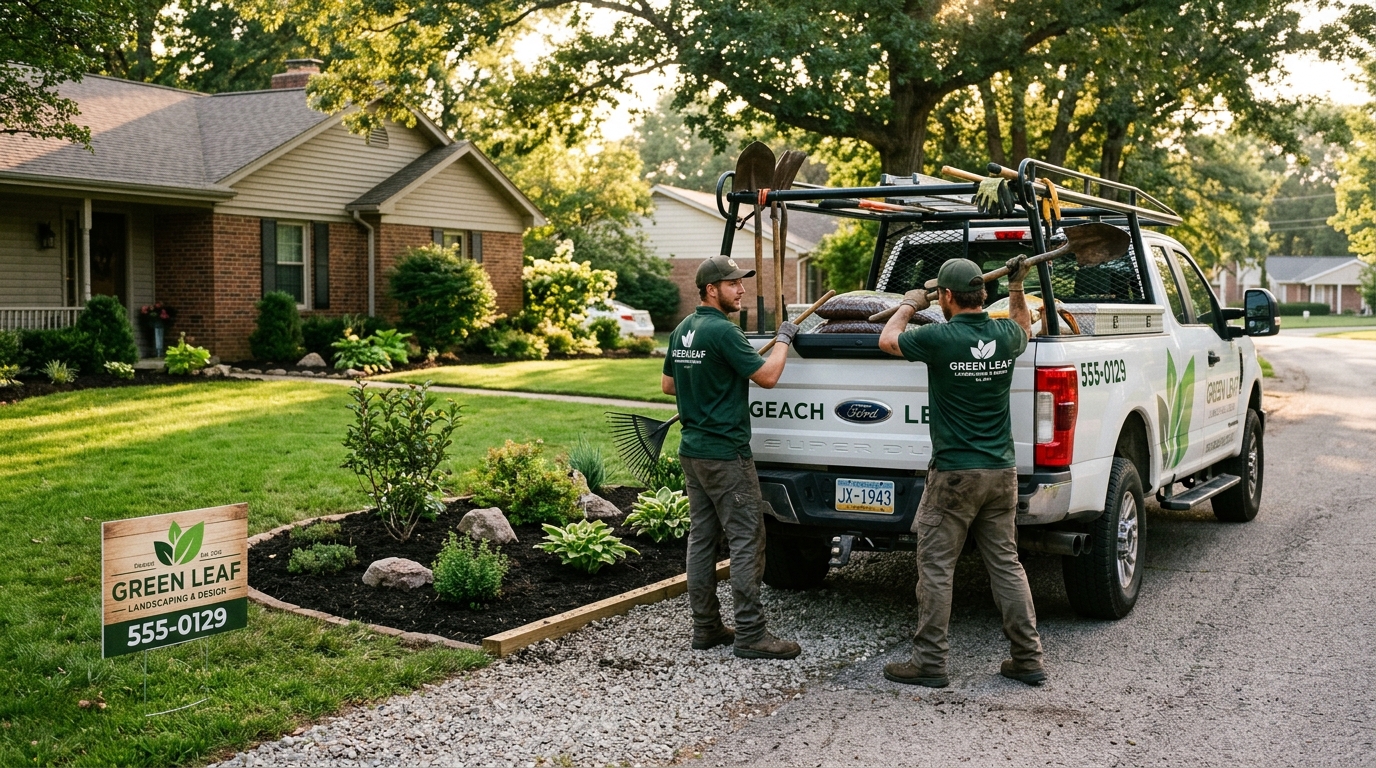
Your fleet is a mobile billboard you already paid for. A branded truck at a job site, a yard sign at the end of the driveway, and crew uniforms in matching colors cost once and work for years. When brand colors can lift recognition by up to 80%, according to a Loyola study summarized by Reboot and Forbes, every painted panel becomes an impression machine.
Run the math. A truck wrap that costs $4,500 and lives on the road for five years is less than $75 a month for daily impressions in your service area. Compare that to a $75 daily Google Ads click and the value is obvious. Yard signs at $8 each, planted after every install, are arguably the highest ROI channel most landscapers ignore.
Simple logos win here. Siegel+Gale’s Simplicity Index found that simpler logos are 13% more memorable. A readable mark on a wrap doing 45 mph beats a detailed illustration every time. Pair that with a consistent uniform across your mulch, snow removal, and irrigation crews and your brand looks bigger than it is. That perceived size wins bids. We covered the full field-marketing playbook in the landscaper’s guide to real marketing.
What Role Does Storytelling Play for a Landscaping Company?
Storytelling is how you turn a patio install into a reason to hire you specifically. Brand storytelling lifts buying intent by as much as 55% and sharing by 44%, according to Headstream research summarized by Forbes. The good news is landscapers have better stories than most industries. You transform backyards.
Good story content does not mean a 12-part documentary. It means a 60-second phone video of the crew lead explaining why this particular drainage solution solved a flooding problem. It means before-and-after photos of a $38,000 retaining wall build with the homeowner quoted about their first family dinner on the new patio. Content marketing also happens to cost 62% less than traditional marketing while generating 3 times more leads, per Demand Metric.
The client is the hero of the story. Your company is the guide. A homeowner scrolling Instagram does not want to hear you brag about your 20-ton excavator. They want to picture themselves hosting a barbecue in that finished space. Put the customer’s voice at the center. We built a full framework for this in the guide to turning client voices into growth.
How Does a Clear Brand Show Up Inside Your Own Crew?
A clear brand is not just an external asset. It is an internal one. Gallup research shows engaged employees outperform disengaged peers by 202%, and teams aligned to a clear brand purpose drive about 20% higher sales. When your foreman knows what the company stands for, every customer interaction reinforces it.
On a landscaping job site, brand clarity means the crew lead knows the answer when a homeowner asks, “Why did you guys quote higher than the other company?” If the answer is a crisp sentence about how you build patios that do not heave after three winters, the sale often closes on the spot. If the answer is a shrug, you lose the add-on irrigation zone or the next-door referral.
Document your brand in plain language. One page. Who you serve. What you promise. How you behave. Then drill it into every morning huddle. The same Marq research notes that brand inconsistency costs businesses more than $10,000 per incident on average. Most of those incidents happen at the crew level: a confused answer, a sloppy job site cleanup, a missed follow-up. Clarity prevents them.
Which Channels Should a Landscaping Brand Invest in First?
Start with the channels closest to a buying decision. Your Google Business Profile, your website, and your review pipeline come before paid ads. Once those are tight, pay-per-click marketing and targeted social become force multipliers. Yotpo’s State of Brand Loyalty report found 88% of consumers need 3 or more purchases before loyalty forms, which is why retention channels like email matter for recurring services.
For landscaping, recurring revenue sits inside services like mulch installs each spring, snow removal each winter, and irrigation startup and blowout each season. That is where loyalty math pays off. A branded email reminder that goes out two weeks before frost hits earns more bookings than any cold ad. Meanwhile, landscaping advertising channels like Local Services Ads and geofenced display buys let you double down in your profitable zip codes.
The sequence matters. Brand foundation first. Owned channels next. Paid amplification last. Skip a step and you are paying to drive traffic to a weak brand, which is how a lot of landscapers end up saying “ads do not work.” Ads work. Ads pointed at a muddy brand do not. For a deeper local tactics primer, we have 10 ways to turn your Google Business Profile into local jobs.
Ready to Sharpen Your Landscaping Brand and See the Marketing Lift?
If any of this hits close to home, the fix is not more ad spend. It is a tighter brand pointed at the right homeowners. We have helped landscaping companies across the country turn inconsistent messaging into a system their crews, their website, and their paid channels can all run on. The result is usually fewer wasted dollars and a higher close rate on the estimates you already pitch.
Contact our team and we will audit your brand touchpoints, flag the leaks, and map the next three moves that will move your revenue. No fluff, no retainer pitch until we know you actually need one.
How much should a landscaping company spend on branding versus direct advertising?
Most established landscaping companies should invest 20 to 30% of their marketing budget on brand foundation work before scaling paid ads. That means website design, truck wraps, crew uniforms, yard signs, and photography. Marq research shows consistent brand presentation lifts revenue 23%, so the foundation pays for itself. Once brand assets are clean and consistent, direct advertising like pay-per-click or Local Services Ads works far harder because every click lands on a credible, matching brand experience. Skipping the foundation is the fastest way to waste ad dollars and blame the channel.
What is the fastest brand fix that improves marketing results for a landscaping business?
Fix your Google Business Profile and review pipeline first. BrightLocal reports 98% of consumers read online reviews for local businesses, and Think with Google shows 76% of near-me searches lead to a visit within 24 hours. Update your NAP details so they match everywhere, add recent job photos, and build a simple text-based review request into your project close-out checklist. These three moves usually raise lead volume within 30 days and cost almost nothing. Most landscapers see a measurable bump before any website redesign or paid media change takes effect.
Does a landscaping company really need a logo redesign to improve marketing?
Not always. A logo redesign only helps if the current mark is illegible on a truck wrap at 45 mph or so dated it undermines credibility on your website. Siegel+Gale found simpler logos are 13% more memorable, so if your current logo is complex, a cleanup usually outperforms a full rebrand. Focus on consistency across touchpoints first. Matching colors, fonts, and photography style on your site, proposals, trucks, and uniforms move the needle more than a new logo. Redesign only when the logo is actively costing you jobs.
How do I measure whether my landscaping brand is actually working?
Track three numbers monthly. First, branded search volume for your company name in Google Search Console, which shows recognition growth. Second, close rate on estimates you pitch, since a stronger brand lifts trust and reduces price objections. Third, cost per lead across your paid channels, because a clearer brand typically lowers cost per lead as ads convert better. Marq data shows 68% of businesses with consistent branding report 10%+ revenue growth. If those three metrics are moving the right direction over 90 days, your brand work is paying off.
What mistakes do landscaping companies make most often with their brand?
The biggest mistake is inconsistency. Different logos on the truck versus the website, different phone numbers on Yelp versus Google, different tone on social media versus proposals. Marq research found brand inconsistency costs businesses more than $10,000 per incident on average. The second mistake is copying bigger competitors instead of owning a specific promise, like specializing in drainage-friendly paver patios or no-call-back irrigation installs. The third is skipping crew uniforms and yard signs because they feel unnecessary. Those low-cost visual assets compound into real recognition and referrals over time.
