

Key Takeaways
- 75% of consumers always or regularly read online reviews when choosing a local business like a landscaper, according to the BrightLocal Local Consumer Review Survey 2024.
- Products and services with just five reviews have a 270% higher purchase likelihood than those with none, per the Spiegel Research Center at Northwestern University.
- Landscapers that reply to at least 25% of their reviews earn 35% more revenue, and consumers spend 49% more at responsive businesses, according to ReviewTrackers.
- A single-star improvement on Yelp can drive a 5-9% revenue lift for small service businesses, per research from Harvard Business School.
- Reviews account for 16-20% of local search ranking weight, and 89% of local consumers check Google reviews before hiring a service pro, based on Whitespark Local Search Ranking Factors.
Your best marketing asset is already written, and it cost you nothing to produce. A single happy client who took three minutes to leave a five-star Google review can influence dozens of future homeowners shopping for a landscaper. According to Podium research, 97% of consumers read online reviews for local businesses and weigh reviews 7.4 times more heavily than traditional advertising. For landscaping contractors, that means client voices are the growth engine, not a nice-to-have.
This guide walks through how to collect customer reviews for landscapers, turn landscaping testimonials into booked jobs, and use response patterns to climb the local map pack. Every recommendation is tied to a recent data source so you know the playbook works before you pick up the phone.

Why Do Customer Reviews Matter So Much for Landscapers?
Reviews decide who gets the call. Research from Podium found 97% of consumers read reviews for local businesses, and the average shopper reads about 10 reviews before they trust a company. For landscaping crews competing on local maps, those ten reviews are the difference between an estimate request and a scroll past your listing.
Reviews also carry weight well beyond first impressions. Nielsen’s Global Trust in Advertising Survey reported that 92% of consumers trust earned media like word-of-mouth and consumer opinions above any paid advertising format. An online review is word-of-mouth at scale: your best client talking to every homeowner within a 20-mile radius, 24 hours a day.
There is a direct revenue line too. A study of Yelp ratings by Harvard Business School economist Michael Luca found that a one-star increase in rating produced a 5-9% revenue lift for independent service businesses. For a landscaping company doing $1.2M a year, moving from 3.8 to 4.8 stars can translate into roughly $60K-$108K in incremental revenue without a single new ad dollar.
Finally, reviews feed the Google algorithm. Whitespark’s ongoing ranking factors research shows reviews account for 16-20% of local ranking weight, with review count, velocity, and response rate all contributing. Consistent landscaping testimonials translate directly into more map-pack impressions, which feeds back into our landscape marketing strategy for clients across the country.
How Many Reviews Does a Landscaping Business Actually Need?
Aim for five before you celebrate and fifty before you relax. Spiegel Research Center found that adding just five reviews boosted purchase likelihood by 270% compared with a listing that had none. That is the single biggest ROI jump in the review data, so the first five are the most important reviews you will ever collect.
Beyond volume, the star range matters more than most owners realize. Spiegel’s research also found that purchase likelihood peaks for products rated between 4.0 and 4.7 stars, not perfect fives. A Podium analysis echoes this: 68% of consumers say they are more likely to trust a 5-star business if it has many reviews, because a handful of perfect scores looks suspicious. A few honest 4-star reviews among your 5-stars actually raises conversion.
Recency matters even more than total volume. BrightLocal’s survey noted that 73% of consumers pay attention only to reviews written in the past 30 days, and Whitespark calls review recency one of the most underrated ranking factors in 2025. A landscaping company with 50 reviews from the last 12 months will usually outrank a competitor with 150 reviews that are three years old.
The practical target: aim for 3-5 new reviews per month, distributed across Google Business Profile, Facebook, and industry platforms like Angi or Houzz. If you want a deeper playbook on platform selection, our guide on local listings for landscapers covers NAP consistency and where to register first.
What Is the Best Way to Ask a Client for a Review?
Ask the same day the job ends, by text, with a direct link. Podium’s research found 23% of consumers have read an online review in the last 24 hours and 28% have looked up a business while standing at its door, so timing drives conversion. The longer you wait after the final walkthrough, the fewer reviews you will collect per request sent.
Use a Short, Personal Text Message
A one-sentence SMS with the direct Google review link outperforms long-form email by a wide margin. Keep it simple: “Hi Sarah, thanks for letting us rebuild your front beds today. If you have 60 seconds, would you leave us a quick Google review? [link].” Personalization is non-negotiable. BrightLocal found that 58% of consumers actually preferred the AI-written review response in a blind test, but only when it referenced specific job details.
Automate the Ask, Not the Message
Field service platforms like Jobber, Housecall Pro, and ServiceTitan can trigger a review request when a job is marked complete. Use that trigger, but write three or four message templates that rotate based on service type (mow-and-blow, design/build, irrigation repair). Pair it with proper tracking and analytics so you can measure response rates and adjust copy weekly.
Make It Stupid-Easy to Leave the Review
Generate a short “g.page/r/…” review link from your Google Business Profile and print it as a QR code on your invoice, yard sign, and business card. Every extra tap you remove lifts completion rates. Bazaarvoice data shows UGC-enabled experiences produce 161% higher conversion, and the same friction-reduction principle applies to asking for the content in the first place.
Should Landscaping Owners Respond to Every Review?
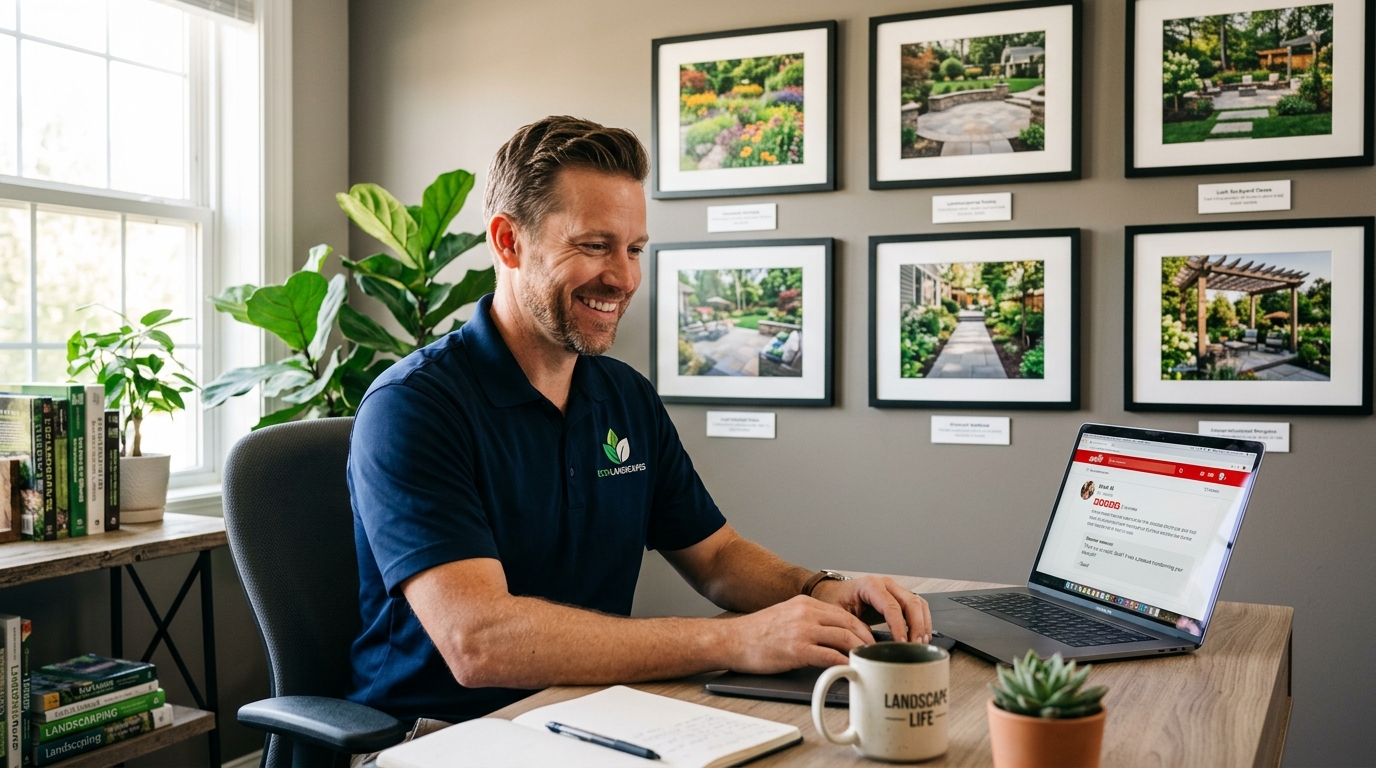
Yes, and the numbers are not close. BrightLocal’s 2024 survey found that 88% of consumers would use a business that replies to all reviews, compared to just 47% for a business that does not respond at all. ReviewTrackers data goes further: companies that reply to at least 25% of reviews earn 35% more revenue than those that ignore them.
Positive Reviews: Thank by Name and Reinforce the Story
Acknowledge the reviewer, mention the specific project, and wish them well. “Thanks Mike, glad the new paver patio survived the kids’ birthday party last weekend. Enjoy the summer back there.” That kind of specificity signals to future readers that you remember clients as humans, not ticket numbers. Reputation.com research shows 78% of consumers believe a business cares more when owners engage publicly with feedback.
Negative Reviews: Reply Fast, Reply Calm
Speed changes the outcome. ReviewTrackers data indicates that replying to a 1- or 2-star review within 24 hours gives the reviewer a 33% higher probability of updating their review, sometimes by as much as three stars. And 45% of consumers say they are more likely to visit a business specifically because it responds to negative feedback. A short, ownership-first reply protects your pipeline: “Mark, I am sorry the crew missed your side gate on Thursday. I have assigned my foreman to personally finish the cleanup Saturday. Please call me at [number].”
Build Response into Your Week
Block 15 minutes every Monday morning to respond to new reviews across Google, Facebook, and Yelp. Treat it like invoicing: non-negotiable. For owners who struggle to keep up, a landscape marketing partner can manage replies, flag risky reviews, and coordinate disputes with Google without slowing your ops team down.
How Do Reviews Connect to Local SEO and Google Rankings?
Reviews are both a direct and indirect ranking signal. Whitespark’s ongoing Local Search Ranking Factors study shows reviews influence 16-20% of local rank, with four of the top 20 factors tied to reviews: total count, review velocity, star rating, and response rate. That puts reviews on par with your Google Business Profile categories in terms of ranking influence.
Keyword signals inside reviews also help. When homeowners naturally mention “paver patio install in Frisco” or “sod replacement near Flower Mound,” Google sees relevance signals it cannot fabricate from your own site copy. Pair this with an aggressive SEO strategy and structured photos (per our GBP photo guide) to compound the ranking lift.
Volume plus photos accelerates results. BrightLocal’s GMB Insights Study found that businesses with 100+ photos receive 520% more phone calls and 1,065% more website clicks than the average listing. When clients leave a review with a photo of your finished work, you are stacking two ranking signals in one action. For a deeper local SEO framework, our local SEO for landscape contractors guide maps the full funnel.
How Can You Turn Landscaping Testimonials Into Marketing Content?
Treat reviews as a content library, not a static rating. Wyzowl’s research shows 79% of people say they have been convinced to buy after watching a testimonial video, and 9 of 10 consumers trust what a customer says about a brand more than what the brand says about itself. Every five-star review on Google is raw material for a social post, a landing page block, or a short video.
Pull Quotes Into Your Website
Add a testimonial carousel to your homepage and each service page. Pair the quote with a before-and-after photo of the actual project when possible. Bazaarvoice research found that 60% of shoppers prefer 10 reviews with photos over 200 reviews without, so the visual pairing matters more than quote volume. A modern website design should make swapping in fresh testimonials a 60-second task, not a developer ticket.
Record Short Video Testimonials
Offer clients a $50 thank-you gift card in exchange for a 60-second phone video walking you through their new backyard. Wyzowl data shows testimonials can lift conversions on sales pages by up to 34%. Post the clip on YouTube, embed it on the matching service page, and slice it into a 15-second TikTok or Instagram Reel. Do this four times a year and you will have a rotating video library that outperforms any stock footage ad.
Feed Paid Campaigns With Real Quotes
Direct-quote ad creatives tend to beat generic “call us today” messaging in head-to-head tests. Use a short customer quote as your Meta ad headline and the matching before/after photo as the visual. Sync this with a focused PPC marketing program and landscaping advertising strategy so your reviews do double duty in paid search, display, and social.
How Should Landscapers Handle Bad Reviews Without Losing Business?
Handled right, a bad review can actually raise conversion. ReviewTrackers reports that 45% of consumers are more likely to patronize a business that responds to negative feedback, and Spiegel Research found that shoppers who see a mix of positive and negative reviews convert at higher rates because the profile feels authentic. The response, not the star, is what future clients read.
The four-step framework we recommend to clients: acknowledge, apologize, act, and take it offline. Acknowledge the specific issue (not a generic “sorry you feel that way”), apologize for the experience, describe the concrete action you will take, and invite the reviewer to continue the conversation by phone or email. Never argue facts in public. Even if you believe the client is wrong, future readers are scoring your composure, not your version of events.
Do not ignore a negative review hoping it drops down the feed. Lipscore research referenced in industry studies estimates a single unanswered negative review can cost a small business up to 30 potential customers. For a high-ticket design/build landscaper, a single lost job can easily be a $25K project, so the math on responding quickly is obvious. Our article on building customer trust with reviews walks through sample response templates you can adapt.
Can Review Strategy Really Grow a Lawn Care Business?
The data says yes, decisively. Podium’s analysis found that reviews increase customer spending by 31% and let businesses raise prices by 11% for every one-point increase in average star rating. For a lawn care company serving 300 homes at $180 per visit, that 11% pricing power is roughly $5,940 per month in added margin with zero new labor cost.
Review velocity also lifts search visibility. Consistent monthly reviews push your listing into the Google Local 3-Pack, which captures roughly 44% of all local clicks according to multiple industry studies. If reviews move your lawn care business from page two to the 3-pack, your contact form volume can easily triple month-over-month.
The compounding effect is what makes reviews the best growth channel a local service business can build. Every signed job becomes a lead source, a ranking signal, and a marketing asset. If you want a deeper walkthrough of the subscription-service economics, our lawn care marketing services hub and our real marketing guide for landscapers lay out the full playbook for turning review momentum into recurring revenue.
Frequently Asked Questions
Aim for at least 25 Google reviews as an initial benchmark, then add 3-5 new reviews per month. Spiegel Research Center data shows five reviews already produce a 270% lift in purchase likelihood, and Whitespark notes that review velocity and recency matter more than raw volume for local rankings.
No. Google’s review policies prohibit incentivized reviews and can remove your listing if you are caught. You can offer a small thank-you gift for recording a video testimonial used on your own website, but never condition it on leaving a public Google, Yelp, or Facebook review.
Within 24 hours. ReviewTrackers found that replying to a 1- or 2-star review within a day gives you a 33% higher probability of the reviewer updating their rating. More than half of consumers expect a business to respond within a week and one in three expect a response in three days or less.
Yes. Whitespark’s Local Search Ranking Factors research attributes 16-20% of ranking weight to reviews, with four of the top 20 factors tied to review count, velocity, star rating, and response rate. Consistent recent reviews can outrank competitors with larger but older review totals.
Google Business Profile first, Facebook second, then industry-specific sites like Angi, Houzz, and Thumbtack depending on your market. BrightLocal’s 2024 survey found 41% of consumers consult three or more review sites before choosing a local business, so a diversified review footprint wins more jobs than stacking every review on one platform.
Ready to Turn Client Voices Into Booked Jobs?
Reviews are the highest-ROI marketing channel a landscaper can build, but they only compound if you work the system every week: ask on the day of the job, respond within 24 hours, repurpose the best quotes into ads, and measure the ranking lift. Sideways8 helps landscape and lawn care companies across the country combine review generation with SEO, paid media, and conversion-ready websites so every happy client turns into three more booked jobs.
Want a partner that treats your reputation like pipeline? Talk to our team at Sideways8 for a free review-and-visibility audit. We will show you exactly where your reviews stack up against the top landscapers in your market and the next three moves that will land you in the Google 3-Pack.
