
- 46% of all Google searches have local intent, totaling roughly 97 billion local searches per month (Google/DemandSage, 2026)
- Businesses in Google’s Local 3-Pack receive 126% more traffic and 93% more conversion actions than those outside it (DataPins/OnTheMap, 2025)
- 36% of Google Business Profiles remain unverified, making those businesses essentially invisible in local map results (Birdeye, 2025)
- 76% of people who search “near me” visit a business within 24 hours (Google, 2025)
- SEO leads close at 14.6% compared to 1.7% for outbound leads, an 8.6x difference (HubSpot/Search Engine Journal)
There are approximately 97 billion local searches on Google every month, according to DemandSage (2026). Nearly half of all Google queries carry local intent. For the 693,000 landscaping businesses in the United States (IBISWorld, 2025), this creates an enormous pool of homeowners actively searching for landscaping services right now. The question is whether they find your company or your competitor.
This guide explains the specific reasons most landscaping companies are invisible in local search and provides the exact fixes in priority order.
How Do Homeowners Actually Search for Landscaping Services?
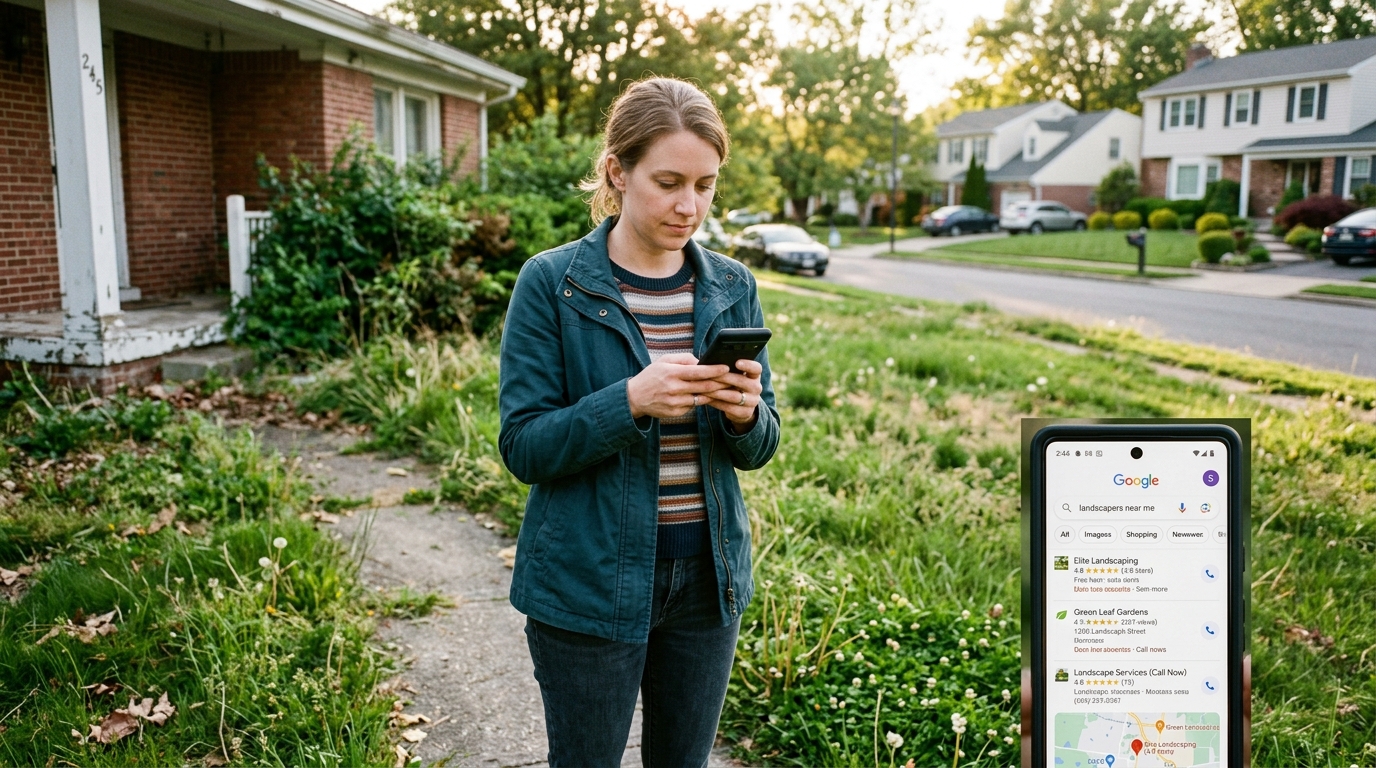
The path from “I need a landscaper” to “I’m hiring this company” now happens almost entirely on a phone screen. According to StatCounter (2025), 63% of all Google searches come from mobile devices. Over 1.5 billion “near me” searches happen every month (Google/Keywords Everywhere, 2025), and 76% of those mobile searchers visit a business within 24 hours.
For landscaping specifically, homeowners search in four distinct patterns:
- Service + location: “landscaping company in [city]” or “lawn care [zip code]”
- “Near me” searches: “landscaper near me” or “best landscaping company near me”
- Specific services: “patio installation,” “tree removal,” “sprinkler system repair”
- Research queries: “how much does landscaping cost” or “best time to resod a lawn”
Each search type represents a potential client at a different stage of the buying process. If your website and Google Business Profile are not optimized for these searches, you are invisible to every one of them.
Why Is Your Google Business Profile the #1 Reason You Are Invisible?
According to Birdeye’s 2025 State of Google Business Profile Report, 36% of Google Business Profiles remain unverified. Fully optimized GBP listings appear 80% more often in search and generate 4x more website visits, 12% more calls, and 10% more direction requests than incomplete or unverified listings.
The Local 3-Pack (the map results at the top of local searches) is where most clicks happen. BrightLocal’s 2025 Local Services Ads Click Study found that 44% of local searchers click on the Local 3-Pack, compared to 29% on organic results and 19% on paid ads. Businesses inside the pack receive 126% more traffic and 93% more conversion actions than those outside it (DataPins/OnTheMap, 2025).
If your profile is missing service descriptions, business hours, photos, or has incorrect contact information, Google has less reason to show your listing. Profiles with photos receive 42% more direction requests and 35% more website clicks (Birdeye, 2025). Your GBP is the single most impactful asset in local SEO.
Why Does Missing Local Keyword Targeting Keep Landscapers Off Page One?
Having a website that says “we offer landscaping services” without mentioning specific cities, neighborhoods, or zip codes is like having a storefront with no address on it. Google cannot connect your business to local searches if your content does not tell it where you work.
The data shows why this matters: position #1 on Google captures approximately 39.8% of all clicks, according to Backlinko’s 2025 analysis of 16.4 million search results. Position #1 gets 2.1x the clicks of position #2 (First Page Sage, 2025). Page 2 results receive less than 1% of all clicks.
Every major service area needs a dedicated page on your website. A “Lawn Maintenance in Roswell, GA” page that describes your specific work in that community, mentions local landmarks and neighborhoods, and includes photos from projects in that area gives Google the location signals it needs to rank your page for searches in that city.
How Do Reviews Make or Break Your Local Search Rankings?
Reviews are now one of the most powerful local ranking factors. According to the Whitespark 2025 Local Search Ranking Factors Report, review recency jumped from the #20 ranking factor to a top-5 factor between 2023 and 2025. Recency and sentiment now outweigh raw review count in Google’s local algorithm.
BrightLocal’s 2026 Local Consumer Review Survey found that 97% of consumers read online reviews before choosing a local business. 49% trust online reviews as much as personal recommendations from friends and family. And 31% of consumers will only hire a company rated 4.5 stars or higher.
If your competitors have 50+ recent reviews with a 4.5-star average and you have three reviews from 2022, Google’s algorithm favors them and so do homeowners. A steady weekly flow of new reviews beats occasional bursts. When a business stops getting new reviews, rankings begin to slip (Whitespark, 2025).
Why Does a Slow or Non-Mobile Website Cost You Clients?
With 63% of searches on mobile and 59% of landscaping website traffic specifically coming from mobile devices (Landscape Leadership, 2025), your site must work flawlessly on a phone. The performance data is unforgiving:
- A 2-second delay in page load time increases bounce rates by 103% (Google/Huckabuy, 2025)
- 53% of mobile visitors abandon a site that takes longer than 3 seconds to load (Google Think)
- Conversion rates drop by 4.42% for each additional second of load time between 0 and 5 seconds (Portent/WebFX, 2025)
- A site loading in 1 second has a conversion rate 2.5x higher than one loading in 5 seconds (Portent, 2025)
- 61% of users will not return to a mobile site where they had trouble accessing it (Google)
A homeowner searching from their backyard on a Saturday morning will not wait for a slow site. They will tap the next result. Test your site right now with Google’s free PageSpeed Insights tool. If your mobile score is below 50, website performance improvements should be your top priority.
Why Do Citations and Backlinks Matter for Local Landscapers?
Citations (mentions of your business name, address, and phone number on directories) and backlinks (links from other websites to yours) provide the external trust signals Google uses to rank local businesses.
The impact is measurable. Businesses with 40 or more accurate citations rank 53% higher in local search results (Firegang/SEO Werkz, 2025). On the flip side, businesses can lose up to 68% of potential customers due to inconsistent NAP information causing confusion and lower visibility (Firegang, 2025). Among the top 10 local search results, the average page has 125 referring domains (Semrush, 2024).
For landscaping companies starting out, the priority is getting listed accurately on the directories that matter: Google Business Profile, Yelp, Angi, HomeAdvisor, BBB, your local chamber of commerce, and industry-specific platforms like Houzz. Ensure your business name, address, and phone number are identical across every listing.
What Should You Fix First for the Biggest Impact?
You do not need to overhaul everything at once. These fixes are listed in order of impact based on the ranking factor data from Whitespark, BrightLocal, and Google:
- Claim and complete your Google Business Profile. Add every service you offer, upload 20+ real project photos, set accurate hours, and write a detailed business description with your service areas. This single step makes you eligible for the Local 3-Pack where 44% of local clicks happen
- Build a review generation system. Ask every satisfied client for a Google review. Send a follow-up text with a direct review link within 24 hours of completing a job. Aim for 2 to 4 new reviews per month consistently
- Create service area pages on your website. A dedicated page for each major city or neighborhood you serve, with specific content about your work in that area. This tells Google exactly where you operate
- Fix mobile speed issues. Compress images, minimize code, and test with PageSpeed Insights. Target a load time under 3 seconds on mobile
- Get listed on relevant directories. Ensure your NAP is consistent across Yelp, Angi, HomeAdvisor, BBB, and your local chamber of commerce
How Does SEO Turn Search Visibility Into Actual Booked Jobs?
The return on local search visibility is measurable and significant. SEO leads close at 14.6% compared to 1.7% for outbound leads like direct mail or cold calls (HubSpot/Search Engine Journal). That is an 8.6x higher close rate. For a landscaping company, the leads coming through organic search are not only cheaper to acquire but far more likely to become paying clients.
Consider the math: 78% of local mobile searches result in an offline purchase (Google/SEO.com, 2025). If your business appears in the Local 3-Pack for 10 relevant searches per day and captures even a fraction of those clicks, the compound effect on your pipeline is substantial. Every month you are invisible in local search is a month of lost revenue you cannot recover.
A professional landscape marketing strategy combines SEO with paid advertising and reputation management to ensure you are visible at every stage of the homeowner’s search process.
What Is the One Thing You Should Do This Week?
Low-visibility brands appear on page one of local search results only 4% of the time, compared to 53% for high-visibility brands, according to SOCi’s 2024 Local Visibility Index. The difference between those two categories is not budget or company size. It is whether the business has completed the foundational steps described in this guide.
Start with your Google Business Profile. If it is unclaimed, claim it today. If it is claimed but incomplete, fill in every field, upload real project photos, and ask three recent clients for reviews this week. That single action puts you ahead of the 36% of businesses that have not even verified their listing.
If you want a professional assessment of where your landscaping company stands in local search and a prioritized plan to fix it, request a consultation with our team.
How long does it take for SEO to work for a landscaping company?
Most landscaping companies see measurable improvements in local search rankings within 3 to 6 months of consistent SEO work. Google Business Profile optimizations can show results faster, sometimes within weeks, because local map pack rankings respond more quickly to profile completeness, reviews, and citation consistency. Full organic ranking improvements typically take 6 to 12 months to compound.
Why does my landscaping company not show up on Google Maps?
The most common reasons are an unclaimed or incomplete Google Business Profile, inconsistent business information across online directories, few or no recent reviews, and a website that does not mention the specific areas you serve. According to Birdeye (2025), 36% of Google Business Profiles remain unverified. Fully optimized profiles appear 80% more often in search and generate 4x more website visits than incomplete ones.
Do I need a website if I already have a Google Business Profile?
Yes. A Google Business Profile helps with map pack visibility, but a website is essential for ranking in organic search results, providing detailed service information, showcasing your work, and converting visitors into leads. Position 1 on Google captures about 40% of all clicks (Backlinko, 2025). Companies with both a strong GBP and a well-optimized website dominate local search results because they appear in both the map pack and the organic listings below it.
How many Google reviews does a landscaping company need to rank well?
There is no fixed number, but the Whitespark 2025 Local Search Ranking Factors Report found that review recency now matters more than total count. A landscaping company with 15 to 20 recent reviews from the past few months will typically outperform a competitor with older reviews. Focus on generating 2 to 4 new reviews per month consistently, maintaining a rating of 4.5 stars or above, and responding to every review within 48 hours.
How much revenue does a landscaping company lose by being invisible in local search?
The exact amount depends on your market, but the data shows the scale. There are roughly 97 billion local searches per month on Google (DemandSage, 2026), and 78% of local mobile searches result in an offline purchase (Google). Low-visibility brands appear on page one only 4% of the time versus 53% for high-visibility brands (SOCi, 2024). If your business is invisible to the 46% of Google searches with local intent, every month represents lost leads, lost jobs, and lost revenue that compounds over time.
