Key Takeaways
- The U.S. landscaping services industry hit $188.8 billion in revenue in 2025 across roughly 692,777 businesses (IBISWorld), so a written plan is the only way a new crew stands out in a crowded local market.
- Word-of-mouth still wins early: Nielsen finds 88% of consumers trust recommendations from people they know above any other form of advertising, which is why your first plan should lean on personal network and referrals.
- Local search is the fastest path to steady leads: 76% of people who do a local search on their phone visit a related business within 24 hours (Think with Google).
- Reviews drive the decision: BrightLocal reports 93% of consumers read online reviews before hiring a local business, and review signals account for about 16% of local pack ranking weight.
- Budget realistically: the SBA recommends 7-8% of revenue on marketing for businesses under $5M, while landscaping companies typically allocate 5-10% of revenue to marketing, with startups often pushing to 12-20%.
You can transform a bare yard into a showpiece, but turning strangers into booked jobs is a different craft. Most new landscaping owners learn the hard way that the U.S. Bureau of Labor Statistics data cited by the SBA shows roughly 20% of small businesses close within their first year and nearly half within five, and weak marketing is a top reason. This guide lays out a clear landscaping marketing plan from opening day through steady, predictable leads, with real benchmarks you can use to pressure-test every step.
Why Does a Landscaping Marketing Plan Matter in the First Place?
A written plan matters because landscaping is one of the most competitive local service categories in America. IBISWorld counts about 692,777 landscaping service businesses generating $188.8 billion in 2025, and NALP reports the industry employs over 1.4 million people. Without a plan, you compete on price alone.
The plan forces you to answer three things before you spend money: who you serve, what job you win, and which channel puts the right phone ringing. Without that clarity, ad dollars vanish. The LendingTree analysis of BLS data shows 22.1% of new U.S. businesses close within a year, and marketing mistakes are a leading cause. A simple one-page plan beats a fancy pitch deck every time.
Think of this document as the operating manual for your growth. It covers offer, audience, channels, budget, and measurement. Our team uses the same framework in our landscape marketing engagements, because every dollar should be traceable to a lead, a proposal, or a signed contract.
What Should Your Marketing Plan Look Like in Month 1?
In month one, skip paid ads and focus on your personal network plus the fastest free trust signals. Nielsen data shows 88% of people trust recommendations from friends and family above any paid channel, and HubSpot notes about half of marketers say word-of-mouth drives 20-40% of their leads, making your contact list the highest-ROI list you own.
Week one is list building. Open your phone, pull up social contacts, and write a short outreach message. Tell friends, family, past coworkers, and neighbors that you have launched and describe the specific job you want, such as spring cleanups or retaining walls under $8,000. Week two is doing those jobs well and collecting photos plus a short written testimonial from every client.
Week three is stacking social proof. Ask each happy client for a Google review, since BrightLocal finds 93% of consumers read reviews before hiring. Offer a small friends-and-family discount on early jobs to unlock faster yes answers. Week four is launching a basic Google Business Profile, which we cover next, so you have a home base for every future referral.
Keep month one scrappy and measurable. Log every conversation in a simple spreadsheet with columns for contact, date, service requested, proposal amount, and outcome. This log becomes your first pipeline and your proof to yourself that outreach works. The discipline you build tracking ten leads in month one is the same discipline you will need when you are tracking a hundred in month six.
How Do You Build Awareness Without a Marketing Budget?
You build free awareness by concentrating in a few neighborhoods and stacking visual proof. Backlinko reports 46% of all Google searches have local intent, and Think with Google shows 76% of nearby mobile searchers visit a related business within a day, so visibility in one ZIP code beats generic reach across a whole metro.
Pick two or three ZIP codes that match your target project type, such as new construction neighborhoods for design-build or established subdivisions for lawn maintenance. Ask current clients for permission to place a branded yard sign for two weeks after a job finishes. Drop simple door hangers on every house within a three-block radius. This route density approach also cuts windshield time, protecting margin.
Layer in free digital reach. Post one before-and-after photo per week on Facebook and Instagram, and tag your town. Join the two or three most active local Facebook groups and answer questions with helpful advice, not sales pitches. For deeper tactical ideas, see our guide on 17 smart ways to market a landscaping company, which maps dozens of low-cost channels to specific growth stages.
Partner with two or three complementary local businesses. A hardscape installer can refer to a landscape designer, an irrigation tech can refer to a lawn care company, and a pool builder often needs a trusted planting specialist. Trade business cards, add a logo to each other’s trucks, and offer a small referral fee on closed deals. These partnerships cost nothing yet consistently generate 5-10% of monthly leads for established shops, and they compound as each partner’s customer base grows alongside yours.
Which Online Assets Do You Need Before Spending a Dollar on Ads?
Before any ad spend, you need three online assets: a focused website, an optimized Google Business Profile, and a review flow. BrightLocal ranks Google Business Profile signals as 32% of local pack weight, plus 16% for reviews, and HubSpot finds 74% of marketers say content marketing generates demand, so these foundations pay off for years.
A clean, fast, conversion-ready website
Your website is your 24/7 salesperson. It needs four things on the homepage: who you are, what services you sell, the cities you serve, and a phone number plus form above the fold. Ruler Analytics pegs the home services industry average conversion rate at 7.8%, so well-built sites actually convert at two to three times the broader web. We build focused lead-gen sites through our website design services, with real photography and fast mobile pages.
An optimized Google Business Profile
Your Google Business Profile is the free listing that appears in the map pack. BrightLocal data shows 42% of searchers click on map pack results for local queries. Fill every section: primary category as Landscaper, service areas by city, hours, services list, and a fresh photo every week. Our Google Business Profile playbook walks through optimization in detail.
A simple review collection flow
Build a repeatable review ask into your closeout process. Send a text with a direct Google review link within 24 hours of job completion, while the smell of fresh mulch is still in the air. BrightLocal shows 32% of customers expect a review response by the next day, so assign someone on your team to reply to every review, positive or negative, within one business day.
How Much Should You Budget for a Landscaping Marketing Plan?
Budget 7-10% of expected revenue in year one, leaning toward the high end if you are starting from zero. The SBA recommends 7-8% of revenue for businesses under $5M, Gartner finds enterprise marketing budgets sit at 7.7%, and Improve & Grow benchmarks landscaping startups at 12-20% of projected revenue.
Split the budget by stage. For a new shop targeting $250,000 in year-one revenue, that is roughly $20,000-$25,000 for the year. A reasonable first split: 40% to Google Ads and Local Services Ads, 20% to website and SEO, 15% to Google Business Profile content and reviews, 15% to print assets like yard signs and door hangers, and 10% reserved for testing a new channel each quarter.
Track every dollar against a single metric: cost per booked job. LocaliQ reports the 2025 average cost per lead for home services at $90.92, but landscaping often lands between $100 and $250 per lead depending on season and service. If your close rate is 30%, a $150 lead means roughly $500 per booked job. Our tracking and analytics services wire this up end to end.

What Is the Right First Paid Channel for a Landscaping Company?
Google Local Services Ads come first, then Google Search Ads, then Meta. WordStream benchmarks show Home & Home Improvement averaging $7.85 per click, and LocaliQ home services data shows CPCs rose for 75% of providers in 2025, so channel selection matters more than budget size.
Local Services Ads (LSAs) sit above the map pack and charge per lead, not per click. They require a Google Guarantee badge, which includes license and insurance verification. LSAs typically deliver lower cost per booked job than Search for lawn care and maintenance, since the intent is extremely high. We manage these campaigns inside our pay-per-click marketing engagements.
Use Search Ads for design-build and hardscape keywords where LSA categories do not cover the service. Reserve Facebook and Instagram Ads for retargeting site visitors or promoting specific seasonal offers. For a deeper dive on channel choice, see our guide to landscaping marketing by the numbers, which shows typical performance ranges by channel and deal size.
Set negative keywords on day one to stop wasted spend. Add terms like jobs, salary, DIY, course, free, and the names of big-box retailers you do not compete with. Cap daily budgets until you have at least 30 conversions per campaign, then let performance data guide scaling. The landscaping advertising team at Sideways8 runs these guardrails for every new campaign because a single bad week of broad match can burn a month of budget.
How Do You Turn Clicks and Calls Into Booked Jobs?
You turn clicks into jobs with a focused landing page, a fast response time, and a specific offer. Ruler Analytics data puts home services conversion at 7.8% on average, but landing pages built around a single service often hit 10-15%. The difference is message match: the page promises exactly what the ad said.
Every landing page needs four blocks above the fold: a specific headline naming the service and city, three trust signals (reviews, Google Guarantee, insurance badge), a phone number with click-to-call, and a short form with four fields max. Below the fold, add a before-and-after gallery, a team photo, and a clear offer such as Free yard assessment this week.
Speed closes the deal. Respond to form fills and missed calls within five minutes. That single discipline often doubles booked-job rate. Our simple marketing funnel guide walks through each step of converting a click into a signed proposal, including the automation stack we install for clients.
How Long Until Your Landscaping Marketing Plan Delivers Steady Leads?
Expect 30-60 days for paid channels and 3-6 months for organic and review-driven growth. HubSpot notes content marketing typically requires 3-6 months before showing substantial results, while Demand Metric research cited by HubSpot shows content marketing generates three times more leads than outbound at 62% lower cost.
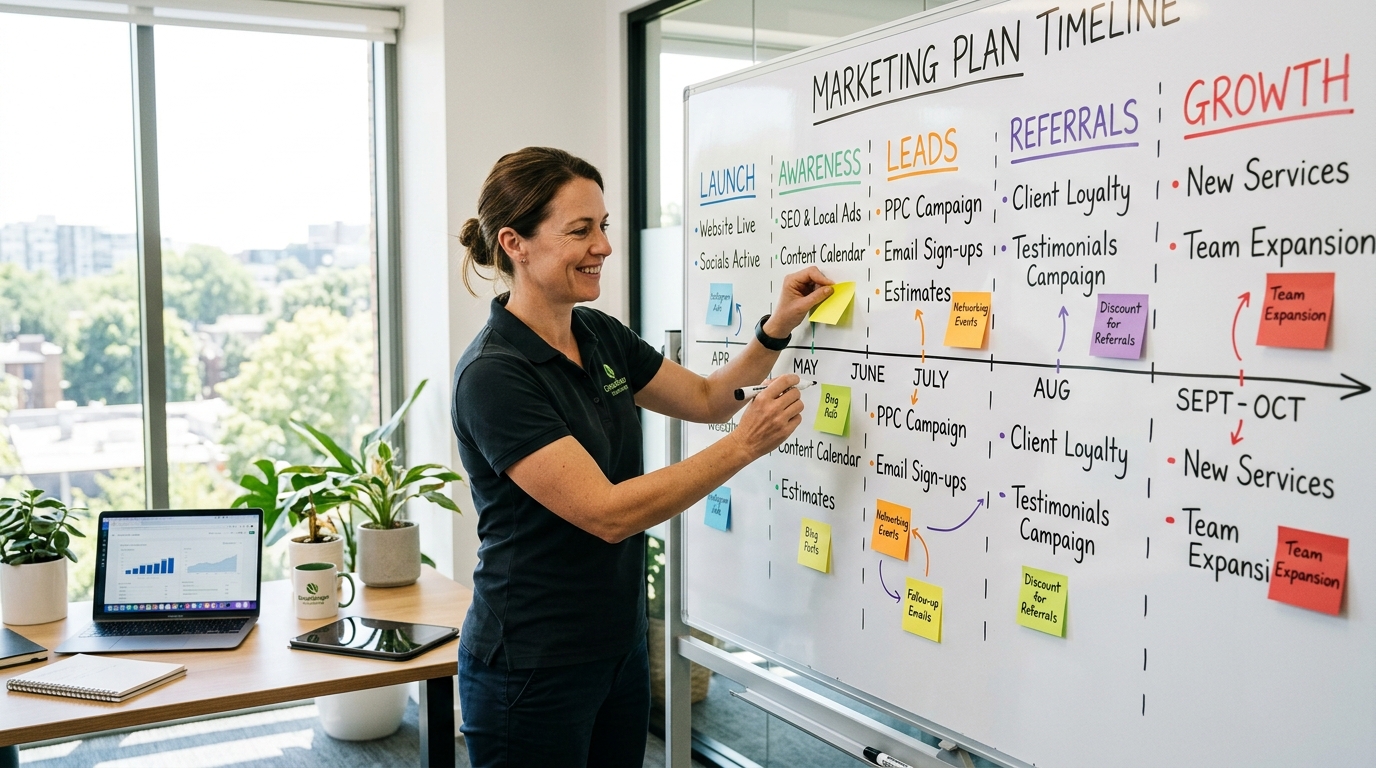
Here is a realistic timeline. Days 1-30: personal network, first reviews, GBP live. Days 31-60: LSAs running, website live, two-to-three active neighborhoods. Days 61-120: consistent weekly leads from LSA, first organic traffic from blog and GBP, referral loop warming up. Days 121-180: a second paid channel tested, seasonal campaigns running, predictable weekly lead volume in the target neighborhoods.
Do not kill a channel prematurely. Give each paid channel 60 days and at least 30 leads before judging, and organic SEO a full 6 months. Our blog on how landscaping companies can grow breaks down what to watch in each window so you know whether to double down or rebuild.
Which Metrics Prove Your Marketing Plan Is Working?
Track six metrics: cost per lead, cost per booked job, close rate, average job value, review velocity, and map pack ranking. LocaliQ 2025 benchmarks peg home services lead costs near $90, but your close rate and average ticket matter more than raw CPL. A $200 lead that closes at $5,000 beats a $50 lead that closes at $300.
Wire up call tracking on every ad, yard sign, and landing page. Set up a simple spreadsheet or a CRM that tags each lead with source, city, service type, proposal amount, and outcome. Review the numbers monthly. The landscaping marketing benchmarks guide shows the exact ranges healthy shops hit for each metric so you can spot problems early.
Email is the quiet compounder. Litmus reports email marketing delivers an average ROI of $36 for every $1 spent, and a monthly newsletter to past clients with seasonal service reminders often becomes the cheapest source of repeat revenue. Tag past clients in your CRM and send three to four emails a year tied to maintenance windows.
Map pack ranking is the leading indicator the rest follow. If you are not in the top three map results for your city plus your primary service, form fills and calls will stay flat. Run a monthly local rank check for five priority keywords across five grid points in your service area. When rankings drop, check review velocity, GBP category, and photo freshness first. For an audit-level view, explore our SEO services and how we build neighborhood-level visibility for landscapers.
Finally, document what works. Once a channel, offer, or neighborhood is profitable, write down the exact playbook in a shared doc so your team can repeat it. Many landscapers lose momentum in year two because the owner was the only person who understood the system. A plan that lives in one head is fragile. A plan that lives on paper scales.
FAQ
How much should a new landscaping company spend on marketing in year one?
Plan to spend between 7% and 12% of projected revenue in year one, with 10% as a safe middle. The SBA recommends 7-8% for businesses under $5M, Gartner CMO data shows enterprise budgets at 7.7%, and landscaping startup benchmarks from Improve & Grow sit at 12-20%. For a shop projecting $250,000 in first-year revenue, that is roughly $17,500-$30,000 split across website, Google Business Profile, LSAs, and print collateral.
What is the single most important first marketing step for a landscaping company?
Claim and fully optimize your Google Business Profile. BrightLocal research shows Google Business Profile signals carry 32% of local pack ranking weight, and 42% of searchers click map pack results. An incomplete or missing profile is the biggest reason new landscapers stay invisible in their own neighborhoods. Fill every field, upload fresh photos weekly, and reply to every review within a business day.
How long until a landscaping marketing plan starts producing steady leads?
Paid channels such as Google Local Services Ads typically produce leads within 7-30 days. Organic channels, including SEO and content marketing, usually take 3-6 months to produce meaningful traffic, matching HubSpot and Demand Metric research. A realistic target is 60-90 days for your first reliable weekly lead cadence, and 4-6 months for a diversified pipeline that no longer depends on a single channel.
Are Google Ads or Facebook Ads better for a landscaping company?
Google Ads usually win for landscaping because the intent is explicit. People type ‘lawn care near me’ or ‘paver patio installer’ only when they want to hire. WordStream 2025 benchmarks show Home & Home Improvement CPCs average $7.85, but close rates are strong. Facebook and Instagram Ads work best for retargeting site visitors and promoting seasonal offers, not cold acquisition in year one.
How many reviews does a landscaping company need to compete locally?
Aim for at least 25 Google reviews in the first 6 months and 50+ within a year. BrightLocal finds 93% of consumers read reviews before hiring, and review signals account for about 16% of local pack ranking. Competitive metros often require 100+ reviews with a 4.7+ average to consistently rank in the map pack. Build review collection into your job closeout process from day one.
Ready to Build a Landscaping Marketing Plan That Actually Fills the Schedule?
A landscaping marketing plan only matters when it drives booked jobs. The playbook is clear: start with your network, own two or three neighborhoods, lock in a Google Business Profile and a conversion-ready site, then layer in Local Services Ads and email. Measure cost per booked job every month and cut what does not pay.
If you want a team that has run this playbook for dozens of crews, our lawn care marketing services and landscape design marketing practices build, launch, and optimize the full stack. Contact Sideways8 to get a custom landscaping marketing plan with the budget, channels, and KPIs mapped to your service area.
