

Key Takeaways
- The U.S. hosts roughly 10.4 million residential swimming pools, and 60-65% of owners use professional service at least part of the year, creating a search-driven demand pool care companies can capture (PHTA, IBISWorld).
- 46% of all Google searches have local intent, and 88% of consumers who run a local search on a smartphone contact or visit a business within 24 hours (BrightLocal).
- The first result in Google’s local 3-pack captures about 17.8% of clicks, and local pack listings pull 126% more traffic than businesses ranked only in organic results (Red Local Agency).
- Businesses with 10+ Google Business Profile photos earn up to 2× more engagement, 42% more driving direction requests, and 35% more website clicks (Google, Birdeye).
- 81% of consumers read Google reviews before choosing a local service, and a single added star can lift conversions by around 44% (BrightLocal 2024, Sterling Sky).
Pool care is a year-round service business, yet most owners only think about finding a pro when something goes wrong with the water. That makes search visibility the single biggest lever for growth. With 78% of pool and hot tub companies expecting continued growth in 2025, the route to steady route density runs through Google. This guide maps out the pool service SEO plan that wins local rankings, fills weekly routes, and protects you from the seasonality that can wreck cash flow.

Why does SEO matter so much for pool service companies right now?
Search is the dominant discovery channel in home services, and pool care is no exception. BrightLocal’s 2024 Local Consumer Review Survey found that 98% of consumers at least occasionally read online reviews for local businesses, and 94% of homeowners start their contractor search online. A pool service with weak rankings is invisible during the exact moment a prospect is ready to book.
The competitive backdrop makes this more urgent. IBISWorld counts more than 14,000 swimming pool businesses in the U.S., and pool cleaning alone is a $7.2B segment across 40,000+ operators. Ranking above those competitors in the local 3-pack for “pool cleaning near me” or “pool service [city]” is the difference between a full schedule and a half-empty truck.
How big is the pool service opportunity in 2025?
The U.S. has roughly 10.7 million swimming pools, and 10.4 million of those are residential, according to the Pool & Hot Tub Alliance. About 8% of American households have a pool, and industry research pegs pool owner median household income at roughly $125,000, which is far above the national median. That buyer has disposable income and a strong preference for outsourced maintenance.
Demand is not flat across the calendar. Google Trends shows query volume for “pool cleaning,” “pool opening,” and “pool maintenance” spiking between March and August, then falling sharply. Pool service SEO wins are built in the off-season: content and technical work done in November ranks by April. If you wait for May to start optimizing, you are buying paid traffic at the highest CPCs of the year while your competitors harvest free clicks.
What keywords should a pool service company target?
Pool service searchers use location modifiers. BrightLocal reports that 46% of all Google searches have local intent, and 80% of U.S. consumers search online for local businesses at least weekly. Your keyword map has to mirror that behavior. Think “[service] + [city]” and “[problem] + [city]” rather than broad head terms like “pool cleaning.”
Core keyword clusters to build pages around
- Service + city: “pool cleaning Gainesville GA,” “weekly pool service Atlanta,” “salt cell replacement Cumming”
- Seasonal jobs: “pool opening [city],” “pool closing [city],” “spring pool startup”
- Problem-led queries: “green pool water fix,” “pool pump not priming,” “cloudy pool after rain”
- Equipment searches: “pool heater repair,” “pool filter replacement,” “variable speed pump install”
- Comparison queries: “saltwater vs chlorine pool,” “weekly vs bi-weekly pool service cost”
Every cluster deserves its own page. Generic service pages that try to rank for every city rarely crack the top 10. If you operate in five towns, build five city pages with unique copy, local photos, and testimonials from customers in that area. This is the same playbook we lay out in our practical SEO guide for landscaping companies.
How do you dominate the Google local pack?
The local 3-pack is where pool service bookings are won. 44% of local searchers click a local pack result compared to 29% for organic blue links, and the #1 local pack listing captures 17.8% of total clicks. Pack placement also drives 126% more traffic and 93% more conversion-oriented actions than a business that is only in organic results.
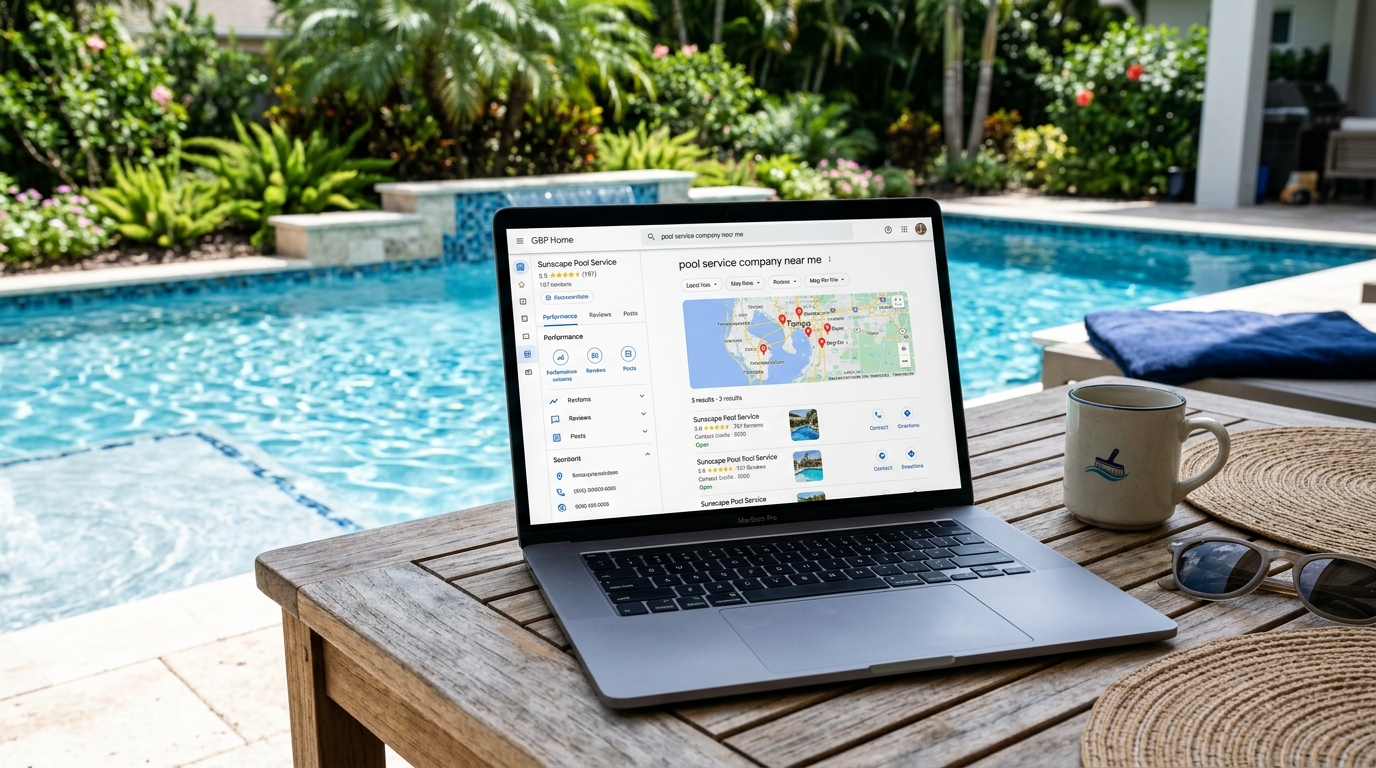
Google Business Profile essentials
According to Whitespark’s Local Search Ranking Factors report, Google Business Profile signals drive roughly 32% of local pack ranking weight, review signals add another 16-20%, and proximity dominates the rest. You cannot change where a searcher is standing, but you can make every other factor bulletproof.
- Pick the correct primary category (“Swimming pool cleaning service”) and add relevant secondary categories like “Swimming pool repair service.”
- Fill every field: hours, service areas, services menu, attributes, and a keyword-rich business description.
- Upload at least 10 high-quality photos. Google data shows profiles with photos receive 42% more direction requests and 35% more website clicks, and Birdeye reports listings with 100+ images see up to 2,717% more direction requests.
- Post weekly updates about seasonal services, promotions, or completed jobs. Posts signal to Google that the profile is active.
For more tactics specific to getting jobs from your profile, our post on turning your Google Business Profile into local jobs breaks down the weekly checklist.
How important are Google reviews for pool service companies?
Reviews drive both ranking and conversion. The BrightLocal 2024 Local Consumer Review Survey found that 81% of consumers use Google to read reviews, 88% would use a business that replies to all reviews (versus just 47% for non-responders), and 71% will not consider a company with an average rating below three stars.
Volume and velocity matter. A Sterling Sky case study found that moving from 9 to 10 reviews produced a measurable local pack ranking lift, and industry data shows a one-star jump in average rating can increase conversion rates by around 44%. For pool service companies, that means the difference between a 3.9 and a 4.9 is worth thousands of dollars a month in booked routes.
A simple review system that actually works
- Send a review request text the same day a technician finishes a visit, with a direct Google review link.
- Reply to every review within 48 hours. Thank positive reviewers by name and address specifics in negative ones.
- Aim for at least 4-6 new reviews per month. Review velocity is a ranking signal, not just total count.
- Encourage reviewers to mention specifics: the service (weekly cleaning, equipment repair) and the city. Those words reinforce your keyword relevance.
What does a high-converting pool service website look like?
A website that ranks is not the same as a website that converts. The average landing page conversion rate is around 2.35% across industries, but the top 25% of pages convert at 5.31% or higher and the top 10% hit 11.45%. For home service businesses, the gap between a bad page and a top-quartile page is usually the difference between 10 and 40 leads a month on the same traffic.
Non-negotiable on-page elements
- Click-to-call phone number pinned in the header. 57% of local searches come from mobile devices (OnTheMap), and a mobile user who has to hunt for a phone number will leave.
- Instant quote or booking form above the fold, with fields kept to five or fewer.
- Service area map with named cities and ZIP codes. This reinforces local relevance for both users and Google.
- Trust signals near the fold: star rating, review count, years in business, licenses, PHTA or CPO certifications.
- Real job photos of your own work, not stock images. Original images build E-E-A-T and differentiate you from the template-site competition.
Our website design services and tracking and analytics services are built specifically for service businesses that need traffic to turn into booked visits.
How does mobile performance affect pool service SEO?
Mobile is the default surface for pool service searches. 57% of local searches are on mobile or tablet, 76% of people who run a local search on their phone visit a business within a day, and searches including “near me” have grown more than 500% over the last three years. A site that loads slowly on a phone is throwing away customers who would have converted on a faster competitor.
Google has also confirmed that Core Web Vitals, now measured with LCP, INP, and CLS after the March 2024 update, are part of its page experience ranking signals. Real user field data is what counts, and Google uses a 28-day rolling window. That means the fixes you make today won’t fully register for a month, so audit your speed now rather than in April.
Speed and mobile checklist
- Compress hero images to under 200 KB and serve modern formats like WebP or AVIF.
- Defer non-critical JavaScript (chat widgets, tracking pixels) until after first paint.
- Use a reliable host with server response times under 200 ms.
- Confirm tap targets (buttons, phone numbers) are at least 48 px tall on mobile.
- Test with real-device field data in Google Search Console, not just Lighthouse scores.
Which content topics help pool companies rank and convert?
Blog content closes the gap between ranking for branded “pool service [city]” searches and ranking for the long-tail questions that pull new audiences. Nearly 60% of U.S. searches end without a click, but local and service-intent queries are the exception because searchers still need to take a physical action. Long-tail how-to content captures those users while AI Overviews grow elsewhere.
Blog topics that consistently rank for pool service companies
- “Why is my pool green and how do I fix it?” is a classic high-volume problem query.
- “How often should I have my pool professionally cleaned?” is a buyer-stage question.
- “Saltwater vs chlorine pool: pros, cons, and costs” is comparison content that attracts remodelers.
- “Pool opening checklist for [state]” is seasonal content that ranks every spring.
- “How much does weekly pool service cost in [metro]?” is a commercial-intent query most competitors avoid.
- “Signs your pool pump needs replacing” captures equipment repair queries, which convert at high rates.
Pair each article with a clear call to action to the relevant service page. For inspiration on structure and internal linking, review our guide to SEO best practices for outdoor service companies and our deep dive on local SEO for field service contractors.
How do citations, NAP consistency, and schema fit in?
Citations are the mortar of local SEO. Inconsistent name, address, or phone (NAP) data across directories confuses Google, dilutes ranking signals, and costs you local pack spots. Our post on NAP accuracy for local contractors breaks the audit process down directory by directory. The same playbook works for pool pros.
Schema markup is the other underused lever. Moz and Search Engine Journal research shows rich results from schema can lift CTR by roughly 20-35%, and Google’s own Nestle case study recorded an 82% CTR lift on pages that qualified for rich results. LocalBusiness, Service, FAQ, and Review schema all belong on a pool service site.
How should voice search and AI search change your strategy?
Voice and AI search already influence how pool customers find you. 76% of voice searches are local, and 58% of consumers use voice to look up local business details. On top of that, 40% of consumers now actively use generative AI inside their search process, so your content needs to be easy for both Google and LLMs to quote.
Practically, that means writing in short, quotable answers. Open every key page with a one-sentence definition, answer common questions directly in the first 60 words of each section, and use structured data so machines can lift the facts cleanly. That is the same pattern we recommend in our beginner SEO guide for service companies.
How should pool service companies handle off-season SEO work?
The off-season is when pool service SEO is actually built. Search volume for terms like “pool opening” and “weekly pool service” can drop 60-80% between October and February based on Google Trends data, yet that is the window when competitors are least active. Companies that publish content, clean up citations, and add city pages in winter consistently outrank companies that wait until April panic mode sets in.
Winter to-do list that pays off in spring
- Audit NAP consistency across the top 25 directories (Google, Bing Places, Yelp, Angi, HomeAdvisor, BBB, Facebook, PHTA member directory, Nextdoor, and local chamber sites).
- Write or refresh every service-area page with 2026 local data, new photos, and recent reviews quoted as testimonials.
- Publish two to four cornerstone blog posts targeting the problem queries that spike in May (green pool, pool opening steps, cloudy water, equipment sizing).
- Rework interlinking so every blog post points to the relevant service page and city page. This alone can lift rankings by one to three positions.
- Run a technical audit focused on Core Web Vitals, broken links, and outdated schema.
How do you measure pool service SEO success?
Ranking reports are vanity metrics if they do not connect to phones ringing and routes filling. Pool service companies should track a short list of outcomes monthly and revisit them alongside seasonality. Our SEO testing guide for outdoor service businesses walks through how to run controlled experiments instead of guessing at what works.
KPIs that actually matter
- Calls from Google Business Profile (tracked in the GBP dashboard).
- Form submissions and phone calls from organic traffic (GA4 + call tracking).
- Local pack rankings for your top 10 service+city combinations.
- Review velocity and average rating by month.
- Cost per acquired customer from organic versus paid, so you know when to push harder on either channel.
When organic is dialed in, pair it with paid search for peak season capacity. And if pool is part of a broader outdoor business, see how we handle landscape marketing and landscaping advertising.
Frequently Asked Questions
Ready to win the local pack and fill your route board?
Pool service SEO is the highest-ROI marketing investment most pool pros can make, but only when every layer (Google Business Profile, reviews, city pages, schema, content, and speed) is pulling in the same direction. If you are ready for an audit and a plan built around your real routes, our team has spent a decade building local search wins for service companies. See how we help pool, landscape, and outdoor service brands grow on the Who We Serve page, then contact Sideways8 to get a free pool service SEO review.
