

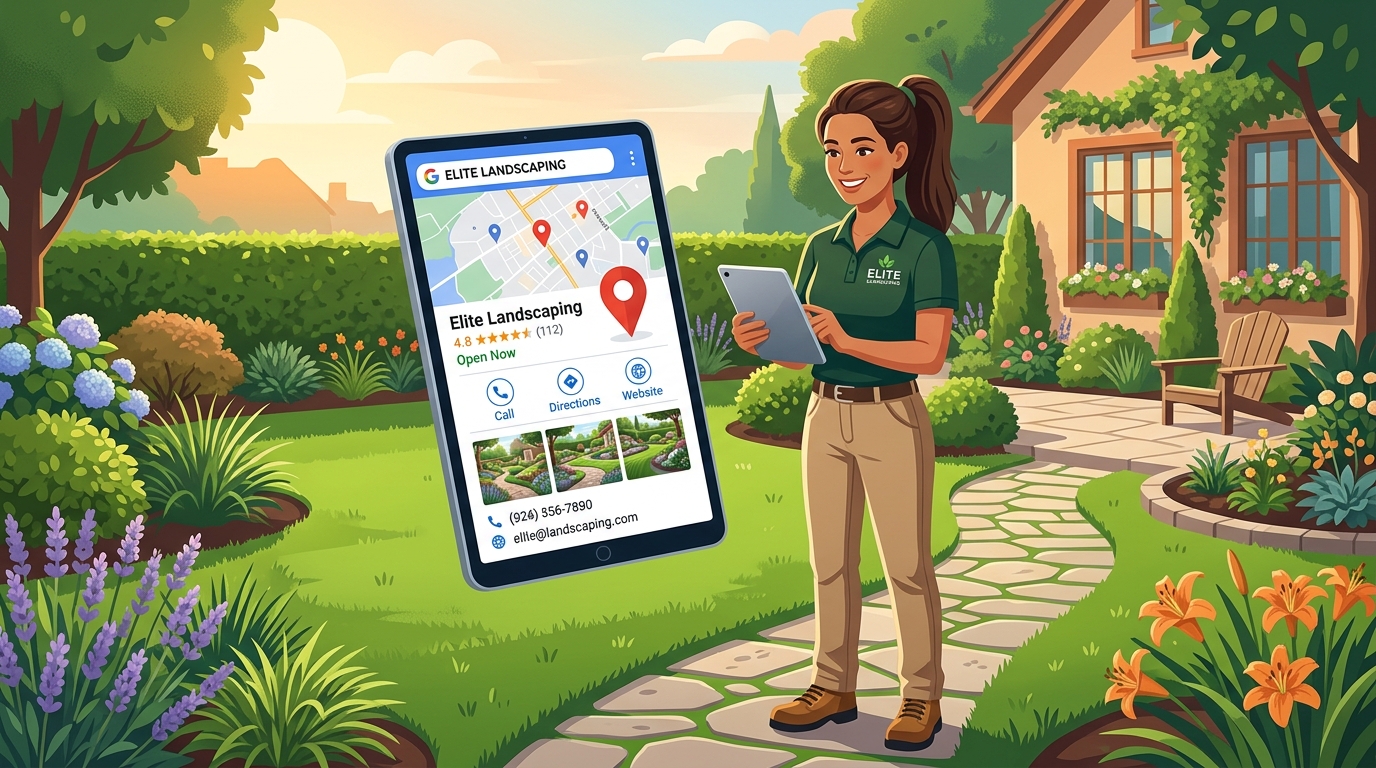
When a homeowner searches “landscaper near me,” they expect accurate results. If your phone number is wrong on Yelp, your address is outdated on Google, or your business name is slightly different on Facebook, you lose that lead before they ever pick up the phone. In a $188.8 billion industry with roughly 693,000 competing businesses (IBISWorld, 2025), the landscapers who keep their local listings clean and consistent are the ones who get the call.
Key Takeaways
- 63% of consumers will avoid a business with incorrect listing information (BrightLocal, 2023)
- Google Business Profile signals account for 32% of local pack ranking weight (Whitespark, 2025)
- NAP inconsistencies rank as the 3rd highest negative factor in local search rankings (Moz, 2023)
- 76% of people who search “near me” on mobile visit a business within 24 hours (Think with Google, 2022)
- Businesses in the Google Local 3-Pack receive 126% more traffic than those ranked 4-10 (SOCi, 2024)
Why Do Accurate Local Listings Matter for Landscaping Companies?
80% of U.S. consumers search online for local businesses every week, and 32% do so daily (SOCi, 2024). For landscaping companies, this means your local listings are often the first thing a potential client sees. One wrong phone number or outdated address can send that homeowner straight to your competitor down the road.
Local listings function as your digital storefront. When someone types “landscaper near me” into Google, the search engine pulls data from your Google Business Profile, Yelp, Facebook, and other directories to decide whether you show up. If those directories disagree about your address or phone number, Google loses confidence in your business data and may rank you lower or leave you out of results entirely.
The stakes are real. Businesses that land in the Google Local 3-Pack receive 126% more traffic and 93% more actions like calls, website clicks, and direction requests compared to businesses ranked 4 through 10 (SOCi, 2024). With 46% of all Google searches carrying local intent (Google, 2018), the opportunity for local SEO is massive.
What Is NAP Consistency and Why Does It Affect Your Rankings?
NAP inconsistencies are the 3rd highest negative factor affecting local search rankings according to Moz’s Local Search Ranking Factors (2023). NAP stands for Name, Address, and Phone number, and these three details must be identical everywhere your business appears online. Even small differences like “St.” versus “Street” or “Landscaping LLC” versus “Landscaping” can confuse search engines.
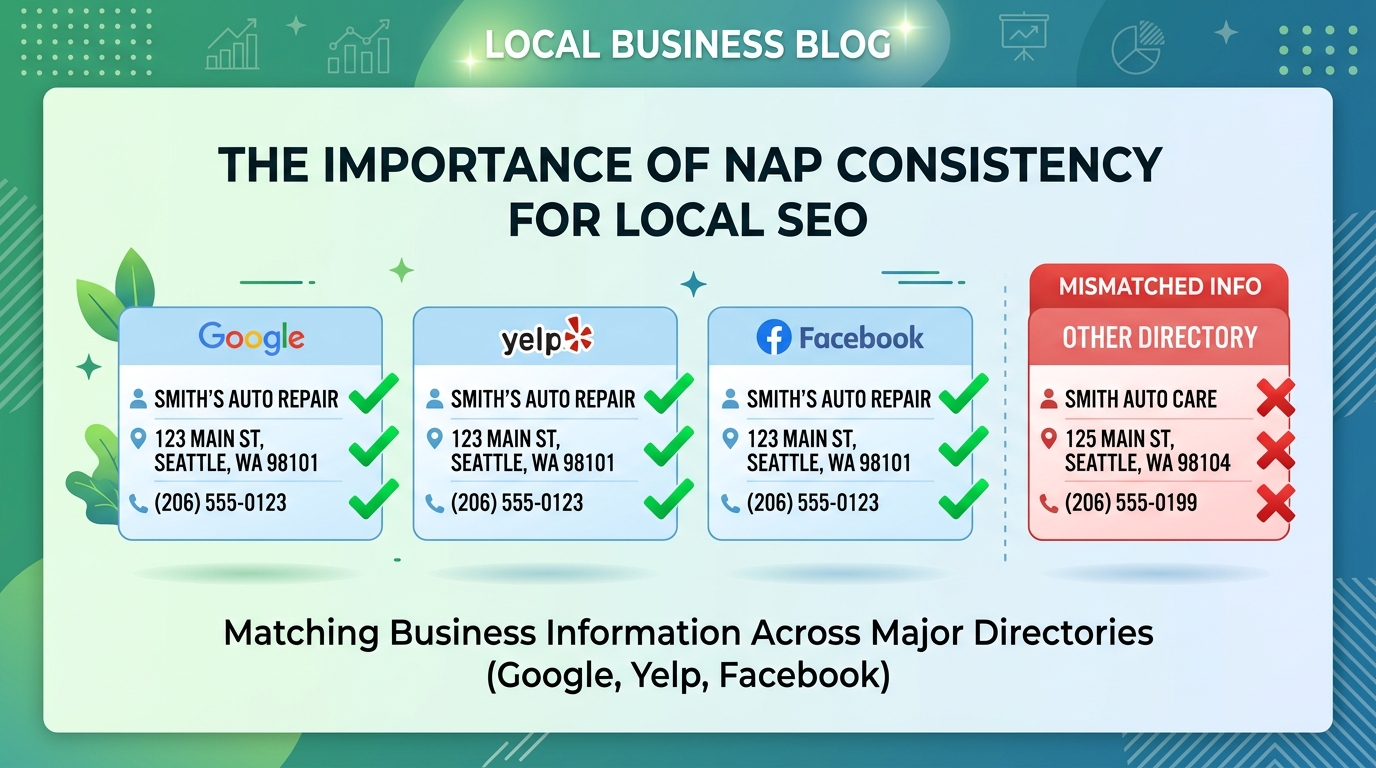
Citation signals, which include NAP consistency across directories, account for approximately 7% of local pack ranking factors, while Google Business Profile signals make up roughly 32% (Whitespark Local Search Ranking Factors, 2025). That means your business name, address, and phone number need to match perfectly across every platform.
Here is what consistent NAP looks like in practice:
- Pick one official format: Decide whether you use “St.” or “Street,” “Suite 100” or “Ste. 100,” and stick with it everywhere
- Use your registered business name: Do not add extra keywords like “Best Landscaping Atlanta” to your business name on directories
- Keep one primary phone number: Use the same local number across all platforms rather than switching between a cell, office, and tracking number
- Create a master reference document: Store your official NAP in one place so anyone updating listings uses the exact same format
63% of consumers say incorrect information on a business listing would stop them from choosing that business (BrightLocal, 2023). That is not just a search ranking problem. It is a trust problem that costs you real jobs.
Which Local Directories Should Landscapers Prioritize?
A complete Google Business Profile is 7x more likely to receive clicks than an incomplete one (BrightLocal, 2024). Start there and then expand to the directories where your target clients actually search. Not every platform deserves equal attention, so focus on the ones that drive real leads for home service businesses.
Tier 1 directories (claim and optimize first):
- Google Business Profile: Your most important listing. Drives the majority of local search visibility and map pack appearances
- Yelp: High domain authority and frequently surfaces in search results for service businesses
- Facebook: Many homeowners check business pages for photos, reviews, and contact info before calling
- Apple Maps: Critical for iPhone users asking Siri for local recommendations
Tier 2 directories (expand after Tier 1 is solid):
- Angi (formerly Angie’s List): Popular with homeowners hiring for larger landscaping projects
- Houzz: Strong for landscape design and hardscaping work with a visual portfolio format
- BBB (Better Business Bureau): Signals credibility to cautious buyers and older demographics
- Nextdoor: Hyperlocal platform where neighbors recommend service providers to each other
To claim a listing, search for your business on each platform. If a listing already exists, claim ownership through their verification process, which usually involves a phone call, email, or postcard with a PIN. If no listing exists, create one from scratch using your master NAP document. Either way, verification gives you control over what potential clients see.
How Do You Audit and Fix NAP Inconsistencies?
Brands with optimized local profiles are 138% more likely to achieve top rankings, higher star ratings, and greater engagement rates (SOCi, 2024). Regular audits catch the mismatches that drag your rankings down. Set a quarterly calendar reminder to check every listing, because directories, users, and automated systems can change your information without warning.
A practical NAP audit process:
- Step 1: Search yourself. Google your business name, phone number, and address separately. Note every directory that appears and whether each detail matches your master NAP
- Step 2: Check major aggregators. Data aggregators like Neustar Localeze, Foursquare, and Data.com feed information to hundreds of smaller directories. Fix errors at the aggregator level to prevent them from spreading
- Step 3: Document every listing. Create a spreadsheet with columns for platform name, URL, business name shown, address shown, phone number shown, and status (correct, needs fix, or unclaimed)
- Step 4: Fix and verify. Log into each platform, update incorrect information, and save screenshots as proof of the change. Some platforms take 1-2 weeks to reflect updates
- Step 5: Monitor for unauthorized changes. Google and Yelp allow users to suggest edits to your listing. Check monthly that no one has changed your hours, address, or phone number
If managing this feels overwhelming, a landscaping marketing partner can handle ongoing listing management so you can focus on the work that keeps your crews busy.
What Role Do Customer Reviews Play in Local Listing Success?
75% of consumers always or regularly read online reviews when searching for local businesses, and 81% of them use Google as their primary review platform (BrightLocal, 2024). For landscaping companies, reviews are not just reputation signals. They directly influence whether Google shows your listing in the local pack and whether homeowners trust you enough to call.
The numbers tell a clear story. 57% of consumers will only hire a business with 4 or more stars, and businesses with a 4+ star average generate 32% more revenue than those with lower ratings (BrightLocal, 2024). Meanwhile, 89% of consumers expect business owners to respond to both positive and negative reviews (BrightLocal, 2025).
Here is how to build a strong review strategy:
- Ask at the right moment: Request a review right after completing a project when the client is happiest with the results
- Make it easy: Send a direct link to your Google review page via text or email. The fewer clicks required, the more reviews you will get
- Respond to every review: Thank positive reviewers by name and address negative ones professionally. Offer to resolve issues offline
- Never buy or fake reviews: Google actively detects fake reviews and will suspend your listing if it finds them
86% of consumers read reviews before hiring a home service provider, and that number jumps to 95% for consumers ages 18 to 34 (Invoca, 2025). Your reviews are not optional anymore. They are part of your listing, and they affect whether you show up at all.
How Can Landscapers Enhance Their Listings to Stand Out?
Businesses with 100+ photos on their Google Business Profile receive 520% more calls, 2,717% more direction requests, and 1,065% more website clicks than the average listing (BrightLocal, 2023). Complete, media-rich listings do not just rank better. They convert better because homeowners can see your work before they ever contact you.
Beyond basic NAP, here is what separates a good listing from a great one:
- Add high-quality photos: Upload before-and-after shots of your best projects. Include photos of your crew at work, your equipment, and finished results from different angles
- List every service you offer: Break out specifics like lawn maintenance, irrigation repair, patio installation, tree trimming, and seasonal cleanups. Google uses these service categories to match you with relevant searches
- Keep hours updated seasonally: Landscaping schedules change with the seasons. Update your hours on Google, Yelp, and Facebook when your availability shifts
- Use Google Business Profile posts: Share seasonal promotions, project highlights, or tips for homeowners. Active profiles signal to Google that your business is engaged and current
- Add local keywords to your description: Mention the neighborhoods, cities, and counties you serve. “Serving residential and commercial clients in Gwinnett County and North Atlanta” is specific and search-friendly
The average Google Business Profile drives approximately 59 actions per month, split between website visits (48%), direction requests (34%), and phone calls (17%) (BrightLocal, 2024). Every enhancement you make to your listing increases the chance that those actions happen with your business instead of a competitor.
What Are the Most Common Local Listing Mistakes Landscapers Make?
“Open now near me” searches have grown 400% year-over-year (Think with Google, 2024), which means homeowners expect real-time accuracy from your listings. Small mistakes compound quickly when your business appears on dozens of platforms. Here are the most common errors that cost landscapers real leads and what to do about each one.
- Duplicate listings on the same platform: Google sometimes creates duplicate profiles when businesses move or change names. Search for your business and merge or delete any duplicates through the platform’s support process
- Outdated seasonal hours: Listing winter hours during summer, or showing “Open” when you are closed for holidays, frustrates customers and damages trust
- Ignoring niche directories: Platforms like Houzz, Angi, and Nextdoor attract high-intent homeowners specifically looking for landscapers. Skipping them means missing qualified leads
- Keyword-stuffing your business name: Adding phrases like “Best Affordable Landscaping” to your Google Business Profile name violates Google’s guidelines and can result in listing suspension
- Leaving reviews unanswered: With 89% of consumers expecting responses (BrightLocal, 2025), silence sends the wrong message
- Using tracking numbers as your primary number: Call tracking is valuable for marketing analytics, but your primary listing number should be consistent. Use tracking numbers in ads, not as your listed NAP phone number
Multi-location brands collectively miss out on an estimated $54.1 billion in revenue across the U.S. by not maximizing their local marketing strategy (SOCi, 2024). Even single-location landscapers leave money on the table when their listings contain preventable errors.
Ready to Turn Your Local Listings Into a Lead Machine?
Your local listings are working for you 24 hours a day, seven days a week, whether you realize it or not. The question is whether they are sending the right message. Start with a NAP audit this week. Search your business name on Google, Yelp, Facebook, and Apple Maps. Write down every inconsistency. Fix the biggest platforms first, then work your way through the rest.
76% of people who do a local search on their phone visit a business within 24 hours (Think with Google, 2022). That is real foot traffic driven by accurate listings. If you need help managing your local SEO strategy and keeping your business information consistent across every platform, reach out to the Sideways8 team for a free consultation.
Frequently Asked Questions
NAP stands for Name, Address, and Phone number. These are the three core business details that must be identical across every online directory, social media profile, and website where your landscaping business appears. Search engines cross-reference NAP data across platforms to verify your business is legitimate, and inconsistencies can lower your local search rankings.
Audit your local listings at least once per quarter. Seasonal changes in landscaping, like shifting service hours or adding winter services, make quarterly checks practical. You should also audit immediately after any business change such as a new phone number, address move, or name update. Set a recurring calendar reminder so it does not slip through the cracks.
Google Business Profile signals account for roughly 32% of local pack ranking weight (Whitespark, 2025), making it the single largest factor in whether you appear in the map results. A complete profile is 7x more likely to receive clicks than an incomplete one. It also feeds Google Maps, Google Search, and Google’s AI results, giving it unmatched reach.
Start by correcting your information at the data aggregator level through services like Neustar Localeze and Foursquare. These aggregators feed data to hundreds of smaller directories, so fixing the source prevents errors from spreading. Then manually update your Tier 1 platforms: Google Business Profile, Yelp, Facebook, and Apple Maps. This two-step approach covers the most ground in the least time.
Yes. Review signals are a confirmed local ranking factor. 57% of consumers will only hire a business with 4 or more stars (BrightLocal, 2024), and businesses with higher ratings generate 32% more revenue. Google considers review quantity, quality, recency, and whether the business responds. Active review management improves both your rankings and your conversion rate.
