


- 46% of Google searches have local intent, and “near me” mobile searches have grown 500%+ in recent years (HubSpot, Think with Google).
- The #1 spot in Google’s Local Pack pulls a 17.5% click-through rate, while #3 gets just 7.5% (BrightLocal).
- Google Business Profiles with photos generate 520% more calls and 2,717% more direction requests (BrightLocal).
- SEO leads close at 14.6% versus 1.7% for outbound like cold calls and direct mail (Search Engine Journal).
- 73% of consumers only consider local businesses with 4+ star ratings, and 87% read reviews before hiring (BrightLocal).
If you own a landscaping company, you already know the phone rings differently in April than it does in November. What you may not know is how much of that seasonal rhythm now runs through Google. The U.S. landscaping industry hit roughly $188 billion in 2025 according to IBISWorld, and the companies taking the biggest bites aren’t always the ones with the nicest trucks. They’re the ones showing up first when a homeowner types “paver patio installer near me” at 7pm on a Tuesday.
This is a plain-spoken guide to search engine optimization for landscapers. No jargon, no fluff, no promises about hacking the algorithm. Just the pillars that actually move the needle.
Why Should a Landscaping Company Care About SEO in the First Place?
Because 46% of every Google search has local intent, according to HubSpot’s roundup of local SEO data. That’s nearly half of all searches. When somebody wants sod laid, a retaining wall built, or weekly mowing, they’re not flipping through the Yellow Pages. They’re pulling out a phone and typing.
And here’s the kicker: Think with Google reports that 76% of people who search for something nearby visit a business within 24 hours, and 28% of those searches result in a purchase. That’s not awareness. That’s a ready buyer with a credit card and a muddy backyard.
Compare that to cold calls or mailers. SEO leads close at 14.6%, while outbound leads close at 1.7%. If you’re spending money chasing homeowners instead of letting them find you, the math just isn’t there anymore. A solid search presence is the closest thing our industry has to a printing press.
What Keywords Actually Bring in Landscaping Customers?
The ones with the word “near me” attached, and the long, specific ones. Ahrefs analyzed 1.9 billion keywords and found 94.74% of them get 10 or fewer searches per month. That sounds bad. It’s not. Those long-tail phrases are where real customers live.
“Landscaper” is a vanity keyword. Nobody in Tulsa types that. They type “paver patio contractor Tulsa” or “how much does a retaining wall cost in Dallas.” Specific. Intent-loaded. Ready to hire. If you want a deeper breakdown on why these phrases convert so well, read our take on what a long-tail keyword is and why it matters.
Build your keyword list around three buckets: services (irrigation repair, spring cleanup, sod installation), geography (city, neighborhood, county), and problems (drainage issues, brown lawn, tree roots in sewer line). Map one keyword to one page. Don’t cram 15 services onto your homepage and hope Google sorts it out.
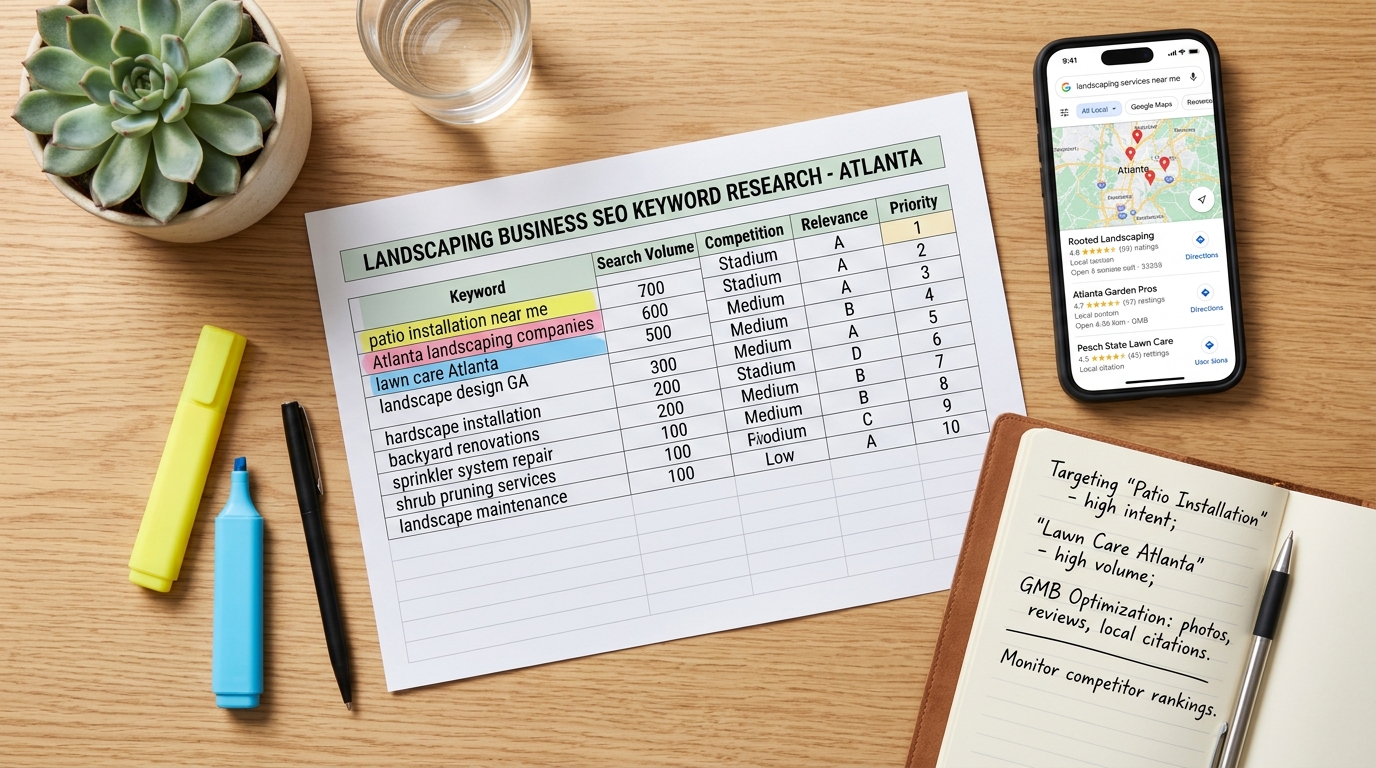
Free tools like Google Keyword Planner and Google’s own autocomplete will get you started. Paid tools like Ahrefs or Semrush show you what your competitors rank for. Either way, write the list down. Track it. This is the foundation everything else sits on, and it’s the core of any serious SEO engagement worth paying for.
How Do I Win the Local Pack and Google Business Profile Game?
You claim, verify, and load up your Google Business Profile. According to Whitespark’s Local Search Ranking Factors survey, GBP signals account for roughly 32% of what decides who shows up in the Local Pack. It’s the single most leveraged asset you own in local search, and most landscapers leave it half-empty.
The top three map results grab the lion’s share of clicks. BrightLocal’s CTR study puts position one at 17.5%, position two at 11%, and position three at 7.5%. Everything below that fights for scraps.
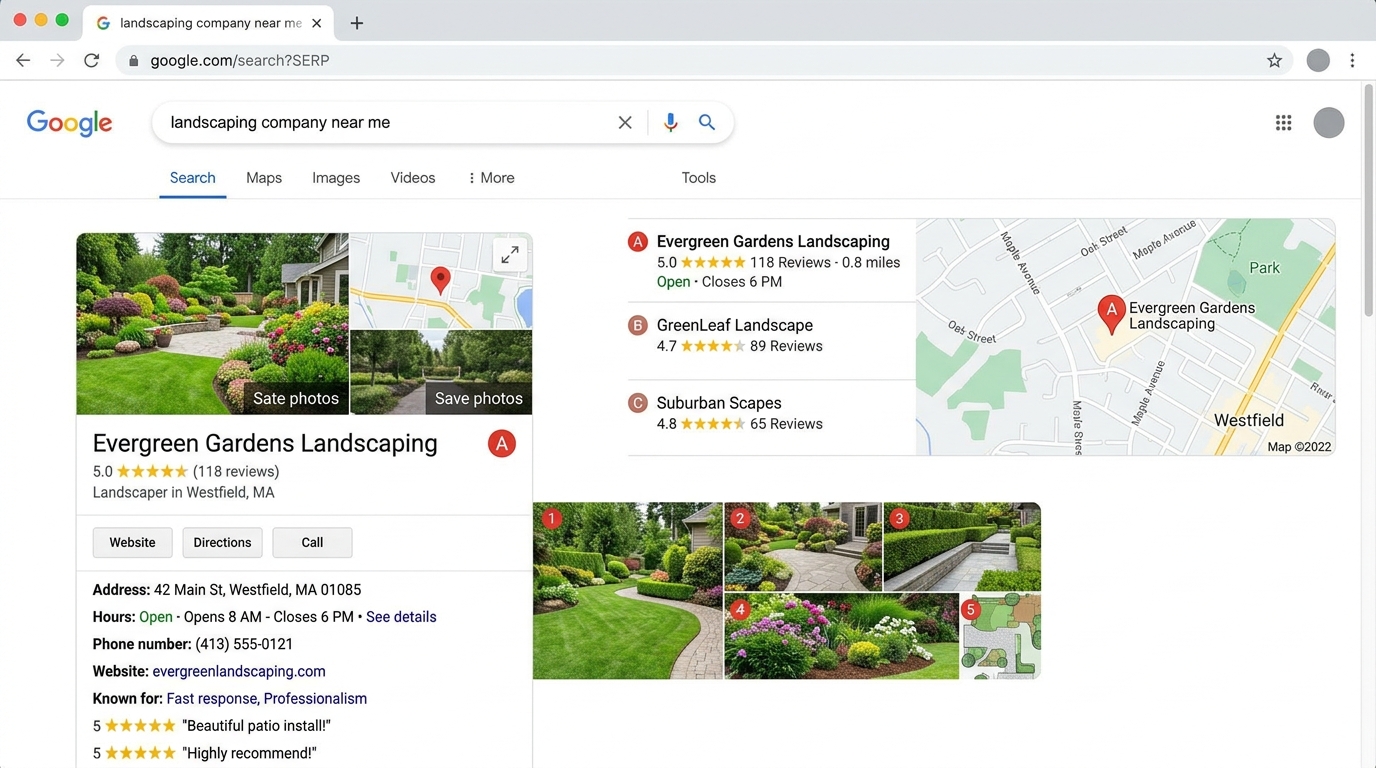
Fill out every field. Hours, service area, categories (primary: Landscaper; secondary: whatever fits, like Lawn Care Service or Snow Removal Service). Then add photos. A lot of them. Job site progress shots, finished patios, crew in uniform, before-and-afters. Profiles with photos generate 520% more calls and 2,717% more driving direction requests per BrightLocal. Those aren’t typos.
Post weekly. A fresh profile outranks a stale one. For a step-by-step on what to actually post, see our guide to mastering Google Business Profile posts for landscaping companies.
What Does an SEO-Ready Landscaping Website Actually Look Like?
Fast, mobile-first, and honest. Think with Google found 53% of mobile visitors bounce if a page takes longer than three seconds to load, and BrightLocal shows 57% of local searches now happen on a phone. If your site wheezes on 4G, you’re losing jobs before the homeowner ever sees a photo of your work.
Google’s Core Web Vitals are the measurable bar. Per web.dev, aim for LCP under 2.5 seconds, INP under 200 milliseconds, and CLS below 0.1. Run your site through PageSpeed Insights. Fix what’s red. Compress images, cache aggressively, and stop running seven tracking scripts you don’t read.
Every service needs its own page. Paver patios, retaining walls, irrigation install and repair, sod, mulch, spring cleanup, fall cleanup, snow removal, hardscape lighting. Each page should answer four questions: what it is, what it costs (give a range), what’s included, and how to book. Add schema markup. Search Engine Land notes that proper schema can lift click-through rates by around 30%.
If the site you’re working with was built before smartphones had face ID, it’s time. A proper rebuild through thoughtful website design services pays for itself within a season.
How Do Reviews and Reputation Tip the Scale?
They do more than tip it. They own it. BrightLocal’s annual survey shows 87% of consumers read online reviews for local businesses, and 73% only consider businesses with 4+ star ratings. A sub-4.0 average is a silent bleed. You’re not losing jobs because your pricing is off. You’re losing them before anyone calls.
Ask every happy customer. Every one. The irrigation tech who finished a repair, the foreman who wrapped a patio install, the designer who delivered a planting plan. Text them a direct review link before you leave the driveway.
Respond to everything. Five-star reviews get a short thank-you. Negative ones get a calm, factual reply. Never argue. Future customers are reading how you handle a bad day, and that reply is a sales pitch to every homeowner scrolling behind them. We dig into this in turning client voices into growth for landscaping businesses.
Consistency across citations matters too. Whitespark puts NAP and citation signals at 7 to 19% of local ranking weight. Same business name, same address, same phone number on Yelp, Angi, HomeAdvisor, BBB, and the Chamber site. No abbreviations on one and spelled-out on another.
What About Content, Backlinks, and the Stuff That Takes Longer?
This is the part most landscapers skip, and it’s why competitors with half the skill rank higher. Backlinko studied 11.8 million Google results and found the #1 ranking page has 3.8 times more backlinks than positions two through ten. Links from other real websites still tell Google you’re legitimate.
Get links the old-fashioned way. Join the local chamber. Sponsor a Little League team. Write a guest post for the regional home builder association. Get the hardscape supplier to list you as a recommended installer. None of this is quick. Ahrefs found only 5.7% of newly published pages crack the top 10 within a year. SEO is a reputation, not a campaign.
Publish honest content too. A page titled “How much does a paver patio cost in Cincinnati?” with real numbers (say, $18 to $35 per square foot installed) will outperform a thousand-word ode to your craftsmanship. Google rewards specifics. So do homeowners. Ahrefs data shows featured snippets capture about 35.1% of clicks on queries where they appear, and those snippets almost always come from pages that answer one clear question.
How Do I Track Whether Any of This Is Working?
You measure leads, not rankings. Rankings are a vanity metric. Phone calls, contact form submissions, and booked estimates are the scoreboard. Set up Google Analytics 4, Google Search Console, and call tracking on every service page. If you can’t tie a dollar to a source, you’re flying blind.
Watch a few numbers monthly. Organic traffic from Search Console. Local Pack impressions and calls from your GBP insights. Form fills by landing page. And close rate by source, because a lead that never closes isn’t a lead. First Page Sage reports position one in organic gets a 39.8% click-through rate, dropping to 18.7% at position two and 10.2% at position three. Tracking tells you whether you’re climbing or sliding.
One more thing worth watching: AI Overviews. Semrush found AI Overviews now appear on about 13.14% of Google queries, and that number climbs quarterly. Pages that answer a clear question in 40 to 60 words have a real shot at getting pulled in. If tracking feels like a foreign language, our tracking and analytics services will set the whole thing up for you.
What’s a Realistic Timeline and Budget for a Landscaping Company?
Expect six months before you see real movement, twelve before the pipeline feels different. That’s the industry reality. Jobber’s economic report showed median landscaping revenue rose about 7% year-over-year in 2024, and the winners in that stat are almost always the companies that started SEO work 18 months earlier.
Budget ranges widely. A solo operator doing everything themselves can get by with $0 cash and 5 hours a week. A small firm hiring an agency usually spends $1,500 to $4,000 monthly on a combined local SEO, content, and citation-building program. Anyone charging $300 a month is selling you a phone line, not a strategy. For a deeper look at what works specifically in this trade, read our guide to local SEO for landscape contractors.
Ready to Stop Guessing and Start Ranking?
SEO for a landscaping company isn’t magic and it isn’t mysterious. It’s six pillars done consistently: keyword research, a claimed and loaded GBP, a fast site, real reviews, earned backlinks, and honest tracking. Do them for a year and your phone rings on its own. Skip them and you’ll keep paying for leads that don’t close.
If you’d rather spend your Saturdays at job sites than staring at keyword spreadsheets, that’s what we do. Our team focuses on landscape marketing for companies who want a pipeline, not a pitch deck. Get in touch with Sideways8 and we’ll tell you straight what’s worth fixing first.
How long does SEO take to work for a landscaping company?
Plan on six months for visible movement and twelve for a steady lead flow. Ahrefs found only 5.7% of pages reach the top 10 within a year, so patience is part of the deal. That said, Google Business Profile optimization and review-building often produce calls within 60 to 90 days. The long game is content, backlinks, and authority, which compound over a full season or two. Anyone promising top rankings in 30 days is selling hope, not strategy.
Do I really need a Google Business Profile if I already have a website?
Yes. Whitespark’s research puts GBP signals at roughly 32% of what decides Local Pack rankings, which is the map box most homeowners click first. A website alone won’t get you into that box. BrightLocal data shows profiles with photos generate 520% more calls. If you do one thing this week, claim your profile, add 20 job photos, and post your service list. It costs nothing and outperforms most paid ads for local searches.
What keywords should a landscaping company target?
Specific, local, service-plus-geography phrases. Think paver patio installer Austin or irrigation repair near Cary NC rather than just landscaper. Ahrefs found 94.74% of all keywords get 10 or fewer monthly searches, and those long-tail phrases are where ready-to-hire homeowners search. Build a list across three buckets: services, locations, and problems. Assign one keyword per page and build the content to match.
How many reviews do I need to rank well?
Enough to stay above a 4.0 star average and more than your top local competitor. BrightLocal found 73% of consumers only consider businesses rated 4 stars or higher, and 87% read reviews before hiring. Quantity matters, but recency matters more, so ask for a handful each month rather than chasing a big batch once a year. Text a direct review link to every satisfied customer before you leave the driveway, and reply to every review, good or bad.
Can I do SEO myself or should I hire an agency?
You can absolutely handle the basics yourself: claiming your Google Business Profile, asking for reviews, writing honest service pages, and keeping your NAP consistent across directories. Most solo operators can do this in five hours a week. Where agencies earn their fee is technical SEO, link-building, content strategy, and tracking. Search Engine Journal data shows SEO leads close at 14.6% versus 1.7% for outbound, so if DIY time is costing you billable hours in the field, outsourcing usually pays for itself.
Tell us your business and a search you want to win. We'll send back where you show up across your service area within one business day.
The Google Business Profile checklist
- Google Business Profile fixed in the first weeks
- Service and town pages built every month
- Every call tracked to the search that produced it
Full systems start at $2,500 a month, priced after a 30-minute call. No long-term contracts.
Book a call
Founder of Sideways8. Mihai designs and builds the websites and runs the marketing behind them for landscape, hardscape and pool companies.
Meet the team

