

Key Takeaways
- According to Backlinko (2024), the #1 Google result earns a 27.6% click-through rate, about 10x the rate of position #10, making top rankings the single biggest lever for landscaping leads.
- According to Think with Google data cited by Backlinko (2024), 46% of all Google searches have local intent and “near me” searches have grown more than 500% in three years.
- According to Whitespark‘s Local Search Ranking Factors (2026), reviews now account for 16-20% of local pack rankings, and review velocity is one of the fastest-rising signals.
- According to Similarweb (2025), zero-click Google searches jumped from 56% to 69% after AI Overviews launched, forcing landscapers to win Google Business Profile visibility and AI citations.
- According to HubSpot, SEO leads close at 14.6%, compared to 1.7% for outbound, meaning organic search is the highest-quality lead source a landscaping company can build.
SEO success for a landscaping company is not about chasing vanity rankings. It is about turning searches like “landscapers near me” and “patio installation [your city]” into booked estimates. According to IBISWorld (2024), U.S. landscaping services is a $178.5 billion industry with 692,777 active businesses, so the competition for every local search is fierce. The companies winning today are the ones treating search visibility as a core sales channel, not an afterthought.
Search behavior has also shifted under your feet. According to Similarweb data reported in 2025, zero-click searches on Google grew from 56% to 69% in the year after AI Overviews launched, while Authoritas found the top organic link’s CTR drops about 79% when an AI Overview appears. Traditional SEO playbooks still matter, but the winners are layering in Google Business Profile, reviews, and AI-citable content.
This guide walks through the exact strategies landscaping companies are using in 2026 to rank higher, generate steady leads, and measure real ROI. Every tactic is backed by data from BrightLocal, Whitespark, Backlinko, Ahrefs, LocaliQ, and other tier-one sources, with links so you can dig deeper into the research that matters most for your market.
What Does SEO Success Actually Look Like for a Landscaping Company?
SEO success for a landscaping company means ranking in the Google local pack for high-intent service-plus-city queries, generating 30 to 150 qualified leads per month from organic and Google Business Profile combined, and lowering your cost per lead below paid channels within 6 to 12 months.
Track four concrete metrics: local pack appearances for your top ten service-plus-city queries, GBP calls and direction requests per month, organic leads from form fills and tracked phone numbers, and the ranking positions for each service page. According to BrightLocal’s Google My Business Insights Study, the average profile appears in 1,009 searches per month, so a healthy landscaping profile should comfortably exceed that benchmark. According to First Page Sage (2024), SEO for local service businesses like HVAC converts at roughly 3.3%, a useful floor for your own benchmarks.
Why Is Local SEO the Foundation of Landscaping Success?
Local SEO is the foundation because homeowners almost never search for a national brand of landscaper. They search for a pro who serves their street. According to Backlinko (2024), 46% of all Google searches have local intent, and according to Hook Agency’s compiled data, more than 70% of mobile searches are tied to local content. A landscaping company that shows up in the local pack for “landscaping company [city]” wins a disproportionate share of calls before organic listings even load.
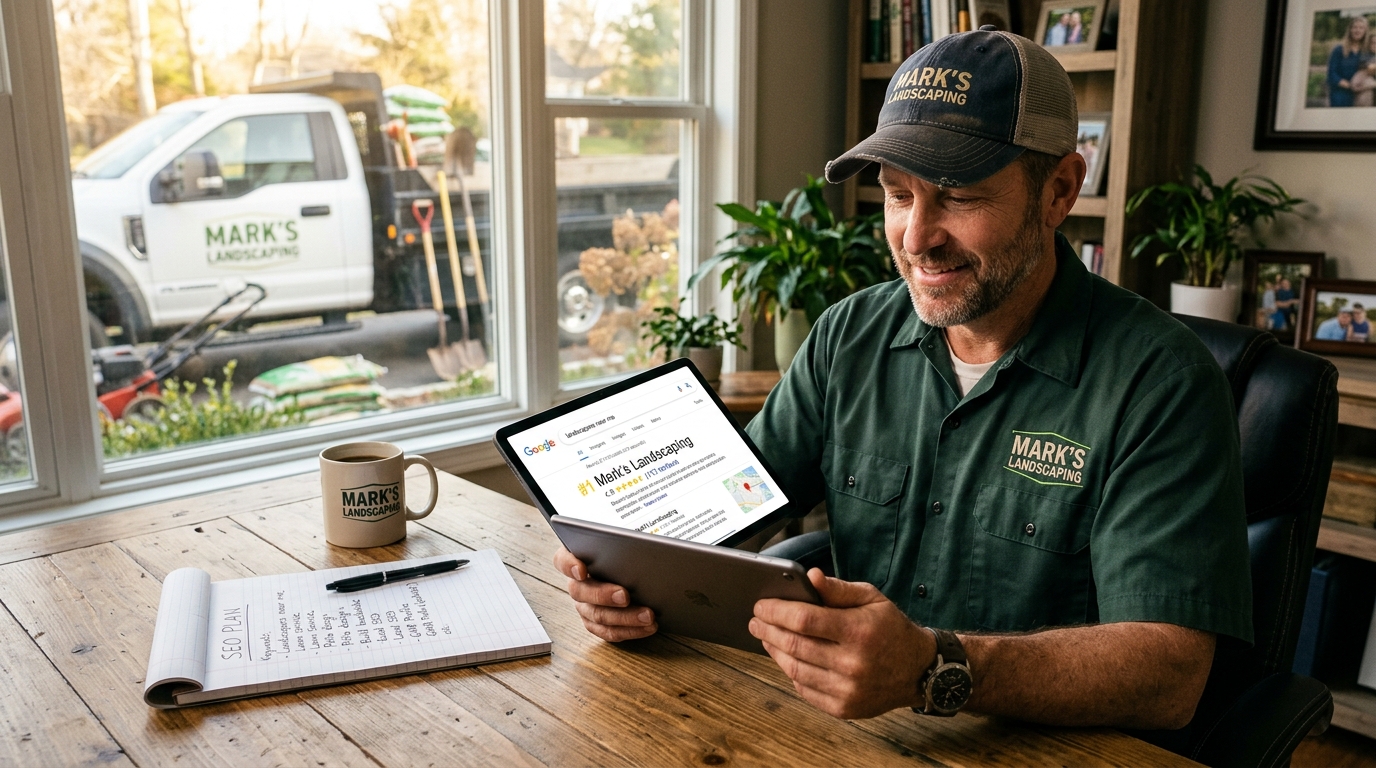
The “near me” signal is the other half of the story. According to Google data compiled by Cube Creative (2024), “near me” searches have grown more than 500% in three years, and 76% of near-me searches result in a business visit within a day. According to Sagapixel’s aggregation of Google Local Pack research (2024), the three-pack captures roughly 44% of clicks on local-intent queries, far more than organic or paid below. If your landscaping business is not in that pack, you are fighting over the scraps.
For a deeper walkthrough of the fundamentals, our practical guide to landscaping SEO breaks down how to structure your foundation before you invest in content or paid traffic.
How Does a Google Business Profile Drive Real Leads for Landscapers?
According to Whitespark’s Local Search Ranking Factors (2026) synthesized from 47 local SEO experts, your Google Business Profile is the single biggest driver of visibility in the local pack. Proximity accounts for roughly 55% of ranking decisions, but the remaining 45% is controllable, and that is where smart landscapers pull ahead. A fully optimized profile can outrank closer but less-optimized competitors on many queries.
Claim, Verify, and Lock Down NAP
Start by claiming and verifying your profile, then match your name, address, and phone number across every citation on the web. Our guide on local listings and NAP accuracy walks through how duplicate or inconsistent entries sabotage rankings. According to BrightLocal, NAP consistency remains a foundational citation signal in 2024.
Pick Primary and Secondary Categories
Your primary category should be the most specific match, usually “Landscaper” or “Lawn Care Service.” Add secondary categories for every service you actually perform, such as “Landscape Designer,” “Garden Center,” or “Snow Removal Service.” Whitespark’s research consistently ranks primary category among the top three GBP ranking signals.
Photos, Posts, and Q&A
Upload 20 or more real job photos with geotagged filenames, publish a weekly Google Post, and proactively answer common questions in the Q&A section. Our deep-dive on Google Business Profile posts for landscapers shows exact post templates that drive engagement. According to BrightLocal, 19% of businesses receive more than 100 direction requests monthly, and photo-rich profiles skew toward the top end.
Review Generation Engine
Reviews deserve their own system. Send a review link within two hours of finishing every job, respond to every review inside 48 hours, and aim for at least two new Google reviews per week. Whitespark’s 2026 report notes that review velocity and response rate are among the fastest-rising signals in local rankings.
What On-Page SEO Strategies Help Landscaping Websites Rank?
On-page SEO is where most landscaping websites leak rankings. Thin service pages, missing service-area pages, slow load times, and duplicate meta tags all cap your ceiling. Fixing these basics often produces ranking jumps within 30 to 60 days.
Dedicated Service Pages
Build one page for each service you sell: lawn care, landscape design, hardscaping, irrigation, tree trimming, mulching, snow removal. Each page should run 800 to 1,500 words and cover materials, process, timeline, pricing ranges, and warranty. According to Backlinko’s analysis of 11.8 million search results, the average first-page result is 1,447 words, and depth of coverage correlates with higher rankings.
City and Service-Area Pages
Create one page per primary city or neighborhood you serve, with unique content covering local soil, climate, HOA rules, and real project examples. Avoid copy-paste doorway pages, which Google penalizes. A service-area approach is essential for landscapers because, according to BrightLocal, service-area businesses receive fewer Maps views than location-based businesses and must compensate with strong on-page local signals.
Titles, H1s, and Internal Linking
Use one H1 per page including the primary keyword and location. Backlinko’s research found titles between 40-60 characters earn the highest organic CTR. Internally link every service page to relevant city pages and supporting blog posts so authority flows through your site. Our SEO services team maps these link structures as part of every campaign we run.
Schema, Speed, and Core Web Vitals
Add LocalBusiness and Service schema to every page, compress images, and target a Largest Contentful Paint under 2.5 seconds. A fast, well-marked-up site is easier for Google to classify and for AI Overviews to cite. Pair this with our website design services for a technical baseline that supports every other SEO investment.
How Do Reviews and Reputation Affect Landscaping SEO Rankings?
Reviews drive both rankings and conversion. According to Whitespark (2026), reviews account for 16-20% of local pack ranking weight and that share is climbing year over year. According to BrightLocal’s Local Consumer Review Survey (2024), 81% of consumers use Google to read business reviews, making it the most-used review platform. Landscaping companies that neglect Google reviews are simultaneously losing rankings and conversions.
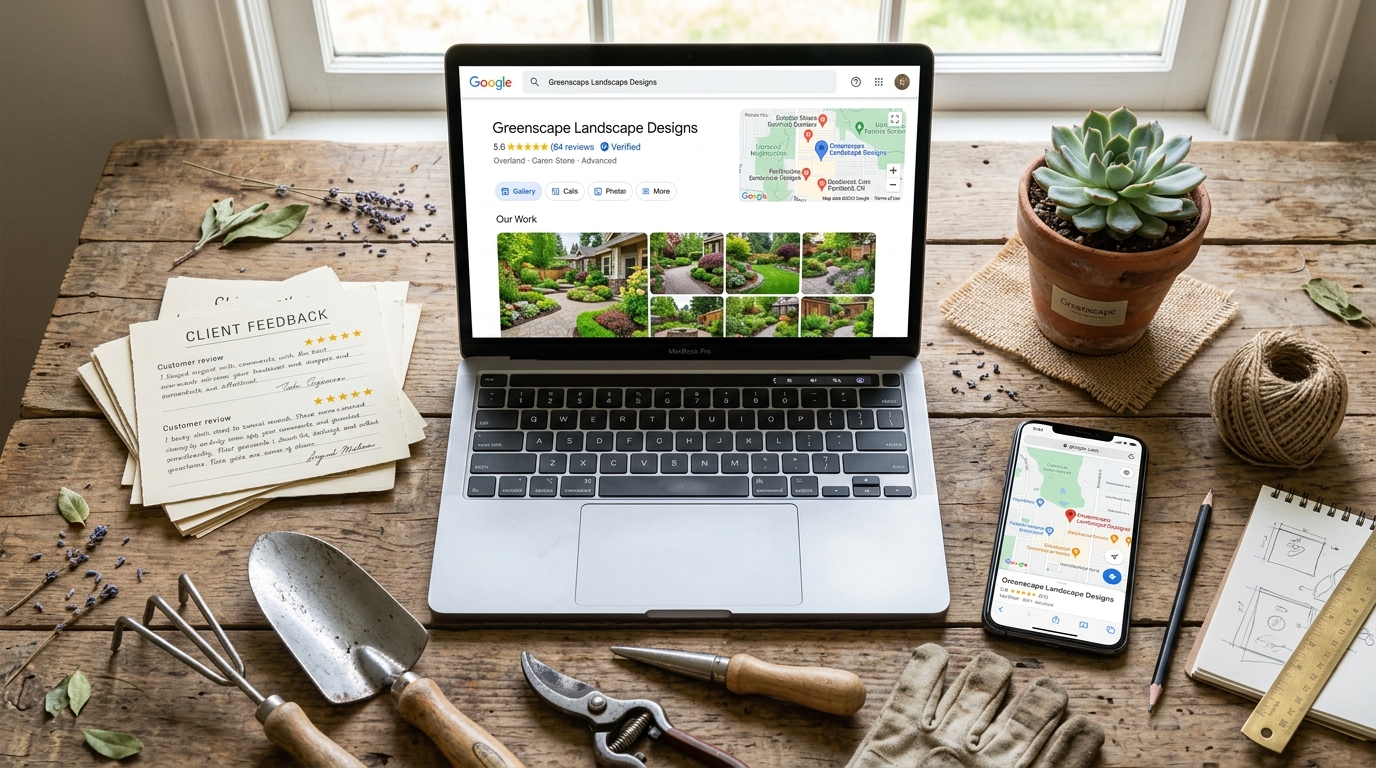
Quantity now beats raw star rating. According to ACHR News reporting on a 2024 industry survey, 91% of homeowners find reviews important when selecting a home service contractor, and 68% say they would choose a company with more reviews and a slightly lower star rating over one with fewer reviews and a perfect rating. That insight changes the math: a landscaper with 180 reviews at 4.6 stars often outperforms a competitor with 40 reviews at 5.0.
Response rate is the other signal Whitespark highlighted in 2026. Respond to every review within 48 hours, thank positive reviewers by name, and address negative reviews with a calm, specific path to resolution. According to BrightLocal (2024), consumers increasingly read responses as proof of how a business handles problems, so your replies are public sales copy.
What Role Does Content Marketing Play in Landscaping SEO?
Content marketing is how you earn rankings for the long tail of landscaping searches and feed AI Overviews with quotable answers. According to Ahrefs’ SEO statistics report (2024), long-form content generates 77.2% more backlinks than short content, which compounds into stronger domain authority over time. For landscapers, that means every seasonal guide or design idea post becomes a durable asset.
Focus on answer-first formatting. Open each article with a 40 to 60 word definitive answer to the headline question, then expand with detail. This structure matches how Google’s AI Overviews select quotable passages. According to Search Engine Land reporting on AI Overview behavior, concise factual answers near the top of a page are cited more often than long setup paragraphs.
Prioritize topics that match real buyer questions: “when to aerate lawn in [region],” “how much does a paver patio cost,” “best low-maintenance shrubs for [climate zone],” and “how to choose a landscape designer.” Publish one FAQ-schema-marked post per month, then refresh your top ten performers every six months. According to Semrush content audit research, updated articles often recover or surpass their original traffic within 30 days.
Our SEO best practices guide for landscapers maps out a full 12-month content calendar built around these principles.
How Is AI Search Changing SEO for Landscaping Companies?
AI search is rewriting the rules of organic visibility. According to Similarweb data reported by Stan Ventures (2025), zero-click searches grew from 56% to 69% in the year after Google launched AI Overviews in May 2024. That 13-point jump represents hundreds of millions of visits evaporating from the open web. For landscapers, this means ranking #1 is no longer enough if an AI Overview answers the query above your link.
According to Authoritas research cited across industry publications, when an AI Overview appears, the top organic link’s CTR drops roughly 79%. The counter-strategy is becoming citable. Structure content with clear question-and-answer blocks, add FAQ and HowTo schema, build topical authority around a tight set of landscaping themes, and secure mentions on authoritative sites so AI engines treat your brand as an entity worth citing.
Perplexity, ChatGPT Search, and Google AI Mode are all becoming discovery channels. According to Similarweb, ChatGPT referrals to news sites grew 25x year over year. While landscaping is a local game, the same citation mechanics apply: if AI models see your brand repeatedly in Google Business Profile data, structured reviews, and authoritative content, you become the name they surface. Our guide to getting chosen in AI search details the exact entity-building playbook.
How Do Landscapers Measure SEO Success and Real ROI?
SEO ROI for a landscaping company is calculated by multiplying organic-sourced leads by your close rate and average job value, then subtracting SEO cost. According to HubSpot, SEO leads close at 14.6% compared to 1.7% for outbound, so even a modest lead volume produces outsized revenue. According to First Page Sage (2024), well-executed technical SEO campaigns deliver around 117% ROI within six months, and thought-leadership content programs reach 748% ROI with a nine-month break-even.
Build a four-layer measurement stack. Layer one is GA4 with conversion events for form submits, phone clicks, and quote requests. Layer two is GBP Insights for calls, direction requests, and website clicks. Layer three is call tracking with dynamic numbers per channel so you know which pages trigger phone calls. Layer four is CRM attribution tying closed jobs back to the original source.
Compare SEO cost-per-lead against paid. According to LocaliQ’s 2025 home services benchmarks analyzing 3,211 campaigns, home services cost per lead rose 10.51% year over year, outpacing the 5.13% all-industry average. Once organic volume ramps, SEO typically lands at 30 to 60% of paid CPL, which is why our PPC services and SEO programs are designed to work in tandem, not in isolation. For deeper ROI instrumentation, see our SEO testing guide for landscapers.
What SEO Mistakes Keep Landscaping Companies Stuck?
Five mistakes account for most stalled landscaping SEO campaigns. First, thin service pages that list two sentences and a phone number. Google has no way to rank a page that does not explain the service, and according to Backlinko, comprehensive coverage consistently outperforms shallow pages.
Second, missing service-area pages. A landscaper serving 12 towns but publishing only one “Service Areas” page will lose every city-plus-service query to a competitor with dedicated pages. Third, ignoring reviews. According to Whitespark (2026), review velocity is one of the fastest-rising signals, and a company adding two reviews a month beats one that plateaued at 30 reviews five years ago.
Fourth, slow sites. According to Google’s Core Web Vitals documentation, a Largest Contentful Paint above 2.5 seconds hurts both rankings and conversion. Fifth, duplicate or inconsistent NAP across citations. BrightLocal has flagged NAP inconsistency as a top negative signal for years, and it still breaks local rankings in 2024. Our landscape marketing services audit every one of these gaps before we write a single line of new content.
Start Ranking Where Homeowners Search
Every month you wait, a competitor adds reviews, sharpens service pages, and claims the local pack real estate your business should own. The data is clear: homeowners are searching, AI is filtering, and the landscapers winning today are the ones who treat SEO as a core growth engine rather than a side project. Start with a Google Business Profile audit, then tighten your service and city pages around the queries that actually drive calls.
If you want a partner who builds landscaping SEO programs around real lead economics rather than vanity rankings, our team at Sideways8 can help. Explore our SEO services or dedicated landscape marketing programs to see how a data-driven plan can fill your calendar with the projects you actually want to run.
