

Key Takeaways
- The U.S. landscaping and grounds maintenance field employs roughly 1.5 million workers with 171,600 job openings projected each year through 2034, according to the U.S. Bureau of Labor Statistics.
- Nearly 80% of landscape companies struggle to fill open positions, and industry turnover runs near 45% annually, based on NALP industry data and NALP shortage reporting.
- Replacing a single employee costs 50% to 200% of their annual salary, per SHRM turnover research.
- Companies with a strong learning culture see 57% higher retention and 23% higher internal mobility, according to the LinkedIn 2025 Workplace Learning Report.
- Only 20% of employees worldwide are engaged at work, costing the global economy $10 trillion, reports Gallup’s State of the Global Workplace.
Running a landscaping company is about more than trucks and mowers; it is about building a crew that clicks as people, not just as workers. Yet nearly 80% of landscape businesses report difficulty filling open positions, according to NALP’s workforce analysis, and the Bureau of Labor Statistics projects 171,600 grounds maintenance openings every year through 2034. The owners who win the decade ahead will be the ones who hire with intention, train with a plan, and retain with real systems. This guide walks through every step, backed by hard numbers.
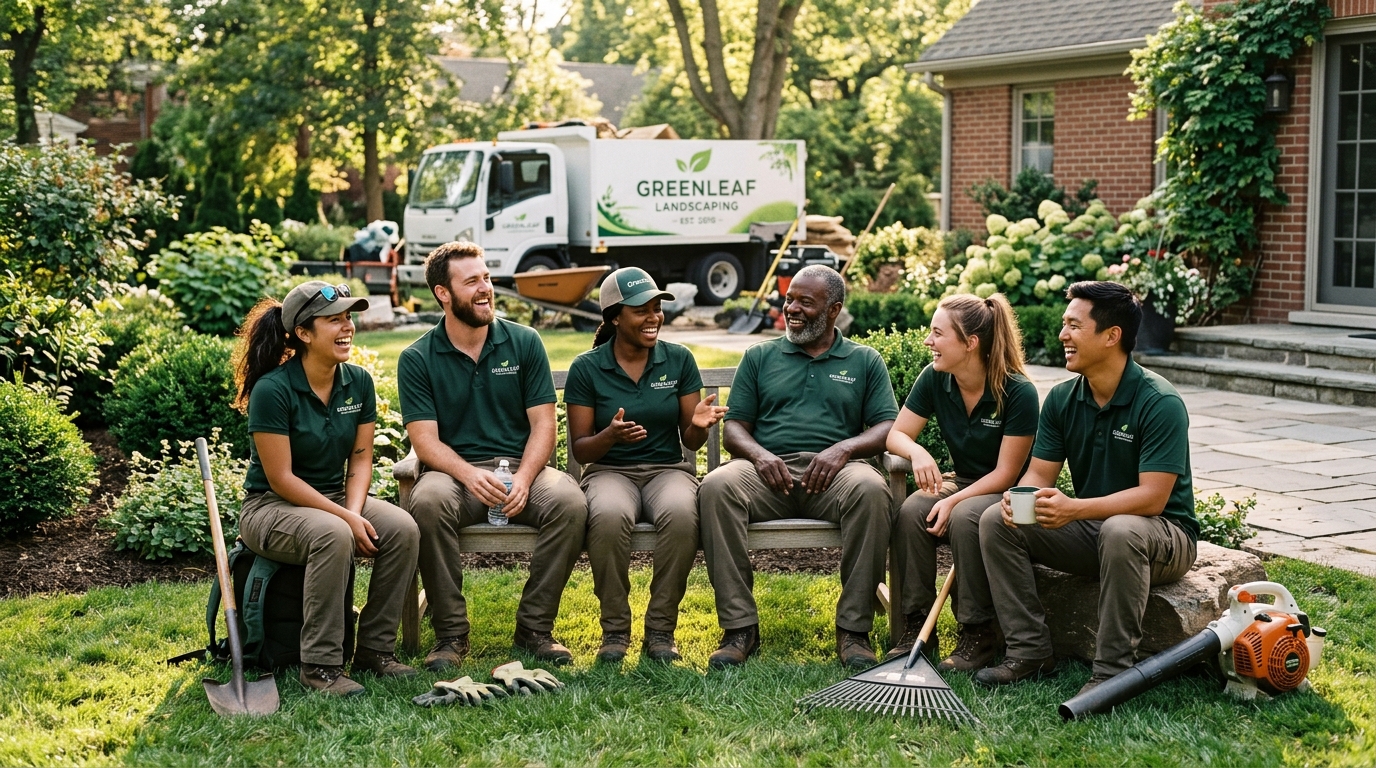
Why Does Team Structure Matter So Much for Landscaping Companies?
Team structure drives everything from crew productivity to client retention. Gallup reports that only 20% of workers worldwide are engaged, a gap costing the global economy $10 trillion in lost productivity. For a field operation, that translates directly into missed appointments, callbacks, and lost bids. Structure is what turns individual effort into a repeatable result.
Most people problems trace back to a shaky team setup rather than a lack of effort. When each staff member has a role that matches their skills and personality, service quality climbs and owners stop firefighting. Whether you run one crew or ten, thoughtful landscaping team building means knowing your people and placing them where they will shine. That same clarity powers stronger landscape marketing, because a consistent crew delivers the consistent experience your brand promises.
Focus on matching jobs to strengths and you will see the ripple effect: morale, reviews, and sustainable growth all improve together. Instead of playing whack-a-mole with issues, you end up with a business that runs on trust.
What Does “Right People, Right Seats” Really Mean in the Landscaping Industry?
The phrase means pairing employees who live your values with roles that fit their real capacity. It matters because the BLS Occupational Employment and Wage Statistics peg landscaping worker mean pay at $40,880 a year, while first-line supervisors average $59,380, so a bad seat mismatch wastes both wage dollars and morale. Fit is not a soft metric; it is a P&L driver.
Breaking Down the Concept
“Right People” are those who embody your company’s values. They leave a job site spotless, they call a client back without being asked, and they set the tone for everyone else. “Right Seats” is about the job fit. Is your irrigation specialist truly cut out for leading teams, or does their best work happen with tools in hand? Good landscaping hiring is about matching drive, skill, and personality to the unique demands of each role, not just scanning a résumé.
What Is GWC (Get It, Want It, Capacity)?
- Get it: Does this person truly understand what the role requires day in and day out? For field techs, it is more than running equipment; it is reading client expectations and the quirks of each property.
- Want it: Do they actually want to do the job? Genuine motivation is hard to fake, and Work Institute’s Retention Report has cited career fit as the top reason employees quit for 12 straight years.
- Capacity to do it: Do they have the skills, mindset, and stamina to deliver and handle stress? A mismatch here means burnout is not far behind.
If someone falls short on any of the three, you feel it in performance, satisfaction, or turnover. Asking these questions during interviews and quarterly reviews keeps your landscaping company staff honest about fit, which matters because landscapers and groundskeepers make up nearly 40% of all H-2B visa positions, so every domestic hire you make well is one less seat to scramble to fill next season.
How Expensive Is It to Get Landscaping Hiring Wrong?
The price tag is steeper than most owners assume. SHRM data shows that replacing an employee costs 50% to 200% of their annual salary once you add recruiting, overtime coverage, training, and lost productivity. On a $45,000 crew member, that is $22,500 to $90,000 out the door per mis-hire, often on a single decision made in 20 minutes.
Industry-specific numbers are even more sobering. The NALP Industry Statistics and third-party reporting peg landscaping turnover at roughly 45% annually, and Harvard Business Review research shows up to 20% of staff turnover occurs in the first 45 days of employment. In other words, half of what you lose every year leaves before you have even recouped their training cost. That is why the hiring for landscaping companies conversation has to start with structure, not speed.
Why Is Alignment Critical When the Season Peaks?
Alignment is the difference between a profitable peak season and a chaotic one. NALP reports that nearly 60% of landscaping companies have one to five open positions they are actively trying to fill, which means every misaligned role on your team is already bleeding capacity. When the phone rings off the hook, clarity is the only thing that scales.
The Signs of Misalignment
Roles become a guessing game. Jobs get forgotten because nobody claims ownership, or two people double the same work. Crews grumble that others are not pulling weight, and clients notice the inconsistency. The fallout is real: negative reviews, lost renewals, and attrition of the high performers who quietly carry the load.
Yet when team alignment becomes routine, efficiency improves, collaboration speeds up, and employees trust one another to deliver. That stability is what marketing dollars and a sharp website are designed to amplify. Strong operations plus strong brand equals compounding growth.
How Do You Apply GWC to Your Key Landscaping Roles?
Start role by role with the same three filters. Because BLS projects 171,600 annual openings across grounds maintenance through 2034, you will rehire these positions many times. The goal is to codify what “great” looks like in each seat so every hiring decision gets easier, faster, and more accurate.
- Landscaping Technician: Do they get the technical work and safety protocols? Do they want to be outside taking pride in their work? Can they handle the pace and the equipment day after day?
- Crew Lead: Beyond skills, do they want to lead, coach, and translate between the team and the client? Can they juggle logistics and people without dropping either?
- Office Administrator: Can they manage bookings, billing, and customer queries with a sense of ownership? Do they genuinely enjoy multitasking and order?
If a role feels like a bad fit, and you have spoken with the employee to confirm, they may need a different seat. Honest GWC conversations give people a voice in shaping their own path and often uncover hidden leadership talent. Our team at Sideways8 has seen this play out again and again with landscaping clients who stopped guessing and started documenting.
Which Tools Actually Build and Maintain Team Alignment?
Two simple frameworks carry most of the load: the People Analyzer and the Accountability Chart. Deloitte’s 2025 Global Human Capital Trends report notes that organizations that expand worker capacity to think and grow are 1.8 times more likely to report better financial results. These tools are how you get there without reinventing HR.
Using the People Analyzer for Cultural Fit
List your company’s core values, such as “Always Reliable” or “Respect the Crew,” and rate each employee against them. Use plus (+) if they live it, plus-minus (+/-) for occasional alignment, and minus (-) if they rarely meet the mark. You will find both bright spots and surprises. Sometimes a quiet crew member consistently upholds your standards while a longtime staffer has drifted out of step. This is not about finger-pointing; it is about clarity and supportive conversations during reviews and rehires.
Creating an Accountability Chart for Role Clarity
Forget org charts that only show reporting lines. An Accountability Chart lays out the core functions of the business, such as Sales, Operations, and Admin, and names who truly owns each responsibility. Limit each seat to 5 to 7 duties and assign exactly one person per seat. With that in place, gaps and overlaps become visible fast. For deeper operational systems, our landscaping business systems guide walks through the documentation layer that makes this chart enforceable rather than aspirational.

How Do You Address Misalignment Without Blowing Up the Team?
Start by separating the two kinds of misalignment and handling each with a different playbook. HBR research shows that formal onboarding programs drive 50% greater retention and 62% greater productivity, which means most “bad hires” are really underdeveloped hires. Before you part ways, check the process.
Right Person, Wrong Seat
Sometimes a person embodies your values but is miscast. Maybe your star mower operator dreads supervising or your sprayer tech would rather educate clients than work solo. Open a conversation: “What work brings out your best?” and “Where do you struggle most?” Creative moves often unlock job satisfaction and protect landscaping staff retention. For leaders navigating those conversations, our practical everyday leadership guide gives a simple script.
Wrong Person, Right Seat
Tougher is when someone is technically capable but clashes with your values. Maybe they finish the work but leave a mess, or they treat teammates poorly. After clear feedback and a real chance to improve, parting ways may be the only answer. Protecting culture protects the whole crew. It is never easy, but it is sometimes necessary for true team alignment.
What Does Great Training and Development Actually Look Like?
Training is the retention lever most landscapers underuse. The LinkedIn 2025 Workplace Learning Report found that companies with a strong learning culture see 57% higher retention and 23% higher internal mobility, and 88% of organizations say retention is a top concern. Investing in growth is cheaper than replacing people.
Mentorship amplifies the effect. Research compiled by mentoring platforms and referenced across industry analyses shows mentees stay at 72% retention versus 49% for non-participants, and 86% of professionals say access to a mentor factors into their decision to stay. For landscape businesses, pair every new hire with a seasoned crew lead in week one, give the mentor a checklist, and review it at 30, 60, and 90 days. Our cultivating talent guide breaks the full program down step by step.
How Does Diverse Leadership Strengthen Landscape Companies?
Diversity is both a workforce reality and a performance driver. NALP workforce data shows women still account for just 9% of landscape workers, which is a talent pool the industry cannot afford to leave on the table. Broadening who you hire and promote expands capacity in the exact market where 92% of employers report difficulty finding good workers.
The financial case is equally strong. McKinsey’s Diversity Matters Even More report found that companies in the top quartile for gender and ethnic diversity on executive teams are 39% more likely to financially outperform peers. For landscape owners thinking about succession or new service lines, that lift shows up in sharper decisions, calmer client interactions, and stickier retention. For more on leading an inclusive crew, see our female-led leadership playbook.
What Does a Real Landscaping Company Success Story Look Like?
Picture a regional landscape business plagued by missed jobs, confused roles, and a revolving door of staff. Given that NALP reports labor costs are expected to rise roughly 20% by 2029, the owner realized every turnover was compounding. He stepped back and defined three core values: “Show Up On Time,” “Do It Right the First Time,” and “Leave It Cleaner Than You Found It.”
Using the People Analyzer, he found some seasoned staff who were skilled but not modeling these values consistently. Meanwhile, a quiet newer employee stood out for complete alignment. The Accountability Chart revealed that nobody truly owned client communications, which was fraying relationships. He promoted the value-aligned crew member and assigned client care to the office manager. Within months, complaints fell, renewals climbed, and the new crew lead’s team became the most requested. The success tracks with Gallup’s finding that engaged organizations see 23% higher profitability. For more on this mindset, see our growth mindset guide.
What Five Steps Should You Take Starting This Week?
Turn the framework into a 30-day sprint. Given that HBR finds up to 20% of turnover happens in the first 45 days, small upgrades to hiring and onboarding pay back fast. Here is the concrete roadmap.
1. Define and Share Your Core Values
Pinpoint the 3 to 5 values that are non-negotiable for your company. Share them openly, weave them into every meeting, and let them guide decisions big and small. Post them where the crew can see them every day.
2. Score Every Employee with the People Analyzer
Write down your staff list and those values, then score each person. This creates an objective snapshot you can use in reviews or hiring for landscaping companies decisions without second-guessing yourself later.
3. Build or Update Your Accountability Chart
Draw a chart that lists each seat, such as Sales, Scheduling, and Maintenance. Assign ownership so there is zero doubt about responsibility. Pair this with a reliable pipeline by investing in pay-per-click marketing and SEO so a disciplined team never runs out of jobs to deliver on.
4. Hold Open Alignment Conversations
Schedule one-on-ones using the GWC framework. Ask about job satisfaction, challenges, and untapped skills. These conversations strengthen unity and surface the insights the People Analyzer cannot.
5. Make the Necessary Changes
Do not shy away from shifting roles, adding training, or, when no other option fits, parting ways. These steps honor everyone’s unique strengths and protect the crew you are building. Owners who specialize in design-build work or lawn care operations both report that role clarity is what separates the 45% turnover average from the companies running below 20%.
Frequently Asked Questions About Landscaping Team Building
What is the average turnover rate in the landscaping industry?
Landscaping turnover runs roughly 45% annually, according to NALP industry data and third-party benchmarks. The figure reflects the seasonal nature of the work, physical demand, and pay pressure. Companies that invest in structured onboarding, mentorship, and clear accountability routinely cut their rate well below the industry average.
How much does it really cost to replace a landscaping employee?
SHRM research pegs total replacement cost at 50% to 200% of annual salary once you factor in recruiting, overtime to cover the gap, training, and lost productivity. For a $45,000 crew member, that is $22,500 to $90,000 per mis-hire. Small hiring process improvements produce outsized ROI because every mistake you avoid is a five-figure save.
How do I know if an employee is the right fit for their role?
Use the GWC filter: do they get the role, want the role, and have the capacity to do it well? Pair GWC with a People Analyzer score against your core values and a quarterly one-on-one. Three consistent data points are enough to make confident decisions about keeping, shifting, or parting ways.
What is the best way to retain landscaping workers long term?
Invest in onboarding, mentorship, and career paths. HBR research shows formal onboarding programs drive 50% greater retention and 62% greater productivity, and mentored employees stay at 72% versus 49% for non-participants. Pay competitively against the BLS mean of $40,880 for landscapers, then layer training and promotion tracks on top.
Should small landscaping companies use H-2B visa workers?
Landscaping is the largest user of the H-2B program, accounting for nearly 40% of all positions, and demand far exceeds the 66,000 base cap. H-2B can fill seasonal gaps, but domestic hiring and retention are cheaper and more controllable. Treat H-2B as a supplement to, not a substitute for, a strong year-round team.
Ready to Build a Landscaping Team That Lasts?
Building your landscaping dream team is an ongoing practice, not a one-time project. The owners who make it stick pair clear values with documented seats, real onboarding, and a pipeline of qualified leads that gives the crew meaningful work to deliver. With industry turnover near 45% and labor costs projected to climb roughly 20% by 2029, the payoff on getting this right compounds quickly.
If you want a marketing partner who understands how operations, brand, and demand generation reinforce each other, our team specializes in helping landscape companies grow on every front. Visit who we serve to see how we support landscape businesses, or contact Sideways8 today to map out the next 90 days of team and marketing growth together.
