

- The U.S. landscaping industry reached $188.8 billion in 2025, but about 70% of landscaping businesses fail within the first 5 years (IBISWorld, 2025; Lawn & Landscape Magazine)
- 80% of landscaping companies struggle to fill open positions, making labor the #1 constraint on growth (NALP/Aspire, 2025)
- Adding a crew costs $40,000 to $60,000 for truck, trailer, and equipment, plus 3 to 6 months of payroll reserve (BusinessCostHQ, 2025)
- High-performing companies generate 35 to 50% more revenue from upselling enhancements on existing accounts (Arbor Note, 2025)
- The average landscaping customer lifetime value is $4,800 to $5,625, making retention far cheaper than acquisition (Lawn Care Marketing Expert, 2025)
The U.S. landscaping industry generated $188.8 billion in 2025 across nearly 693,000 businesses, according to IBISWorld. The industry grew 5.8% that year and is projected to reach $213.3 billion by 2030. Yet the average landscaping company has just 2.1 employees and most generate under $500,000 in annual revenue. The gap between industry growth and individual company growth reveals a pattern: owners who are busy doing the work but not building the business.
This guide covers the financial benchmarks, growth paths, and hiring strategies that separate landscaping companies that scale from those that stay stuck.
What Is the Difference Between Being Busy and Actually Growing?
About 70% of landscaping businesses fail before reaching their fifth year, according to Lawn & Landscape Magazine. The primary reason is not lack of demand. It is the failure to build systems that allow the business to operate beyond the owner’s personal capacity.
A packed schedule feels like growth, but if you are personally involved in every estimate, every job check, and every client call, your business has hit a ceiling. That ceiling is your time. True growth means revenue increases while your personal workload stays flat or decreases. That only happens when you build systems that let other people handle day-to-day execution.
Warning signs that you are busy but not growing:
- Revenue goes up but profit stays flat. Net profit margins for landscaping companies range from 5% to 15%, with the most successful hitting 14% (Aspire Software, 2025). If your margins are not improving as revenue climbs, you are adding work without managing costs
- You cannot take a week off. Everything stops or falls apart when you are not there
- You are turning down jobs not because of pricing but because you cannot fit them in
- Revenue stays the same year after year. Seasonal fluctuations even out and nothing really changes
What Financial Benchmarks Should You Hit Before Expanding?
Expanding without understanding your financials is the fastest path to cash problems. According to Aspire Software’s 2025 benchmarks, total labor costs should stay between 25% and 40% of revenue. Exceeding 50% signals that scaling will create losses, not profits. Target a net profit margin of 10% to 20% before adding capacity.
Key metrics to get straight before you expand:
- Gross margin by service type. Design/build projects carry 25% to 40% margins while lawn care maintenance runs 10% to 15% (Grow Group Inc., 2025). Know which services actually make money after labor, materials, and equipment
- Customer lifetime value. The average landscaping customer is worth $4,800 to $5,625 over the relationship, with annual revenue per customer averaging about $1,875 (Lawn Care Marketing Expert, 2025). A $500 cleanup client who becomes a maintenance client is worth many times the initial sale
- Customer acquisition cost. Typical CAC for landscaping runs $100 to $300 per new customer. Maintain at least a 3:1 ratio of lifetime value to acquisition cost for sustainable growth (Coalmarch, 2025)
- Crew utilization rate. What percentage of available hours are your crews actually billing? Anything under 75% means you have capacity to grow without hiring
- Revenue per employee. The national average is $106,722 per employee for design and installation work (Aspire, 2025). If your number is significantly below that, fix efficiency before adding headcount
Your marketing benchmarks and profitability metrics tell you exactly where to invest and where to cut. Without them, expansion is a gamble.
What Are the Three Main Paths to Expand a Landscaping Company?
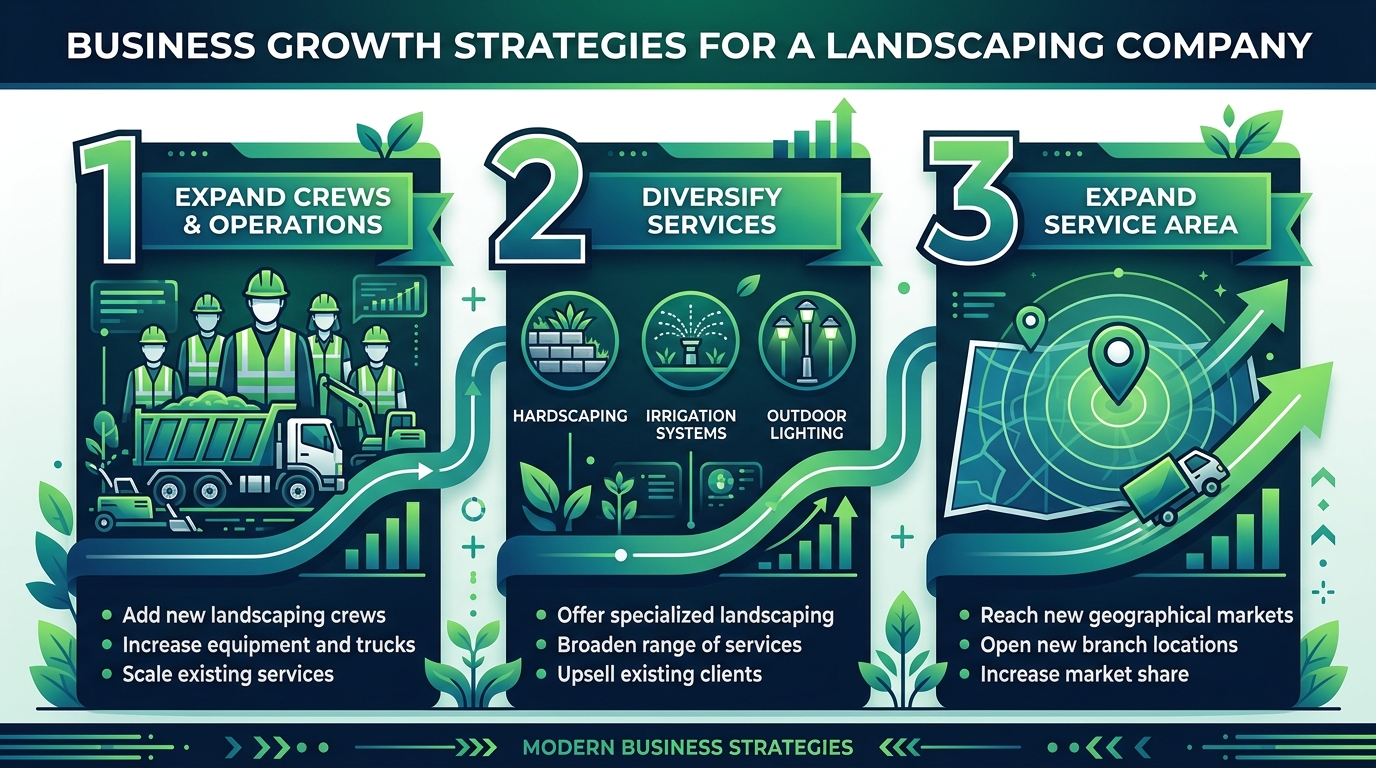
Path 1: Add Crews in Your Current Market
The most common expansion path. You hire additional crew members, promote a crew leader, and take on more jobs in the same service area. According to Aspire’s benchmarks, a highly efficient residential maintenance crew produces $200,000 to $300,000 per year in revenue.
Adding a crew costs $40,000 to $60,000 for a truck, trailer, and equipment (BusinessCostHQ, 2025). That breaks down to $15,000 to $25,000 for a used truck, $5,000 to $12,000 for a commercial mower, and roughly $2,000 per year for a workers’ comp and general liability insurance bundle (Insureon, 2025). Add three to six months of payroll reserve and the total investment typically lands between $50,000 and $75,000.
Requirements: documented job procedures, a trusted crew leader, reliable equipment, and enough leads to keep the new crew busy from day one. Most companies reach this stage at $400,000 to $750,000 in annual revenue.
Path 2: Add New Services
If you currently do maintenance only, adding design-build, hardscaping, irrigation, or lighting lets you increase average job value. High-performing companies generate 35% to 50% more revenue from enhancement services on existing accounts, and those enhancements deliver 2 to 4 times the profit of routine maintenance (Arbor Note, 2025; LeanScaper, 2025).
It is also 68% more expensive to acquire $1 from a new customer than to upsell an existing one (Arbor Gold, 2025). Expanding your service menu to existing clients is the lowest-risk, highest-margin growth strategy available.
Requirements: training or specialized hires, updated marketing materials, and service pages on your website targeting the new keywords.
Path 3: Expand Your Service Area
Moving into adjacent cities or neighborhoods increases your addressable market. The residential landscaping segment holds 52.68% of the market and is growing at a CAGR of 7.0% through 2030 (Grand View Research, 2025). The commercial segment is growing even faster at 7.76% CAGR (Mordor Intelligence, 2025).
Requirements: location-specific pages on your website, updated Google Business Profile service areas, and potentially a second staging location for equipment.
Why Should You Build Your Marketing Engine Before You Expand?
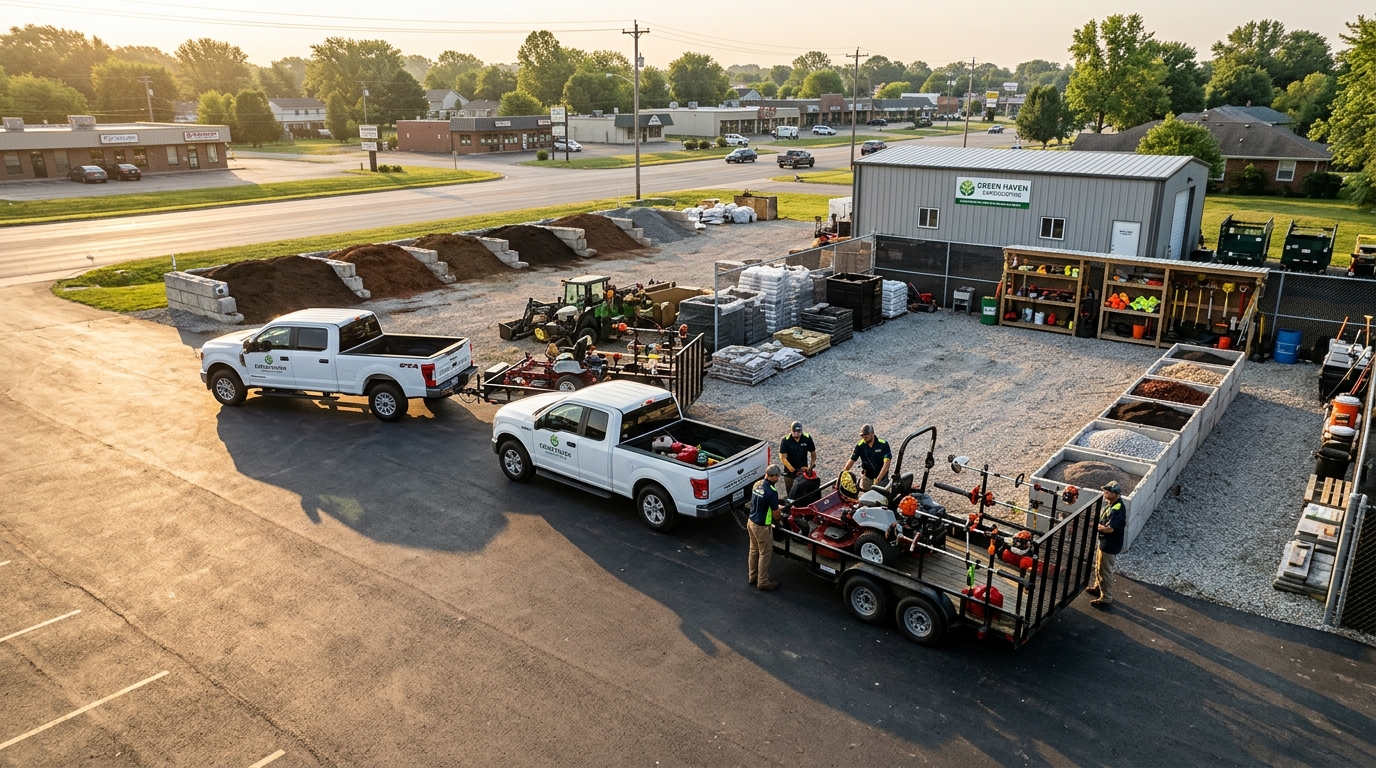
The biggest mistake landscaping companies make when expanding is adding capacity before having the lead flow to support it. Most landscaping companies invest 5% to 10% of annual revenue in marketing, according to Landscape Leadership (2025). Growth-stage companies should allocate 8% to 12%, while startups may need 12% to 20% (Improve & Grow, 2025).
Build the pipeline before you add the capacity:
- Invest in SEO three to six months before you plan to expand. Organic rankings take time, so start early. SEO generates leads at roughly $31 per lead versus $181 for PPC (AllOutSEO, 2025)
- Launch paid ads to test demand. Run Google Ads in your target expansion area to verify lead volume before committing resources
- Build your review base. New markets trust companies with strong reputations, so accumulate reviews before expanding
- Create content for new services or areas. Have service pages ranking before you need them to generate leads
Use tracking and analytics to measure which channels produce leads at the lowest cost. A solid marketing plan ensures that when you add capacity, the demand is already there to fill it.
How Do You Solve the Labor Problem When Scaling?
Labor is the #1 constraint on landscaping expansion. According to NALP’s 2026 Economic Forecast Report, 54% of contractors identify recruiting and retaining staff as a top business risk. The problem is getting worse: 70% of contractors plan to raise wages in 2026, with 44% planning increases of 4% or more. Labor costs industry-wide are projected to rise roughly 20% by the end of 2029 (Aspire, 2025).
Meanwhile, 25% of landscaping companies have employee retention rates of 69% or less (Aspire, 2025). Turnover is expensive. Every crew member you lose costs thousands in recruiting, training, and lost productivity.
Companies that expand successfully treat hiring as an ongoing process, not a seasonal scramble:
- Recruit year-round. Do not wait until spring to start looking. The best candidates are hired months before peak season
- Pay competitively. The cost of underpaying (turnover, retraining, lost quality) far exceeds the cost of paying above market rate
- Create advancement paths. Crew members who see a future with your company stay longer. Promote from within when possible
- Document everything. Standard operating procedures let new team members get productive faster and reduce training time
How Do You Handle Seasonal Revenue Swings During Expansion?
Seasonality is one of the biggest cash flow risks during expansion. Peak months (April through July) generate 2 to 3 times winter revenue for most landscaping companies (Gitnux, 2026). Winter months see a 20% to 30% revenue drop unless offset by snow removal, holiday lighting, or other seasonal services (Relay Financial, 2025).
When you add a crew in March, you need enough cash to cover their costs through the following winter. Plan for at least six months of the new crew’s fully loaded costs in reserve before hiring. Companies that expand without accounting for seasonal cash flow dips are the ones that end up cutting the crew they just hired by November.
Consider adding winter services to smooth revenue: snow plowing, holiday lighting installation, and hardscape projects that can run through cooler months. Each additional revenue stream reduces your dependence on the spring-through-fall window.
What Is the First Step You Should Take This Week?
The landscaping industry is projected to grow to $213.3 billion by 2030 (IBISWorld). That growth creates real opportunity, but only for companies that prepare before they expand. Pick one action based on where you are today:
- If you do not know your margins, calculate gross margin by service type this week. You cannot grow what you cannot measure
- If your margins are healthy but you are turning down work, start pricing out a second crew setup and building a hiring pipeline
- If your clients keep asking for services you do not offer, identify the one service with the highest demand and lowest startup cost, then build a plan to add it
- If you want to expand geographically, start with SEO and content in the new area now so leads are flowing when you are ready to serve them
Every improvement you make now compounds over time. The companies that capture industry growth are the ones building systems, tracking numbers, and investing in their pipeline today.
When is a landscaping company ready to expand?
You are ready when you consistently turn away work, your gross margins are healthy (25% or higher for installation, 10% or higher for maintenance), you have at least one person who can run jobs without your direct oversight, and your marketing generates more leads than you can handle. Most companies reach this stage at $400,000 to $750,000 in annual revenue. Target a net profit margin of 10% to 20% before adding capacity.
How much does it cost to add a crew to a landscaping company?
Adding a crew typically costs $40,000 to $60,000 for a truck, trailer, and equipment according to BusinessCostHQ (2025). Add workers’ comp insurance averaging $2,029 per year (Insureon, 2025) and three to six months of payroll reserve. The total investment usually lands between $50,000 and $75,000. The safest approach is to have six months of the new crew’s fully loaded costs in reserve before hiring.
What is the biggest risk when expanding a landscaping business?
Expanding without sufficient lead flow to fill the new capacity. This creates cash burn where you are paying crew salaries and equipment costs without enough revenue to cover them. About 70% of landscaping businesses fail within 5 years according to Lawn and Landscape Magazine, often because they scaled before their pipeline could support the added costs. Build the marketing engine before adding capacity.
Should I expand services or service areas first?
If your current clients frequently request services you do not offer, expand services first. Upselling existing clients costs 68% less than acquiring new ones (Arbor Gold, 2025), and enhancement services deliver 2 to 4 times the profit of routine maintenance. If you are maxed out in your current area but only offer a few services, geographic expansion may make more sense. Let your customer data and margins guide the decision.
How much should a growing landscaping company spend on marketing?
Most established landscaping companies invest 5% to 10% of annual revenue in marketing according to Landscape Leadership (2025). Growth-stage companies should allocate 8% to 12%, while startups may need 12% to 20%. The general service business benchmark from the 2025 CMO Survey is 9.4% of revenue. Focus spending on channels that produce the lowest cost per lead and highest close rate, typically SEO and Google Business Profile optimization for local service businesses.
