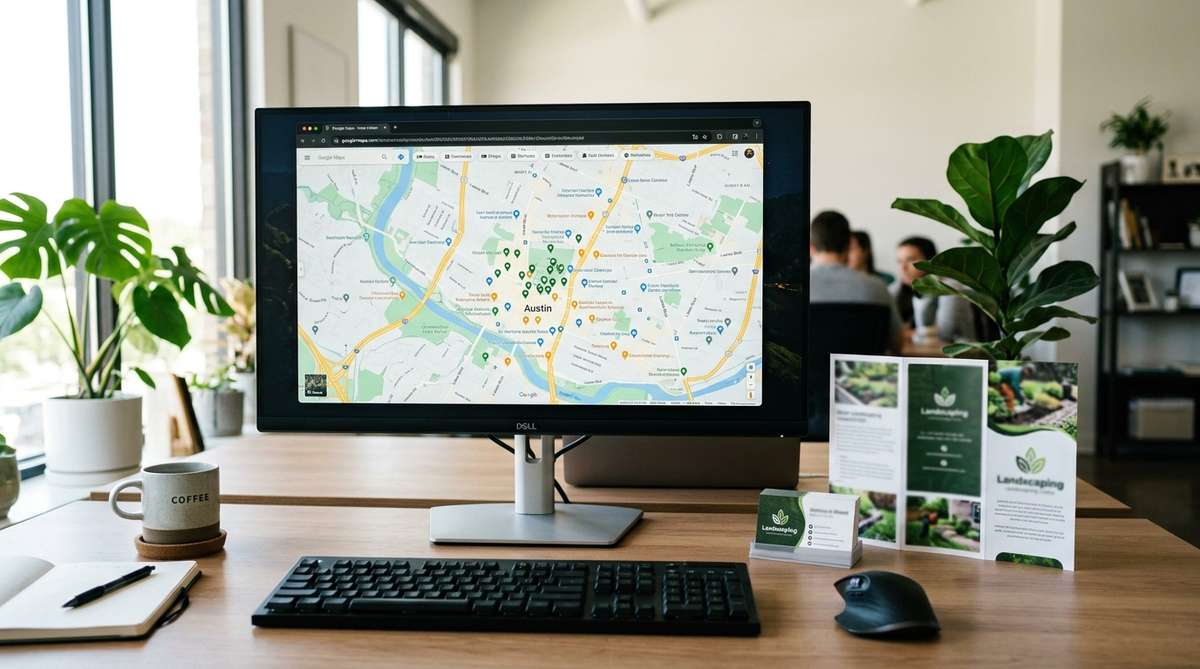
- Google processes 5 trillion searches per year (~13.7 billion daily), and 46% have local intent (Search Engine Land/On The Map, 2025)
- Google Local Services Ads average $39 per lead for landscapers compared to $104 per lead on standard Google Ads (99 Calls, 2024)
- Complete Google Business Profiles get 7x more clicks than incomplete ones, and 86% of GBP views come from discovery searches like “landscaper near me” (Birdeye, 2025)
- Position #1 organic CTR has dropped from 28% to 19% in 2025, and AI Overviews can reduce CTR an additional 49-65% on affected queries (Growth SRC/Seer Interactive, 2025)
- 1.5 billion “near me” searches happen monthly, and 76% result in a business visit within 24 hours (Backlinko/Krofile, 2025)
Google handles 5 trillion searches per year, equivalent to roughly 13.7 billion searches per day according to Search Engine Land (2025). With 89.62% global search engine market share (StatCounter, 2025), Google is where the majority of new landscaping clients start their search. If your company is not visible across Google’s ecosystem, you are losing jobs to competitors who are.
This guide covers the three Google channels that matter most for landscaping companies, current performance benchmarks, and how to prioritize them based on your budget and growth stage.
Where Does Your Landscaping Business Need to Appear on Google?
When a homeowner searches for landscaping services, Google displays results in three distinct sections, each requiring a different strategy:
- Google Local Pack (Map Results) — the top three local business listings with map pins, driven by your Google Business Profile. Position #1 in the Local Pack captures 23.6% of clicks (Outerbox, 2025)
- Organic Search Results — the traditional blue-link results below the map, driven by your website’s SEO
- Paid Ads — sponsored results at the top and bottom of the page, driven by Google Ads campaigns including Local Services Ads (LSAs)
The strongest landscaping companies appear in all three. According to The Media Captain (2025), when given a choice, 41.27% of searchers click Maps results first, 27.78% click LSAs, and the rest split between organic and standard ads. Multi-channel visibility builds trust, the kind that turns searchers into callers.
Why Is Google Business Profile the Single Most Important Free Tool?
Google Business Profile (GBP) is free, and it is the highest-impact Google marketing channel for landscaping companies. According to Birdeye’s State of Google Business Profile 2025, 86% of all GBP views come from category-based discovery searches like “landscaper near me” rather than direct brand searches.
The performance gap between optimized and unoptimized profiles is enormous. Verified GBPs with complete data are 80% more likely to appear in search results, and complete listings get 7x more clicks than incomplete ones (Search Endurance, 2025). Each additional review drives approximately 80 more website visits, 63 direction requests, and 16 calls (Content by Cass, 2025).
To make your GBP work as a lead generator:
- Complete every section. Business name, address, phone, website, hours, service area, and a detailed description with target keywords. Primary category is the #1 local ranking factor (Local Falcon, 2025)
- Add all your services individually. Google lets you list each service with a description, helping you match more search queries
- Upload 20+ high-quality photos. Before-and-after shots, team photos, equipment. Businesses with photos receive 42% more direction requests and 35% more website clicks
- Post weekly updates. Google Business posts about completed projects, seasonal tips, or promotions signal active business management
- Respond to every review within 48 hours. Top-ranking businesses average 47 reviews, with positions 1-3 in the Local Pack typically having significantly more recent reviews than competitors (Blogging Wizard, 2026)
How Do Google Ads Compare to Local Services Ads for Landscapers?
Google Ads puts your business in front of homeowners the moment they search. The cost economics matter: According to 99 Calls (2024), landscapers average $104 per lead on standard Google Search Ads, with seasonal swings from $40-$50 in late April/early May to $80-$90 in summer.
Three Google Ads formats matter for landscapers:
Google Search Ads
Text ads at the top of search results, billed per click. LocaliQ’s 2025 Home Services Benchmarks show landscaping CTR is 4.69% (one of the lower rates in home services), while overall home services average 6.37%. Target high-intent keywords like “landscaping company [city]” or “patio installation near me” for the best conversion rates.
Google Local Services Ads (LSAs)
LSAs appear above standard search ads with a “Google Guaranteed” badge. You pay per lead, not per click. According to 99 Calls (2024), LSAs average $39 per lead for landscapers (significantly lower than standard PPC). Blue Grid Media (2026) reports LSAs average $25-80 per lead with a 31% booking rate and approximately 4x ROAS.
The catch: LSA costs are climbing. Brick & Mortar Digital (2025) tracked a 12% year-over-year rise in LSA cost-per-acquisition with conversion rates dropping over 9% between 2024-2025. Still the most efficient paid channel for most landscapers, but margin compression is real.
Display and Retargeting Ads
Display ads show banner ads on websites your potential clients visit. Retargeting specifically targets people who already visited your website but did not call. This keeps your business visible after the initial search, addressing the reality that most homeowners need multiple touchpoints before hiring.
How Does Organic SEO Compare for Long-Term Growth?
While ads deliver immediate results, organic SEO builds a sustainable lead pipeline that compounds. Landscaping SEO costs $10-30 per lead after 6 months versus $50-200 per lead on Google Ads (SEO for Home Service, 2025). The crossover where cumulative organic leads surpass paid typically happens between months 8-12.
The challenge in 2025-2026: Position #1 organic CTR has dropped from 28% to 19% (a 32% decline) according to Growth SRC’s 2025 study of 200K keywords. Position #2 fell from 20.83% to 12.60%. AI Overviews now appear on roughly 16% of all queries (SemRush, 2025) and reduce CTR an additional 49-65% on affected queries (Seer Interactive, September 2025).
For landscaping companies, the highest-priority SEO actions remain:
- Service pages. Dedicated pages for each service optimized for local search terms
- Location pages. Unique content for each city or area you serve
- Blog content. Articles targeting informational searches that bring future clients to your site early in their research journey
- Technical SEO. Fast load times, mobile-friendly design, secure HTTPS, and clean site architecture
SEO takes 3-6 months to show measurable results, but leads it generates are essentially free once you are ranking.
How Important Are Google Maps and “Near Me” Searches?
Google Maps passed 2 billion active users in early 2026 (SQ Magazine). Over 75% of US smartphone users rely on Google Maps weekly for navigation and local search. 200 million+ businesses are listed on Maps with about 1.5 million new listings added per month.
The “near me” search trend is even more striking. According to Krofile (2025), there are 1.5 billion “near me” searches per month (~50 million per day). “Near me” searches grew 900% over the past two years, and “open now near me” queries jumped 400% (Cube Creative, 2025). 76% of “near me” searches result in a business visit within 24 hours (Backlinko, 2025).
For landscaping companies, this means optimizing your Google Business Profile for local pack visibility is non-negotiable. With 80% of local Maps searches resulting in a physical business visit (On The Map Marketing, 2026), the businesses that show up in the top 3 Map results capture the bulk of intent-rich local traffic.
Why Does Mobile Optimization Matter for Google Marketing?
Mobile dominates Google search. According to SQ Magazine (2025), 72% of Google’s global search traffic now comes from mobile devices, up 5% from 2023. Mobile represents 64.35% of total global web traffic. In the US specifically, 63% of Google organic traffic is mobile (SemRush, 2025).
Despite mobile traffic dominance, desktop still drives 56% of high-value conversions. The implication: a landscaping website needs to load fast on mobile (where searches happen) but also support deeper research and decision-making on desktop (where contracts get signed). Both experiences must work flawlessly.
Voice search adds another layer. 153.5 million Americans use voice search in 2025 (Yaguara, 2026), with Google Assistant claiming about 92 million US users. 40.7% of voice search answers pull from featured snippets (Digital Silk, 2025), making structured, question-and-answer content increasingly valuable for landscaping companies trying to capture voice queries like “who is the best landscaper near me?”
How Should You Allocate Your Google Marketing Budget?
Not every landscaping company can invest in all channels at once. Here is how to prioritize based on stage:
- Starting out ($0-$500/month). Focus entirely on Google Business Profile optimization and review generation. These are free and have the fastest impact on local visibility
- Growing ($500-$2,000/month). Add Google Local Services Ads for immediate lead flow ($39 average CPL for landscapers) while beginning basic SEO work on your website
- Scaling ($2,000-$5,000+/month). Run Google Search Ads alongside LSAs, invest in ongoing SEO and content, and add retargeting to capture prospects who do not convert on the first visit
According to Digitalized Elevation (2025), the optimal long-term mix is 60% SEO and 40% Google Ads. For immediate-results focus, flip to 40% SEO and 60% Ads. Shoestring budgets often work best at 80% SEO and 20% PPC. At every budget level, tracking and analytics are essential to know your true cost per lead and shift budget toward winners.
How Do Reviews Affect Your Google Marketing Performance?
Reviews influence both rankings and conversions. According to Midland Marketing (2025), reviews contribute approximately 10% of local ranking factor weight and drive 15-20% conversion lift. Shapo (2025) reports 4.5-star rated businesses earn up to 25% more clicks than 3.5-star ones.
Recency now matters more than total count. Sterling Sky’s 2025 case studies found that 73% of customers only care about reviews from the past month. 71% of consumers will not consider a business below 3 stars (Wiser Review, 2026). Reaching 10 reviews produces noticeable Map Pack ranking lift for your main keyword (Sterling Sky, 2025).
Build a systematic review request process. Turning client voices into growth is one of the highest-leverage marketing habits available to landscaping companies.
What Should You Do This Week to Improve Your Google Marketing?
Pick one action this week based on your current Google marketing maturity:
- If your Google Business Profile is incomplete, finish it today. Complete listings get 7x more clicks. This is free and high-impact
- If you have fewer than 10 reviews, ask your three most recent satisfied clients this week. 10 reviews produces noticeable Map Pack ranking lift
- If you are not running paid ads but want immediate leads, apply for Google Local Services Ads. They average $39 per lead for landscapers and you only pay for actual leads
- If your website lacks dedicated service pages, create one for your highest-margin service with your city in the title
- If you want a full Google marketing strategy, request a consultation or learn more about our landscape marketing services
Google sends millions of homeowners searching for landscaping every day. The companies that capture them are the ones showing up across all three result sections (Map Pack, organic, and ads), with complete profiles, fresh reviews, and content that matches search intent. Every improvement you make compounds into more calls, more booked jobs, and more revenue.
How much should a landscaping company spend on Google Ads?
Most landscaping companies see good results starting at $1,000-$2,000 per month in ad spend, plus management fees if using an agency. Standard Google Search Ads average $104 per lead for landscapers (99 Calls, 2024) while Google Local Services Ads average just $39 per lead with a 31% booking rate (Blue Grid Media, 2026). The right budget depends on market competition, your average job value, and how many new clients you can handle each month.
Is Google Ads or SEO better for landscaping companies?
They serve different purposes. Google Ads delivers leads immediately but stops when you stop paying. SEO takes 3-6 months to build but generates leads at $10-30 each after 6 months versus $50-200 per lead on ads (SEO for Home Service, 2025). The optimal long-term mix is 60% SEO and 40% Google Ads (Digitalized Elevation, 2025). Use ads for immediate pipeline and SEO for sustainable compounding growth.
How do I know if my Google marketing is working?
Track three metrics: cost per lead (total marketing spend divided by leads generated), lead-to-client conversion rate, and return on ad spend (revenue from marketing-sourced clients divided by marketing cost). For landscapers, target $39 CPL on LSAs and under $100 on standard Google Ads. If your overall ROAS exceeds 3:1, your Google marketing is performing well. Use Google Analytics, call tracking, and a lead source spreadsheet to measure consistently.
Can I do Google marketing for my landscaping company myself?
Google Business Profile optimization, review management, and basic SEO are very doable for business owners. Google Ads management is more technical and benefits from professional help, since a poorly managed campaign can waste budget quickly. Many landscaping companies start with DIY GBP and SEO, then hire an agency for paid advertising once they want to scale beyond $1,000 per month in ad spend.
How do Google AI Overviews affect landscaping marketing?
AI Overviews now appear on roughly 16% of all queries (SemRush, 2025) and reduce CTR an additional 49-65% on affected queries (Seer Interactive, September 2025). For landscaping, the impact is smaller for transactional queries like “landscaper near me” (which still favor Map Pack and Local Services Ads) but larger for informational queries like “how often should I aerate my lawn.” The strategic response: invest in Google Business Profile and LSAs for transactional traffic, and structure SEO content to be answer-rich enough that AI summarizes citing your brand.
